
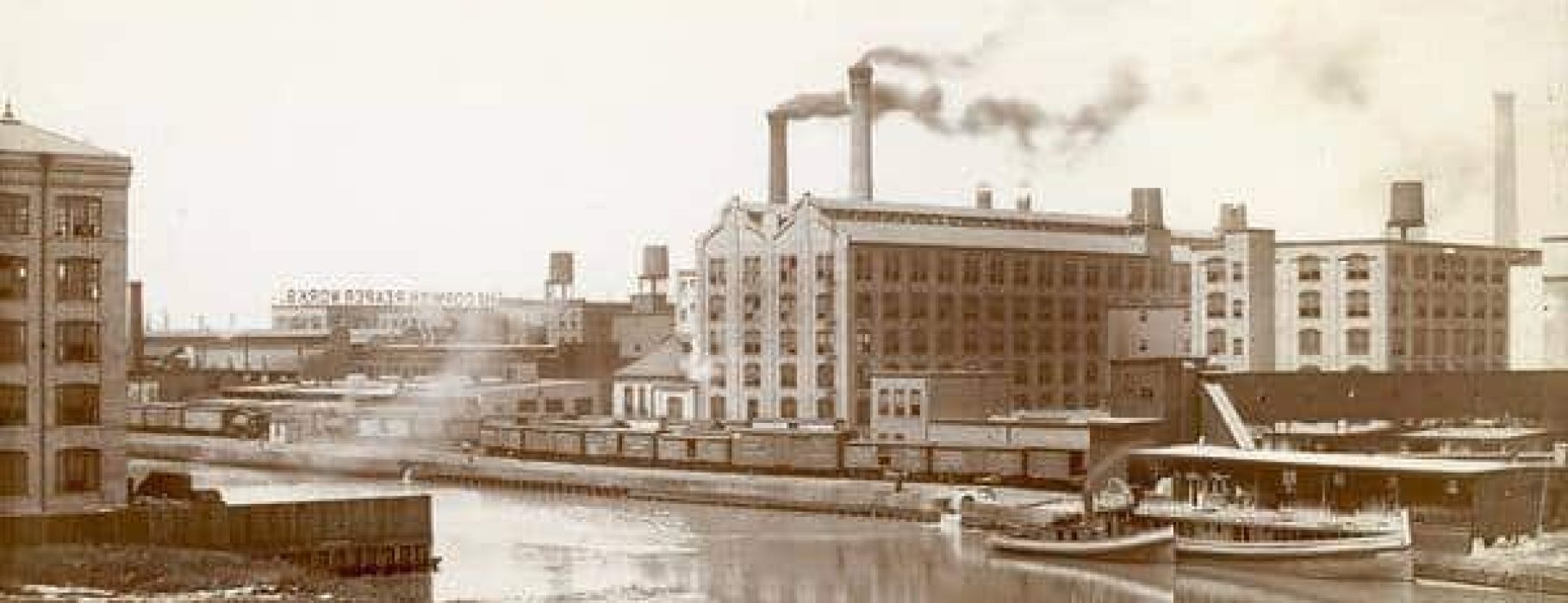
In the early twentieth century, eight thousand people were employed at International Harvester’s McCormick Works plant in Chicago. Today the land where it once stood is occupied mostly by logistics industries. There is a cargo container yard, a sugar refiner warehouse, and a company offering refrigerated warehousing that is called (in perhaps too glib a pun) Frozen Assets. Far fewer people are employed here.The sidewalks are deserted, and the buildings’ windowless exteriors hide the work that goes on inside. Unlike the stockyards, where the Union Stockyard Gate is a protected Chicago Landmark, this erstwhile site of industrial production has no marker to commemorate it.
Part of the reason the emptiness of the zone is so striking is that it abuts a vibrant neighborhood to the north. In Pilsen, real estate values and rents have been on the rise for more than four decades, and residents have waged an antigentrification struggle for almost as long. Since 1970, Pilsen has been a predominantly Mexican-American neighborhood; a century before that, it was a destination for Bohemian immigrants, who gave it its name. Homeowners here are bombarded with offers from developers to buy them out in cash. Tenants whose building changes hands often face displacement; the new owners rush them out so they can convert the building to higher-end rentals or condos.
It’s strange to find that a single street demarcates a pricey residential real estate market from a zone where stacks of giant intermodal cargo containers sit in a yard. Rows of newish townhouses stand in the path of diesel fumes from the trucks passing by and idling at the refrigeration warehouse. The smog hangs in the air for blocks. The use of these two zones, industrial and residential, seems inharmonious. Just what happened here?

As it turns out, this area was an important site of labor struggle. The month of May is an opportune time to recall those fights, since the McCormick Harvester Company (later renamed International Harvester) played a central role in the strife of the 1886 May Day strike that culminated in the Haymarket massacre. At that time the company was notoriously antiunion—a precedent it held to throughout the first half of the twentieth century, and later revived in the 1970s when management sought to fill out profit margins by slashing labor costs. However, despite many defeats, workers kept linking up and wielding their collective power. Eventually, with support from the Communist Party in the 1930s, they made Harvester’s plants into strongholds of an exceptionally radical union, the United Farm Equipment Workers of America (FE).
Today, for most people, “labor” and “capital” no longer evoke two unitary entities in open conflict. To better understand the working-class militancy of the past, with a view to reawakening it, I will first survey a time of upsurge for the workers’ movement through the lens of Harvester and its workers. This extends from approximately the Gilded Age through World War II. As Toni Gilpin chronicles in The Long Deep Grudge, Harvester’s employees met their boss’s ruthless antiunion tactics with great tenacity and creativity. Their workplace fights drew from and contributed to the radical political movements that were coursing through society in the world outside the plant.
After taking inspiration from the victories, I will examine the key period of defeat in the late 1970s and early ’80s. This was a time of stress for Harvester management and devastation for Harvester workers. After management provoked a costly standoff with the union, the Volcker recession hit, and the firm suffered its worst ever financial losses. As part of the firm’s efforts to remain solvent, it divested itself of about 70 percent of its workforce over the following few years.1Barbara Marsh, A Corporate Tragedy: The Agony of International Harvester Company (Doubleday & Company, 1985), 278. During that period, the weakened union made contract concessions to help appease Harvester’s lenders. But the firm’s farm equipment business never recovered and it sold off the business of its origins and registered under a new name in late 1984.
This mass divestiture was an aggressive maneuver in a battle with labor waged by the business class in concert with the investor class. By looking at Harvester’s case, we can see the interconnection between the deindustrialization and the financialization of the economy, and the contingency of both processes. A restive working class in the 1970s plus persistent trends of commodity price inflation and slow economic growth threatened both industrial capital’s profits and financial capital’s assets (for example, stocks and bonds), whose value was being canceled out by inflation. When industry and finance aligned in favor of curbing inflation and—most importantly—disciplining labor, the federal government achieved these ends by implementing policies such as the Volcker Shock. These new policies inaugurated an era of union attrition and broad-scale worker defeat.
In short, capital wielded deindustrialization as a weapon in a counteroffensive against a working class that was increasingly strident and demanding in the 1970s. Capital was able to move out of US industry rapidly because it could go into the FIRE sector—newly open to investment and more profitable than before because of early 1980s policy changes enacted by the federal government. Just as the struggles at Harvester provide a glimpse of the militant worker organizing at the turn of the century, the decisions of the managers and financiers responsible for dismantling Harvester provide an insight into the paths culminating in the capitalist class’s counteroffensive in the 1970s. Rather than resulting from an “inevitable” or “natural” process of economic development, the transformation of the McCormick Works site into the deserted blocks of warehouses, with their thinner and more scattered workforces, marks the shifting fortunes of over a century of class struggle waged in the heart of the United States.
I. Harvester’s Role in May Day and the Eight-Hour Movement
The McCormick Works plant shut down in 1959. To understand the foundations of the adversarial industrial unionism of the 1970s, we must go all the way back to the plant’s opening in the Gilded Age. Worker radicalism reached new heights in this period, and the labor movement innovated a new model to fight back against the mechanization and deskilling of work. The eight-hour day campaign embodied this new way of organizing that recruited both skilled craftsmen and unskilled laborers to the cause. This was crucial to the capability of the working class to force limits on workday length. The storied 1886 general strike flexed the new strength of organized labor. The strike’s harsh repression was in keeping with capitalists’ typical response to worker action at that time: using the firepower of the state on their own employees. May Day 1886 did not win the eight-hour workday, but it raised workers’ consciousness, and sparked further contestations that finally forced employers to decisively step back their diktat of how long workers had to toil.
The date of the 1886 general strike was set two years prior. At the convention of a trade union federation, delegates resolved that eight hours would, after May 1, 1886, constitute a legal workday. The mass worker agitation was the result of broader social changes occurring in the latter decades of the nineteenth century.
The decades after Reconstruction were marked by rapid urban growth and industrialization. For instance, Chicago’s population doubled in the 1880s, largely as a result of in-migration. By 1890, 79 percent of its residents were first- or second-generation immigrants. Capitalist enterprises were growing fast, and when they hit a limit—as the railroads did once they had crisscrossed the country—they protected their profits by joining together (as with the railroad cartels) or gobbling up competitors to monopolize a market (as with Rockefeller’s Standard Oil Company). This consolidation of power and wealth, as well as the personal ostentation of the moneyed of the time, contrasted with workers’ hard lot. Among the working class, homelessness and hunger were rampant, as periodic depressions threw masses of people out of work. Hours were gruelingly long. In the two decades prior to the 1886 strike, workers clashed with their employers with escalating intensity.
One memorable episode occurred in July 1877 when railroad workers in West Virginia walked off the job to protest a wage cut in the worst year of a multiyear depression. This triggered railroad walkouts across the country, with broad-based working-class support that verged on a general strike. The response of state authorities was to send in militiamen, who fired upon the crowds of striking workers and supporters, killing ten in Baltimore and twenty in Pittsburgh. When the strike spread to Chicago, drawing in wage laborers from almost all the city’s industries, the police brought out their clubs and guns there too.2Paul Avrich, The Haymarket Tragedy (Princeton University Press, 1984), 30–33, https://doi.org/10.1515/9780691222202. Police attacked workers gathered on the Black Road (now Blue Island Avenue) north of McCormick Harvester, and at the railyards at 16th and Halsted. In clashes that spanned two days in late July, they killed thirty men and boys.3James Green, Death in the Haymarket: A Story of Chicago, the First Labor Movement and the Bombing that Divided Gilded Age America (Pantheon Books, 2006), 77–80. Witnessing the state’s brutal response to the railroad strike reinforced the suspicion of some working people that neither capital nor the state would willingly provide for workers’ needs, and that this would only happen through the collective actions of workers themselves. This was true for certain anarchist leaders, such as Albert Parsons, who would go on to be prominent spokespeople for the 1886 strike in Chicago. The railroad strike was suppressed, but in the following years labor organizing only intensified. Chicago, an industrial dynamo, became the center of the workers’ movement. By this point, McCormick Harvester Company was among the city’s big employers. The company’s history—and, more importantly, the history of its struggles against its workers—illuminates the broad social shifts leading to a high point of worker militancy.
Cyrus Hall McCormick I moved to Chicago in 1847. By 1851, he had constructed a brick factory building on the north branch of the Chicago River that local papers touted as the largest of its kind in the world. There he ramped up production of the mechanical reaper, a horse-powered farm machine that greatly reduced the human labor required for harvesting and threshing grain. By 1860, McCormick employed a workforce of 250. His mechanical reaper met a need that was poised to expand, due in part to the growth of his adopted city.4Although McCormick is widely credited as the inventor of the reaper, due in part to his own strenuous efforts to lay claim to that title, he had help. Jo Anderson, a man who was enslaved by McCormick and his family, assisted him in perfecting the design while McCormick was still in Virginia. As Gilpin notes, the Chicago Defender and others have argued that Anderson deserves the credit for the invention that was appropriated by his master.Toni Gilpin, The Long Deep Grudge: A Story of Big Capital, Radical Labor, and Class War in the American Heartland (Haymarket Books, 2020), 147. Big industrializing cities were hungry for the surplus food and raw materials from rural farms. McCormick grew rich. In 1871, the Great Chicago Fire destroyed his factory, and when he rebuilt the plant, it was on a larger scale and at a new site with adjoining land that provided room for expansion. This new plant was the McCormick Harvester Works.
Up until the mid-1880s, Harvester met labor agitation primarily from its iron molders, who belonged to a craft union. The union struck six times between 1862 and 1866.5Marsh, A Corporate Tragedy, 25–26. None of these conflicts was as explosive as those that would arise under the watch of Cyrus McCormick II, who took the helm from his father in 1880. By then, the tensions between labor and capital had become searing. Chicago’s moneyed classes for their part were paranoid about the threat posed by jobless tramps and foreigners with radical political ideologies, so much so that local newspapers speculated that the Great Fire was an act of arson by a “firebird” or “Communist incendiary” hailing from Paris, where that spring radicals had seized power and governed the city for two months.6Green, Death in the Haymarket, 42–45. Yet for those who toiled ten hours or more a day for subsistence wages, the threat was neither paranoia, nor media product—they had been directed to accept their lot at the point of a gun. Workers began to coalesce around a demand in which they had a common interest: the eight-hour workday. The workers’ organizations, steadily increasing since the 1870s, took up this popular demand. This time they planned to strike, having by now lost faith in the legislative route since state and federal laws passed in the 1860s were easily circumvented by employers. By early 1886, a quarter of a million workers nationwide supported the demand for an eight-hour day and numerous groups were working to pull even more into the strike campaign.
The livelihoods of skilled workers were increasingly under threat; in the early 1880s industrialists were investing heavily in new machinery that replaced skilled workers by deskilling jobs. Capital created a situation that undermined the solidarity within craft unions, as competition for jobs and piece-rate wages came to predominate over pride in craftsmanship. However, in Chicago in particular, a movement was growing that encompassed both the “green hands” and the skilled workers. Undergirding the eight-hour demand was a radical political vision of worker emancipation that attracted thousands of recruits in the early to mid-1880s. The so-called Chicago Idea upheld by the International Working People’s Association saw revolutionary promise in militant unionism.7Avrich, The Haymarket Tragedy, 72–73, 86–87; Green, Death in the Haymarket, 128–31. With the long-term goal of creating an autonomous workers’ commune, adherents to the idea understood they could not afford to exclude unskilled workers—or any category of lower-paid worker, such as women. Broad-based solidarity was needed to confront capitalist mechanization and job deskilling.
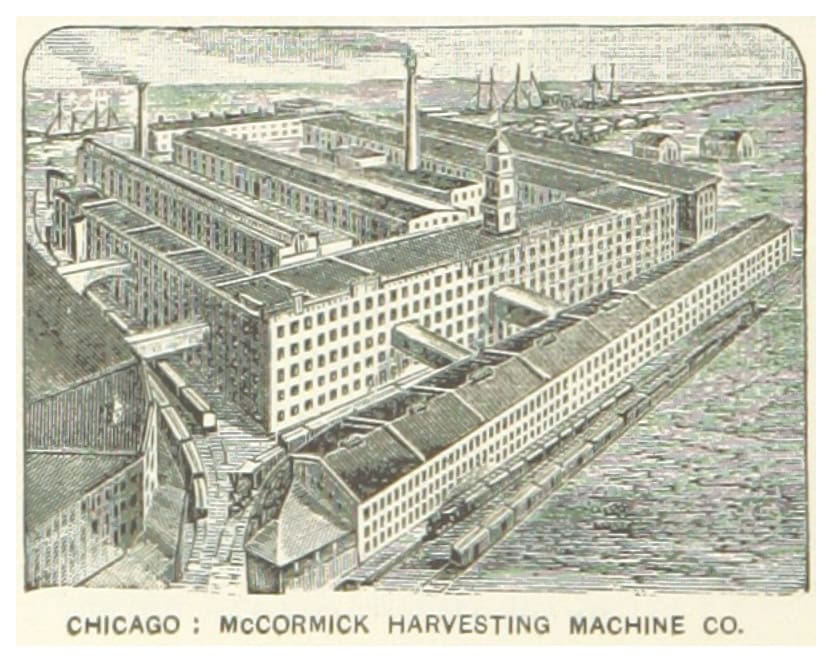
Photo Credit: British Library
This principle was embraced at Harvester for the first time in 1885. When the iron molders struck in late March, the younger Cyrus McCormick had a group of strikebreakers ferried down the Chicago River; he was thus able to bypass the pickets and restart production. So on the morning of April 8, the molders met their 1,200 fellow workers on their way into the plant, and persuaded them to stay out and join the strike. Shortly thereafter, as a Pinkerton-guarded bus transported scabs into the plant, workers accosted them and prevailed in the conflict when the guards ran off on foot. Cyrus was forced to restore wages to their levels from the previous December, when he had slashed them across the board by 10 percent.8Gilpin, The Long Deep Grudge, 23-26; “Capital and Labor: A General Strike of the Workmen Employed in the McCormick Reaper Works,” Chicago Daily Tribune, April 8, 1885, ProQuest Historical Newspapers.
However, this defeat suffered in his first year as company president motivated Cyrus to avoid its repetition. By the end of the summer he had made a switchover in the foundry to pneumatic molding machines that could be guided by common laborers. In this way he implemented the tactic of “weed[ing] out the bad element among the men,” firing the troublesome iron molders.9Gilpin, The Long Deep Grudge, 26. He also pivoted his strategy in negotiations: when in February 1886 a workers’ committee approached him with two demands—for a large wage increase and for the dismissal of five nonunion molders, with their replacements to be hired from among employees who had been laid off—he granted the first and denied the second. As Gilpin explains, “he would grant immediate financial concessions if they would buy greater management control.”10Gilpin, The Long Deep Grudge, 30.
The workers didn’t accept the deal. Cyrus McCormick, preempting their strike, locked them out and shut down the plant. Two weeks later, he resumed production with those men who crossed the picket line (now with the protection of the Chicago police). Thus, when the nationwide agitation for an eight-hour day crested in early May 1886, Harvester workers were more than two months into their own strike. Their energy had been flagging, but the May Day general strike gave renewed vigor to their cause.
The hard work of the IWPA and the broader eight-hour coalition paid off on May 1 with a mass strike of more than three hundred thousand workers in thirteen thousand workplaces across the US. In Chicago, forty thousand workers participated. The militancy was already having results: about thirty thousand workers had been granted an eight- or nine-hour workday by the second week of April. The rallies and marches of May 1 went off peacefully. However, on Monday, May 3, the weapons of the state were once again turned against workers at the behest of the bosses—and McCormick Harvester was the workplace where this violence was unleashed. That afternoon, while the anarchist journalist and orator August Spies was addressing a mass meeting of lumber workers up the street, the bell sounded at the Harvester plant that signaled the shift change. Some of those gathered to hear Spies broke off to confront the strikebreakers who were now leaving the plant. A brawl ensued, as those on the strikers’ side drove the scabs back into the factory with their fists and broke its windows by hurling stones and bricks. A contingent of two hundred police was soon dispatched to protect Cyrus McCormick’s property. They attacked the strikers with clubs as well as pistols, killing at least one.11Gilpin, The Long Deep Grudge, 31–32; Green, Death in the Haymarket, 169–71.
In response to this brutality, anarchists called a protest gathering at Chicago’s Haymarket the following evening. As that rally was about to end, a phalanx of policemen marched toward the produce cart that served as the speakers’ stand—and a bomb was thrown at the police and exploded. The police opened fire on the crowd, shooting wildly and hitting both civilians and each other. All told, seven police officers died and about seventy were injured. At least one worker was shot and killed. Many others were injured, and more blood was to follow.
In August, the highly politicized trial of eight anarchists found all of them guilty of murder, and in October the judge sentenced seven to death by hanging. Though it was clear that none of them had thrown the bomb and some weren’t even in the Haymarket at the time, the prosecution secured a conviction on the basis of conspiracy—an unprecedented move and a doubtful basis for meting justice. However, despite a defense movement that extended across the globe, on November 11, 1887, one died by suicide and four were hanged.
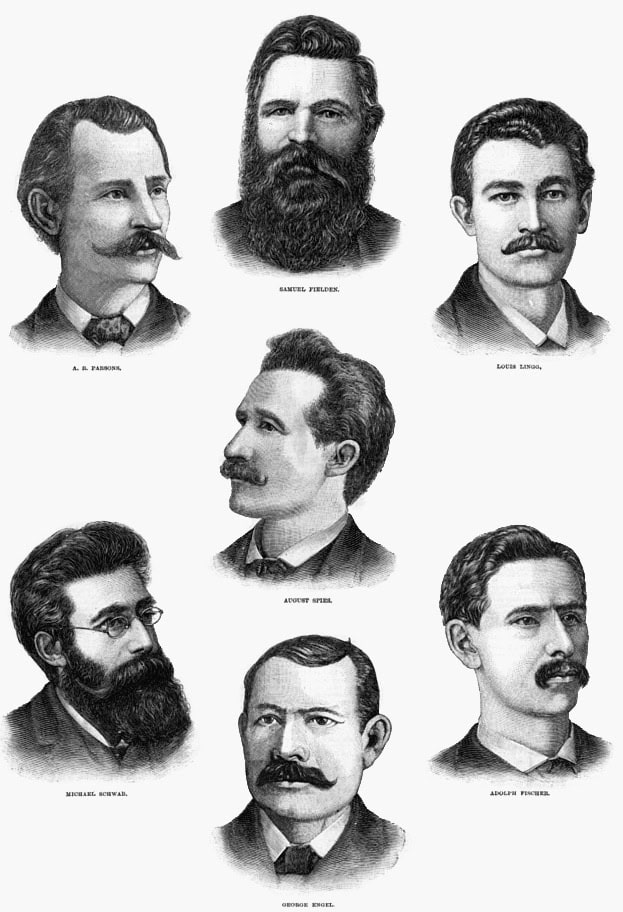
Photo Credit: Frank Leslie’s Illustrated newspaper via wikimedia
In the immediate aftermath of the Haymarket tragedy, both the Harvester employees’ strike and the broader general strike ended in defeat. The bomb thrown by an unknown person at the Haymarket initiated a Red Scare, and both employers and law enforcement went on a spree of busting labor organizations of all kinds. By the end of 1886 only a few thousand workers in Illinois had workdays limited to eight hours. Cyrus McCormick reinstated ten-hour shifts at McCormick Works shortly after the Haymarket Eight were pronounced guilty.12Gilpin, The Long Deep Grudge, 35. Worker organizing at the company fell back to a low ebb for decades.
For the eight-hour workday movement, which was international in scale, the panic in Chicago was a temporary setback. By December 1888, the AFL had regrouped and it set May 1, 1890, as the next strike date—this time planning for the carpenters’ union to go out, with other unions to rally with them. The date saw a record number of walkouts, with hundreds of thousands of workers winning wage gains and reduced hours.13Philip S. Foner, May Day: A Short History of the International Workers’ Holiday 1886-1986 (International Publishers, 1986), 44–45. Thus it was militant worker action, not legislation, that set and enforced the standard of the eight-hour day and forty-hour week. Strong federal legislation upholding this standard would arrive only in the 1930s.
Workers around the world took up the radical cause for which the Haymarket Eight had been martyred. At the Paris Congress of the Second International in July 1889, delegates adopted a resolution to hold an international demonstration for an eight-hour workday on May 1, 1890. Successful mass demonstrations followed in England, Germany, Austria, Poland, Cuba, and elsewhere. May Day caught fire and continued to burn in 1891 with even broader demands.14Foner, May Day, 41-54, 72.
The struggle for the eight-hour workday marshaled mass mobilizations—and hit employers where it hurt, by shutting down production. Throughout it, workers exerted their strongest force by withholding their labor. The force that employers brought to bear took the form of police violence to the point of murder. The story of Harvester in the twentieth century provides further testament to the lengths capital will go to maintain their control over the organization of workers’ labor.
II. Harvester and the FE Union in the Twentieth Century
During the first three decades after the turn of the century, as Harvester grew larger and more dominant in its markets, it continued to hold to the antiunion principle that Cyrus McCormick II had staked out in the 1880s. As Gilpin observes, when faced with labor militancy, the company granted wage increases and other concessions with the aim of placating workers, but refused union recognition and quickly weeded out suspected agitators. To break through these obstacles, workers had to come up with new moves. Clandestine organizing and reliance on support from a larger institution—the Communist Party—were what finally got Harvester workers their own union. Despite these tactical shifts, the workers of the FE maintained the commitment to building solidarity across divisions that fueled the militant organizing of the 1880’s.
Major change was afoot at the company by 1902, when McCormick Harvester merged with its foremost competitor, Deering, and two smaller farm equipment makers to become International Harvester. By 1910 it was the fourth-largest corporation in the country and employed a total of thirty thousand workers in sixteen plants. In Chicago it opened three new plants, including the Tractor Works on the other side of Western Avenue from McCormick Works. This was its first modern facility focused on assembly-line production.15Gilpin, The Long Deep Grudge, 40-41, 68.
Also in this period, Cyrus McCormick developed new techniques to obstruct worker organizing. In 1916, Chicago workers staged their first multi-plant walkout after a wage cut was foisted on employees at the lowest-paid Chicago plant. Cyrus responded by agreeing to a wage increase, but then set a plan into motion to head off future agitation. Two years later, Harvester established a Department of Industrial Relations, which was tasked with the “scientific” management of workers. Devising a plan for company-controlled employee representation was its first remit. The Industrial Council Plan was rolled out in March 1919, proposing a so-called works council as the venue for employees to meet with management to discuss workplace issues. Within the year, workers at almost all Harvester plants had voted to approve the plan, with only McCormick Works holding out. However, after Harvester defeated a large strike in the summer of 1919, the fledgling worker rebellion at McCormick Works was again crushed. It, too, voted in a works council in 1921.16Gilpin, The Long Deep, 45–50.
The works councils ensured that workplace democracy remained out of reach for Harvester workers for about fifteen years. However, this management ploy wasn’t enough to withstand the massive wave of labor agitation that swept the country during the Great Depression—when one-third of workers nationwide were jobless—and the accompanying upsurge in radical politics. In February 1938 a Harvester plant finally won its first contract: the FE beat out the company union in an NLRB election at Tractor Works and won sole bargaining rights. The union organizing was accomplished via a yearslong effort by the Communist Party, which began in secrecy and gradually won over works council representatives. By the time the nascent union started wielding its power in 1936, it already included a large majority of the employees among its ranks.17Gilpin, The Long Deep Grudge, 82–85.
In the late 1930s and early ’40s, the FE organized more plants, including McCormick Works, and by 1943 it had nearly twenty-two thousand members. During World War II Harvester benefited immensely from federal defense contracts, and it doubled in size.18Gilpin, The Long Deep Grudge, 162. It continued to dominate the farm equipment market, while diversifying into new businesses including tractors, trucks, and gasoline engines. The war years saw the FE win contract gains despite the no-strike pledge it took after the United States entered the war. It received favorable rulings from the national board that mediated labor-management conflicts in order to safeguard production. That board’s authority gave the FE an edge in its 1942 contract negotiations, enabling it to win its major demands from the latest McCormick in charge, Fowler. In the next few years, the board twice ruled that the system that governed payment for pieceworkers during production slowdowns should be made fairer for workers. The FE also won significant across-the-board wage increases.19Gilpin, The Long Deep Grudge, 118–24.
Following the war’s end, in spite of the massive profits it reaped during it, Harvester’s approach to the FE remained hostile. In this it resembled other US manufacturers, just as its employees’ fighting spirit was widely shared by other workers: more than 4.5 million engaged in work stoppages in the year 1946.20Gilpin, The Long Deep Grudge, 127–28. This massive strike wave won wage and benefit gains but overall did little to challenge management’s control over production. Thus, the work-rule wins of the FE were exceptional. Compared to other unions, the FE’s organizing style was more relentless, and the areas in which it contested management control were more wide-ranging. As Gilpin highlights, its philosophy was that “management had no right to exist,”in the words of FE organizer Milt Burns.21Gilpin, The Long Deep Grudge, 6. This meant constant shopfloor warfare, organizing around every grievance because each one of them was a chance to contest management control and empower workers. This class-struggle unionism had roots in the Chicago Idea of nineteenth-century anarchists. As Gilpin illuminates throughout The Long Deep Grudge, the FE often invoked the tradition of the Haymarket anarchists, honoring the martyrs in May Day events and framing contract fights as a continuation of their struggle. Both militant groups organized with an eye toward an ambitious horizon: they saw their campaigns as part of a transformative global effort to assert labor’s power over and against that of capital.
Before leaving the era of the FE, it bears mentioning that the union scored an amazing victory in 1947 in Louisville, Kentucky. When Harvester opened a large plant there and hired local workers, they paid them the lowest wages of any of their plants, exploiting the so-called Southern Differential. But the FE made the shop one of its most tenacious strongholds. First, since the workforce was interracial, the FE organized both Black and white workers. As Gilpin details, they got past white workers’ prejudice through a combination of open discussion and solidarity in shopfloor action. Second, the FE made the Southern Differential the target of its strike campaign in the fall of 1947—and won wages for the Louisville workers nearly equal to their Northern counterparts.22Gilpin, The Long Deep Grudge, 155–71. Just as 1880s radicals who recruited “green hands” into the movement alongside skilled craftsmen, workers here built solidarity around the divisions capital created.
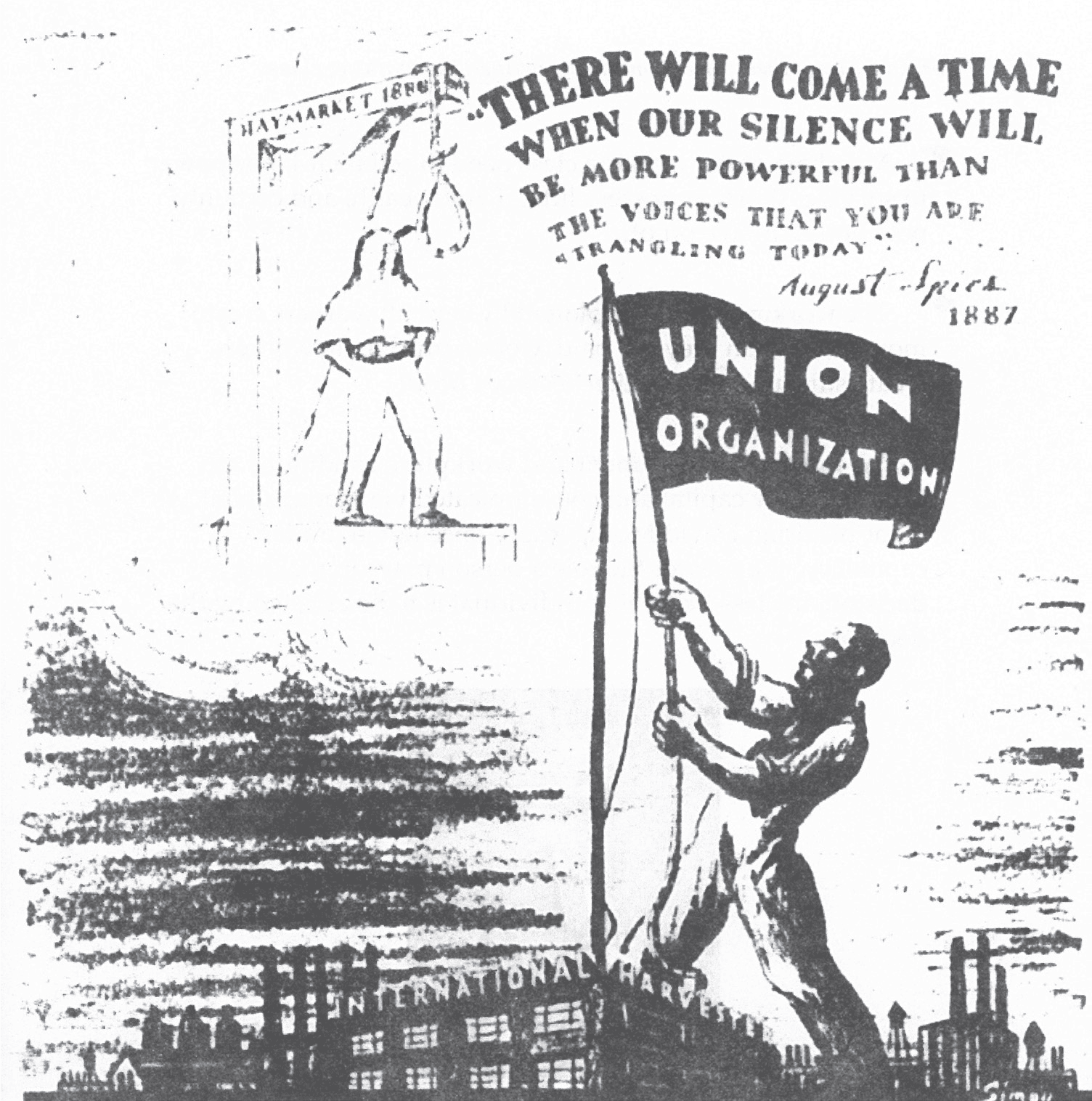
Photo Credit; The Long Deep Grudge, 60.
This was very different from the stance adopted by the UAW, the FE’s competitor. In addition to forcing Communists out of the union, the UAW president in the postwar years, Walter Reuther, led US organized labor in brokering a compromise with employers. The 1950 “Treaty of Detroit” with GM was a deal with the devil: it bought wage wins at the cost of ceding ground for class struggle. The five-year contract tied wage increases to productivity gains—taking it for granted that it was in workers’ best interest to get a slice of a “larger pie” even if this meant that management had an unchallenged right to tell them how to do their jobs and how fast to work.As Gilpin elucidates, in its position papers and reports, the FE condemned the Treaty of Detroit and the principle of cooperation with industrial capital that undergirded it.23Gilpin, The Long Deep Grudge, 199–202.
The FE’s militant, day-in-day-out style of organizing enabled it to win provisions in its contract beyond just wage and benefit increases. In making and winning demands that advanced workplace democracy and changed the terms and conditions of work itself, the FE nurtured a sense of entitlement in Harvester workers. This provided them with remarkable resilience even after the FE merged into the UAW in the mid-1950s and ceased to be an independent presence.
III. A CEO Chases Shareholder Value, Harvester Faces Down Failure
International Harvester’s trenchant antiunionism was again on display in the late 1970s and early ’80s. It first took the form of a cost-focused CEO’s attempt to strip critical proworker provisions from the UAW contract. Then it manifested itself in plant closures and mass layoffs. Cyrus McCormick II had attempted to tamp down labor unrest by “weeding out” the disgruntled iron molders. Now, in the turbulent 1970s, the “bad element” to be weeded out by management was the majority of its workforce.
To situate ourselves in 1970s, it is useful to contrast it with the postwar period. US industry in the postwar years carried out heavy investment and received excellent returns. Its rate of workforce productivity growth was surging. In the latter half of the 1960s, however, the net corporate profit rate declined, and US manufacturers were particularly hard hit, with a 50 percent fall in their profit rate. Harvester did not escape this: it, too, saw a rapid decline in profits.24Marsh, A Corporate Tragedy, 124. In the early 70s, the recession triggered by OPEC’s oil embargo delivered another blow to industrial productivity and profits.25Jonathan Levy, Ages of American Capitalism: A History of the United States (Random House, 2021), 545–47. Also, commodity prices were set on a course of inflation even as economic growth remained slow.
The assurance of a “larger pie” year over year, which had undergirded the postwar organizing model of the UAW and other unions, was now gone. In the 1970s, the business class became concerned with workers’ rising expectations. So-called inflationary expectations were vilified both because they caused wage-push inflation (higher wages leading to higher prices) and because higher expectations among one segment of the working class was seen to make others aspire to more, too.
Returning to Harvester, we find that as the 1970s began, it was still a behemoth with a US workforce of more than sixty thousand. But as it lumbered forward, it dragged along a number of problems related to its finances and managerial practices. One was its high debt levels. Another was that it was overly diversified: it had too many businesses and not enough capital to continually invest in any of them. Without spending money to update plants, build new ones, or improve product models, it was falling behind competitors such as Deere and Caterpillar.26Marsh, A Corporate Tragedy, 123–24, 130–31.
Its chief executive made efforts to address these problems, with minimal success. However, Brooks McCormick did propel Harvester to get in step with the times by hiring the consultancy Booz, Allen & Hamilton. They advised a major reorganization and a new CEO who was focused on cost control.27Marsh, A Corporate Tragedy, 172. Brooks carried out these recommendations, personally leading the search for a new executive that eventually led to Archie McCardell, whose cost-cutting record was stellar. As COO of Xerox, McCardell had slashed eight thousand jobs in one year in the early 1970s to keep up its profit margins. His proclivities dated back to college, when he had a job checking up on construction site timeclocks to ensure workers were where they said they were. Harvester brought him on in 1977, with salary and bonuses totaling $1.9 million—the highest pay of any executive that year.28Joseph Winski, “McCardell Plowing Up New Ground at Harvester,” Chicago Tribune, July 11,1979.
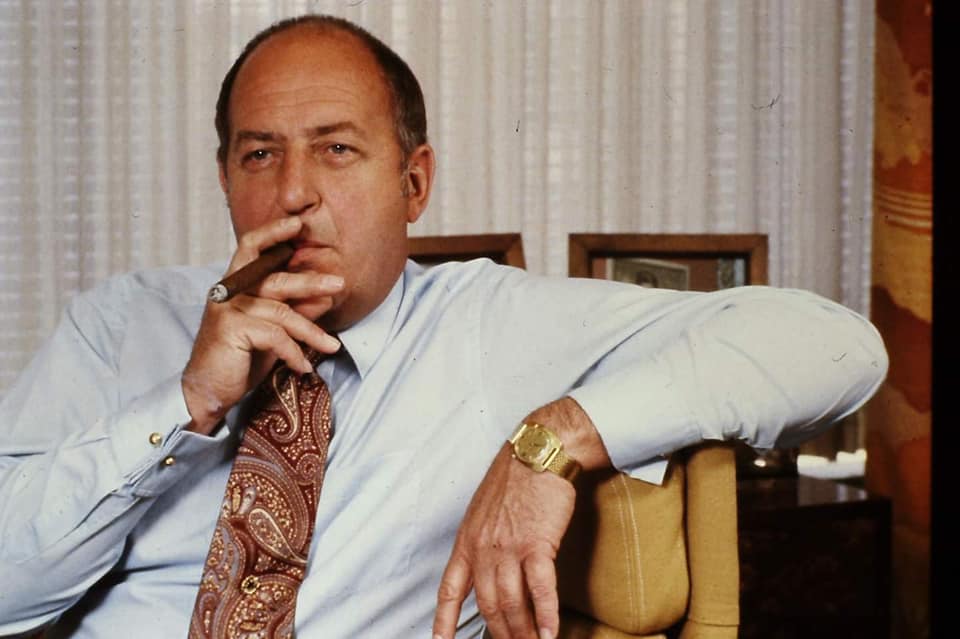
Photo Credit: Herbert Starzinger via Facebook
Both the reorganization and the new CEO hiring criteria were among the managerial “best practices” of the day. So was the structure of executive compensation. Under the reorganization, Harvester was divided into five business groups based on product lines, each of which was headed by an executive who was accountable for its profitability (and financially incentivized on that basis). McCardell’s contract included a $1.8 million company stock-purchase loan that would be forgiven if he pushed Harvester’s annual profit rate above its main competitors’.29Marsh, A Corporate Tragedy, 234–35.From the outset of McCardell’s tenure, success was defined in terms of shareholder value. The profit rate for a given year—that is, the extreme short term—was now the key metric that executives were encouraged to maximize, as opposed to prioritizing steady expansion over the long term. This shareholder value ethos took root during the 1970s, in the context of the overall less prosperous outlook for manufacturing enterprises.
It might have been a minor trend but for the expanding expectations of the working class. As Melinda Cooper notes, not only did unions continue to win wage increases, but also young industrial workers embarked on wildcat strikes and sabotage in their battles with management, and emancipatory movements such as feminism and welfare rights activism demanded an extension of the social wage beyond male breadwinners.30Melinda Cooper, Counterrevolution: Extravagance and Austerity in Public Finance (Zone Books, 2024), 12, 123–29, https://doi.org/10.1353/book.125374. Despite the less-than-ideal economic conditions, labor appeared ready to push capital back to the same extent it had in the late 1800s or the 1930s—if not more. But this time, industrial capital was already on guard, seeking to claw back profit margins by slashing labor costs. Corporate managers’ endeavors were merely the first sally in a much larger offensive, however. As I will describe in the next section, federal policies would soon cause financial assets to assume a greater importance in the economy relative to industrial profits, thus creating an opening for industrial managers to run away from workers’ demands by excising them from their payrolls.
At Harvester, with McCardell at the helm, the new agenda was quickly taken up. McCardell charged his top executives with locating $640 million in “excess costs.” The reports came back stating that about half of the excess was in labor. The company had eliminated eleven thousand jobs by mid-1979.31Winski, “McCardell Plowing Up New Ground at Harvester.”
Yet when McCardell went to take on the union regarding its contract, like a man crossing out a word on a page, it didn’t go as smoothly. McCardell challenged the union on mandatory overtime and several other longstanding provisions. He insisted that the company needed these work-rule changes in order to be competitive—but union members saw the ability to refuse overtime as a right. Dave Boynton, who was in his late twenties at the time of the strike, recalled in an interview with Barbara Marsh that “it would be giving up our life: life at home or our life at play. Your life would be at work, see, and you wouldn’t have any choice about it. You know nobody’s going to give that up once they’ve got it!”32Marsh, A Corporate Tragedy, 207–10. Boynton’s father had spent his career on the line at the same plant in the Quad Cities. But whether or not they were second-generation Harvester workers (and many were), the union members were continuing the tradition of the FE radicals, which rejected management’s invitations to collaborate. It was no surprise to observers when the UAW struck on November 1, 1979. But McCardell miscalculated how long they would stay out. By February, he began to capitulate on his initial goals. Yet it took until late April to sign an agreement, by which point it was the UAW’s longest strike ever. The union won wage and benefit increases, and McCardell’s concession seeking resulted in only minor changes. Overtime remained voluntary.33Marsh, A Corporate Tragedy, 220–22; “A Long Strike Yields Little for Harvester,” Business Week, May 5, 1980.
The financial losses of those six months of halted production and McCardell’s misguided actions in the immediate aftermath put the company in a place in which all its other problems caught up with it. Harvester lost nearly $400 million in 1980, the worst year in its history, and sales dropped 25 percent.34Marsh, A Corporate Tragedy, 234; Joseph Winski, “’81 Proving to Be Grim Reaper for Harvester,” Chicago Tribune, May 3, 1981 Nevertheless McCardell pushed forward with an untimely capital-spending plan and encouraged the company’s business groups to keep up production—a serious error. Meanwhile, starting in early 1980, Moody’s hit the company as well as its customer-financing subsidiary with the first of several credit rating downgrades. By mid-1981 Harvester had run up against a cash crunch. With its options for borrowing now limited to credit lines from private banks, these suddenly became astronomically expensive due to a recent change in policy at the Federal Reserve—the Volcker Shock. In September, management began secretly considering whether to file for bankruptcy. In December, having already made one failed attempt to cut a deal with its banks, Harvester managed to negotiate a $4.15 billion refinancing plan. It pledged to lenders to further trim its workforce and consolidate production into fewer plants. It was now theoretically on a path to recovery.35Barbara Marsh, A Corporate Tragedy, 235, 238–41, 254–55.
In its frantic efforts to maintain solvency, Harvester laid off workers in droves and shut down plants, including several in the Midwest. It made a 34 percent cutback in global employment in the year 1982 alone. For a manufacturing enterprise, this was a bit like bailing water out of a sinking boat by taking apart the boat and throwing its parts overboard. Whatever remained would be a shell, divested of most of its productive capacity and in no position to regain its market footing.
Mass divestitures by manufacturers added up to nationwide deindustrialization—which federal policy instigated. Harvester was not just one company with the ill luck to have its financial resources exhausted while caught between the stubbornness of management and labor. Rather, the determination of this union and others to stand up against management’s cost-cutting, profit-enlarging attempts—and to ask for even more—outraged and alarmed the business class as a whole. In response it allied with the investor class, which also had a direct interest in curbing wages insofar as they were one of the inflationary conditions eating into the value of financial investments. As I will elaborate below, industrial and financial capital allied to hit back at labor hard.
In recognition of the dismal situation into which McCardell had led the company, the board pushed him out in May 1982. However, that was not before he had pocketed a $1.8 million bonus via the forgiveness of his stock-purchase loan. McCardell had earned it based on the company’s 1979 performance—right before everything went south.36Marsh, A Corporate Tragedy, 234–35, 274–75. He landed on his feet after that, getting into the real estate game by selling lots in a high-end subdivision. He also refashioned his experience into a new sideline: running an emergency management services firm aimed at helping companies in trouble.37Marsh, A Corporate Tragedy, 298.
In the end Harvester management eked out the rescue they needed for the now hollowed-out company. After negotiating for weeks on the renewal of the 1981 pact, Harvester and its lenders finally closed the deal in October 1983 at the company’s headquarters in Chicago. Harvester reps, bankers, and attorneys went out to celebrate that night with drinks at Z’s, a Near North Side sports bar.38Marsh, A Corporate Tragedy, 292–94. But Harvester’s former workers had nothing to celebrate. Shuttered plants such as those in Fort Wayne, Indiana, Canton, Illinois, and the Pullman neighborhood of Chicago would not reopen.
The shrunken company would not continue in this form. At the end of 1984, Harvester decided to sell its original, namesake business of farm equipment to Tenneco Inc. What was left—its truck and engine manufacturing businesses—was rebranded with the new name of Navistar.
IV. Industrial and Financial Capital Team Up to Sabotage the Social Contract
When McCardell spoke to author Barbara Marsh about the 1979 strike a few years later, he stated that he had the broad support of other industrial managers in adopting his hard-nosed position. He recalled that Ford CEO Philip Caldwell told him, “Somebody has to stand up and do this, Archie. You just stick in there!”39Marsh, A Corporate Tragedy, 217. Industrial executives were fixated on bringing labor costs down, and McCardell’s standoff was one among several high-profile attempts to force unions to accept concessions.40A comparable situation occurred the same year when Chrysler sought a federal bailout to avoid bankruptcy, then successfully prevailed upon the UAW to amend its contract and make concessions in the interest of aiding Chrysler’s recovery and meeting the government’s terms. McCardell’s obstinacy failed to win givebacks of what workers of previous generations had won. US industrial workers as a whole were disinclined to make concessions—rather, in the 1970s, they were lifting their sights to greater freedoms, such as the freedom to enjoy “life at home or life at play” instead of maxing out their productivity and hours on the job. Overall, direct contract negotiations didn’t deliver enough cost savings to satisfy the profit-thirst of either the business class or the investor class. For that—and out of fear of an existential threat—industry had to join forces with finance to smash unions and hinder militancy. Financialization and deindustrialization enabled industrial corporations to back out from their basic obligations to their workers, starting with the obligation to continue to employ them.
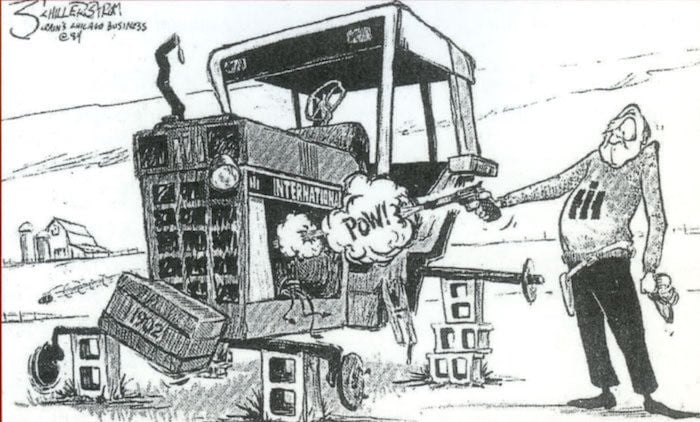
What ultimately did Harvester in? What justified its deluge of plant closures and layoffs? The answer is complex, but crucial to understanding capitalism today. Two things happened at once: A new sector in which capital could be invested to make bigger profits opened up, and opportunities for US manufacturers to prosper were foreclosed. Both these trends began before the 80s, yet at the beginning of that decade they came to embody a seismic shift in US and global capitalism. Changes in federal policy made a steady flow into a flood: capital fled from manufacturing industry and went into finance, investment, and real estate (FIRE). In the 80s, FIRE capital surpassed manufacturing in its share of national GDP and of corporate profits.41Greta R. Krippner, Capitalizing on Crisis: The Political Origins of the Rise of Finance (Harvard University Press, 2011), 30–34, https://doi.org/10.2307/j.ctvjk2x23.
This financialization abetted deindustrialization, and both processes were spurred by federal policies. In late 1979 under the leadership of its new chairman, Paul Volcker, the Federal Reserve’s monetary policy became strangling-tight—that is, money was made scarcer and credit more costly to access in order to jolt the economy out of its inflationary course. This policy triggered an abrupt, severe recession—the Volcker Shock—that had a significant negative impact on industry and, even more so, on industrial workers. High interest rates attracted investment in the dollar, so the dollar’s value increased and foreign competitors gained an advantage because their costs were now comparatively lower. As a result, the market was flooded with cheap commodity imports that edged out US manufacturers’ market share. Also, the recession meant that fewer people were buying and they were buying less. On top of that, the lines of credit available to manufacturers were now more expensive (which was disastrous for Harvester). For workers, this meant layoffs and unemployment: the first three years of the 1980s saw the loss of 2.5 million industrial jobs.
A second key change was in fiscal policy, that is, federal expenditures. Big tax cuts in Reagan’s 1981 Economic Recovery Act encouraged real estate investment and speculation, driving a commercial real estate boom. Reagan’s supply-side approach put an emphasis on giving handouts, in the form of tax breaks, to FIRE asset holders instead of spending to create jobs and redistribute wealth.
During the Volcker recession, there was lots of foreign capital flowing into dollar investments, and the United States was still the richest country on earth. There was no shortage of capital that could have been used to keep the gears of industry turning. However, the shift in economic conditions was so great that corporations themselves, when they had cash in hand, found more profitable options in the FIRE sector than in fixed investments in industry.42Levy, Ages of American Capitalism, 600–04. Likewise, banks had many options, and their demands upon creditors became more exacting.
At Harvester, lenders demanded divestment—fast. The banks wanted cost cuts, the same method that had been McCardell’s first priority in trying to restore bigger profit margins. But the strictures imposed by the banks were more drastic: they severely limited Harvester’s capital spending, and restricted the sales volume that its credit subsidiary could finance.43Marsh, A Corporate Tragedy, 255–56. The divvying up of loans between this credit arm, known as International Harvester Credit Corporation (IHCC), and its parent company became a sticking point in the 1981 refinancing deal. Its first attempt at a deal fell apart because management wanted lenders to extend credit to the parent, which was in desperate need of an infusion, but banks favored IHCC because they considered it a better risk. Even within Harvester itself, therefore, finance now had better prospects than industry. Under their pressure, McCardell looked for any chance to sell off smaller businesses (and the subsequent CEO didn’t stop at the small ones). Divesting a business based on calculation of its value as an “asset” at a specific moment in time represented the shareholder value ethos in overdrive—it closed off considerations of what long-term investment could yield. By 1981, when Harvester had paused certain loan payments due to lack of funds, the banks were sizing up the company as a collection of assets, with a view to recouping their value if it went under.44“International Harvester: Can It Survive when the Banks Move In?,” Business Week, June 22, 1981.
The banks forced Harvester management to move faster—but in many ways, it was toward the same goals. The massive purge of Harvester’s workforce was part of a class-wide offensive of capital against labor that began around 1980 and has continued to the present day. In 1979 Harvester had a workforce of sixty-four thousand; by 1983, it employed only nineteen thousand.45Marsh, A Corporate Tragedy, 278. Harvester’s layoffs and business sell-offs undermined unions’ basic assumption that the employer-employee relation would continue into the future.
Looked at in terms of class conflict, Harvester’s financial collapse had a clear effect. In November 1979 McCardell failed to convince the union that he couldn’t afford to give them a choice about working overtime. Then, after signing a contract, he did the CEO equivalent of turning out his pockets to show that he was broke. The bankers’ repo men that prowled company headquarters effectively backed him up. In the spring of 1982, Harvester management persuaded the UAW to enter contract talks, once again seeking givebacks. This time, with the threat of business failure hanging over the negotiations, they got them: the union agreed to $200 million in wage and benefit concessions.46Winston Williams, “Harvester and U.A.W. in Pact on Concessions,” New York Times, April 30, 1982.
The early-1980s sea change in federal policy served the interests of not only financial capital, but also industrial capital. In creating, almost simultaneously, a poor outlook for domestic manufacturing and thriving conditions for financial assets, it gave industrial capital an out from having to meet workers’ demands (and from thereby adding fuel to their out-of-control expectations). Admittedly, Harvester as a company paid a steep price for this escape hatch by ceasing to exist as a unified entity and a name brand—but this was something the business class could afford to let go of. Moreover, industrial capital was on board with the Federal Reserve using its policy tools to curb inflation, even if it meant a shock. Inflation hampered both industrial managers’ profit making and asset holders’ wealth generation. (Hard as it is to imagine today, in the 1970s both prices and wages were climbing at a faster rate than returns on most stocks and bonds.) While the Volcker Shock created an economic downturn, with heightened foreign competition and pricier credit, industry was capable of surviving these worsened conditions. Even in Harvester’s case, the corporation weathered its crisis and continued on in its rebranded form (in a twist, it readopted the “International” name a year and a half ago). Yet industrial capital could not accept workers asking for more, and having the strength in numbers to get it. Nor could finance. For the survival of capitalism itself, they had to be checked.47Cooper, Counterrevolution, 12, 36.
The threat from a working class feeling its strength is what triggered capital’s counteroffensive. By the end of the 1970s, slow growth and the falling profit rate created an urgent imperative for industrial managers. Unlike in the postwar years, when they went along with the idea that everyone could benefit from prosperity, they now sought to impose lower wages and thereby help bring inflation down, but most of all, to diminish workers’ expectations of their jobs and employers. However, workers had other ideas. Their demands for both continued wage increases and federal spending for emancipatory ends posed a direct threat to both industrial capital and financial capital. For having the gall to refuse work-rule changes and demand higher wages in the midst of a profit squeeze, the business and investor classes thought that unemployment and a decades-long span of stagnant wages was the least of what workers deserved.
V. Answering Capital’s Denials by Refusing to Hear Them
Capital dealt labor a wounding blow with the rapid deindustrialization of the US economy. The stream of layoffs that began in the 1970s and became a cascade in the early 1980s did not stop after the Volcker recession ended. Plant closures and layoffs continued throughout the 1980s and ’90s at a pace that fluctuated based on—again—federal policies, not unavoidable economic “weather.” The ill effects are still with us in highly visible ways: plants remain shuttered; former industrial cities are depopulated and underfunded. At the old McCormick Works site, the sugar refiner warehouse is visited by trucks picking up shipments. It is common industry practice to contract out shifts and it’s reasonable to assume that the truck drivers are classified as independent contractors—placing the burdens of truck maintenance and regulatory compliance squarely on their shoulders. This practice leads to frequent misclassification, and limits drivers’ opportunities for collective action. The trucking industry is one among many with a much lower unionization rate than it had before 1980 (when trucking was deregulated). Many newly created jobs resemble those that prevail in this industry: non-union to begin with, and structured so as to prevent solidarity building. Meanwhile, investment and real-estate development continue to fuel the gentrification of nearby Pilsen.

Photo Credit: Art Valencia via Google Maps
With financialization, capital has again innovated its way around and through worker organization. In the Gilded Age, it used Pinkertons and the strong arm of the state to break strikes. In the 1920s, company unions blocked workplace democracy. In the 1940s and for many subsequent decades, it fled unions by way of plant relocations to the South. Each time, workers came up with a new method of organizing or a renewed determination to seize control of their jobs and lives.
How do we regroup from our present state of defeat, to rekindle militancy and grow capacity for collective action? The history of labor struggle can provide, if not the answer, at least some clues. From the Chicago anarchists who in the 1880s brought unskilled workers into the movement, and from the FE radicals who followed Harvester south to Louisville and organized Black and white workers with the goal of equal pay regardless of race or geography, we learn that solidarity must cross those lines that capitalism draws. The contrast between the FE in the 1940s, with its constant shopfloor battles and bargaining over work rules, and the UAW, with its willingness to share a “larger pie” with management at the cost of speed-ups on the line, tells us that class struggle is best fomented in real time by fighting back against employers’ encroachments, and not by agreeing to a predetermined cut of the pie that may later turn out to be crumbs. Finally, just as Harvester workers in 1979 refused McCardell’s demands that they give up their choice to work overtime or not, we, too, should ignore the excuse from employers—and from the state—that they can’t afford to let working-class people have greater freedoms.
As with the iron molders who were tired of burning up in the foundry ten hours a day, six days a week, or the unemployed masses in the Great Depression who were hungry, workers’ demands for better, freer lives can’t be turned away. Though capital would love to stop workers from even imagining that there could be more, that’s one thing it will never be able to do.