
Service with a Scowl

Review of Beneath the Wage

May 12, 2026

9781945861093
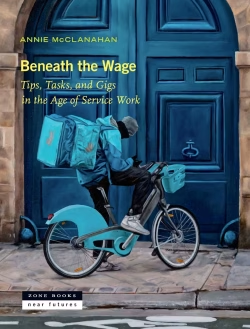
Beneath the Wage: Tips, Tasks, and Gigs in the Age of Service Work
by Annie McClanahan
Zone Books
2026

In a recent talk, Chris O’Kane noted that it’s cliché now to begin with the statement that there has been a return to Karl Marx since around 2007.1“Social Constitution and Fetishistic Social Domination (with Chris O’Kane, Sam Fisher, and Rob Knox),” YouTube video, 1:29:50, posted by “Historical Materialism: Critical Marxist Theory,” April 7, 2026, https://www.youtube.com/watch?v=BQhv-uwfAe0. Yet, here we are. The field of analysis is so full that we are ready for a history of the nearly twenty years of Marxist thought since that turning point. In any such account, Annie McClanahan would have to figure prominently as a key voice among those taking on the dynamics of capitalism’s long crisis, including little real economic dynamism, the exaggeration of wealth disparities, the immiseration of work, a shattered labor movement, the dismantling of social welfare, and increases in state provision for the military, border patrolling, and policing.

How did we get here? Among the tasks of these decades has been to answer this question, in part by historizing and theorizing a dominant figure from the before-times: the male factory worker, paid by the hour. In Family Values: Between Neoliberalism and the New Social Conservatism (2017), Melinda Cooper describes this man as the recipient of the Fordist family wage, a phrase that points to the predictability and routinization of production on the assembly line.2Melinda Cooper, Family Values: Between Neoliberalism and the New Social Conservativsm (London: Zone Books, 2017), https://doi.org/10.2307/j.ctt1qft0n6. It also captures the way that, with the expansion of industrial production and the growing bargaining power of unions, some women and children came to be placed outside of the industrial workplace, relegated to the home and school. The sanctity of the respectable family was to be protected by women homemakers dedicated to the work of social reproduction, accessing the wage not directly but through their husbands, who could bargain for higher pay on these conservative grounds.

Due to the nature of capitalism itself, which tends to create surplus populations, this wage form was never the norm for work compensation on the global stage and it could ultimately never be universalized. Marx writes that “the same number of workers operate with a constant capital of ever-growing scale”; in this process, “the mass of living labour applied continuously declines in relation to the mass of objectified labour that it sets in motion.”3Karl Marx, Capital, Vol. 3, trans. David Fernbach (London: Penguin, 1981), 318–19. In simplified terms, industrial capacity expands as labor processes are converted into more advanced machinery. As a result, less labor is required to produce the same number of commodities, which thus become progressively cheaper. The rate of profit falls.

In the face of that falling rate of profit, the capitalist has to renew efforts to extract as much surplus as he can, and the process of increasing the contingency, intensity, and superfluity of labor continues. Within this downward spiral, though a minority in terms of the overall composition of global labor, the factory worker has nevertheless been a crucial engine of the expansion of industrial capacity and productivity. This has granted him singular importance within real labor struggles and a heightened significance for Marxist analysis.

Service Work, Then and Now

In Beneath the Wage, McClanahan argues that the centrality of this model worker to labor history and policymaking has entailed constitutive racialized and gendered exclusions, which have pushed many kinds of work—service work, in particular—out of the range of worker protection and wage reform. Legal categories of protected employment, which were crucial to the rise of industrial wage labor, were positioned against other forms of work that were characterized by irregular hours, indirect management, and the absence of regulatory standards. Workers excluded from prevailing regulatory frameworks were disproportionately service workers and usually compensated by nonhourly wage payments.
McClanahan explains how compensation for this work deviated from the standardized hour. She argues that slow productivity growth in service work and a broader “inertial economy” manifest in the pressure to speed up work, technologically enhance forms of domination over work, and maintain “wages so low that the worker’s everyday existence becomes perilous.”

McClanahan traces the origins of these nonhourly wage forms in the experiences of farm workers, newspaper boys, railway porters, and domestic servants, among others. In the early years of expanding factory employment, these were all positioned against routinized waged workers producing commodities for sale. Working as a cook and a cleaner in someone’s home or as a train porter assisting with luggage was framed as embarrassingly servile work that white American men should certainly not be doing. As with farm labor, it was work that ostensibly could not be measured by the wage because its patterns of intensity were unpredictable, requiring the worker to be available at all times even when not actively engaged in work. Jobs like these would be left out of emerging legal frameworks designed to protect employees, a term that came to indicate people whose work featured predictable hourly rhythms and outputs directly overseen and controlled by bosses. If you don’t have a foreman looking over your shoulder and aren’t part of a team engaged in a work process that results in the production of an alienable material commodity, chances are that, to this day, you might not be categorized as an employee. You might instead be labeled an “independent contractor.”

In chapters examining superexploited tipwork, deskilled clerical microwork, and informalized circulation gigwork mediated by digital tools, McClanahan explains how compensation for this work deviated from the standardized hour. She argues that slow productivity growth in service work and a broader “inertial economy” manifest in the pressure to speed up work, technologically enhance forms of domination over work, and maintain “wages so low that the worker’s everyday existence becomes perilous.”4Annie McClanahan, Beneath the Wage: Tips, Tasks, and Gigs in the Age of Service Work (Brooklyn: Zone Books, 2026), 15, https://doi.org/10.2307/jj.40478850. Many types of service work may be resistant to wholesale automation (they have not yet turned all restaurant servers or nurses into robots) but these jobs today are nonetheless subject to unique forms of intensification and deskilling, in which a job is split apart, or “unbundled,” and simplified so that it can be rationalized and automated or just offered at a lower wage.

McClanahan pinpoints the many kinds of nonprotection that informalized so-called “independent” service workers face because their work is conceived outside of regulated wage norms. Restaurant workers in many US states are still not protected by minimum wage laws on the grounds that the tips they make should add up to some kind of wage minimum, and the intensity of their work is concentrated at certain portions of their shift in ways that ostensibly justify not compensating them for every hour on site. The National Restaurant Association (NRA) and other lobbyists from the hospitality and restaurant industries have fought hard against wage minimums for restaurant workers because they recognize that the tip is itself a disciplining mechanism: people dependent on tip wages will want to do a good job, and quickly.

A restaurant server has this in common with a circulation worker (think of drivers and delivery people organized by Uber, Lyft, or Instacart) who is paid by the task and by tips, with employers sometimes deducting the tips received from what they themselves pay to the drivers. Like the NRA, rideshare companies have played an active role in intervening politically to ensure that circulation workers are not classified as regular employees. This work has been marketed as a kind of freedom from the nine-to-five grind of a regular job. It’s the “open road,” after all, teeming with the promise of adventure. For McClanahan, there is no reason to deny the appeal of this freedom. We do well, in fact, to lean into the desire for escape from the tedium of the routine workday and see in it a yearning for a better, more varied and fulfilling life. It is a desire that these companies actively betray, of course, however they may appeal to it in their marketing. They have developed digital tools to monitor their workers thoroughly, knowing that the compulsion to earn money through continuous, quick work is itself a primary disciplining force. Circulation workers are in fact subject to near constant technological surveillance, with customers performing the function of mini bosses controlling discrete segments of their working day, organizing their time, and rating them.

But the most egregious example of what it means today to be a so-called independent contractor working “beneath the wage” may be the microworker. Often located in the Global South, or kept out of other kinds of work by disability, workers distributed by platforms like Amazon Mechanical Turk perform relatively brief tasks for micropayments, sometimes only amounting to a few cents. Most make well below any minimum wage. Companies are thus able to reach a ready and flexible workforce 24/7, and they neither need to employ people at a regulated rate, nor invest in a suite of computers or office space.

One of McClanahan’s theoretical interventions here is her comradely pushback against the idea that automation is more spectral than real in the service sector, an argument that is sometimes made because of the hard limits on automation’s capacity to meaningfully increase profits.5See Aaron Benanav, Automation and the Future of Work (New York and London: Verso, 2022); Jason Smith, Smart Machines and Service Work: Automation in the Age of Stagnation (London: Reaktion Books, 2020). In particular, she interrogates the distinction between technological innovations that are “actually automating” and those that are intensifying and “merely augmenting” human labor, arguing instead that techniques of intensification and technologies of automation now “coexist, combine, and shape one another.”6McClanahan, Beneath the Wage, 161. Technologies for deskilling and speedup are often preludes to automation or emerge in lockstep with it, with microwork being a good example. The companies assigning tasks like video transcription or checking if some content meets safety standards now choose between using AI and contracting human workers. Meanwhile, microworkers are themselves doing tasks, such as identifying objects in images or labelling photos, that help develop the AI that may eventually take their place.

It is rare that a book manages to pull off both a major intervention in Marxist theory and an important piece of cultural analysis. Beneath the Wage does just this.

Another workplace where deskilling and automation are proceeding apace together is the modern university. McClanahan, who is an English professor at the University of California, Irvine, subjects the campus to her own workers’ inquiry. You may be familiar with William Baumol’s cost disease theory, or the idea that costs will inevitably rise in certain sectors like performing arts, healthcare, and teaching, because wages will climb in these fields in accordance with general social norms, even though these sectors have few ways of increasing productivity. Baumol surmised that efforts to save on wages in these areas will not include speedup and automation if this would lead to an unacceptable deterioration in quality. McClanahan argues that this theory is being tested in higher education today. Look all around you. Most of those charged with managing our universities have had little to say in the face of the AI onslaught, or indeed have been complicit, welcoming the newest rounds of AI infused Edtech as they dream up ways to cut labor costs and find a path to profitable deals from packaging harvested student data.

In a recent article, McClanahan’s colleague Ricky D’Andrea Crano writes that “as higher ed union membership ranks continues to expand, the dream of AI as an infinitely scalable assistant marks a tacit acceptance of ongoing deprofessionalization—a vision of the university purged of labor struggle, affective excess, and any sign of relational friction.”7Ricky D’Andrea Crano, “A Pedagogy of the Inevitable,” Critical AI 3, No. 2 (2025), http://doi.org/10.1215/2834703X-12095991. Matt Seybold argues that we are lurching toward an endgame in which AI, with little input from any individual instructor, can track and synthesize common course materials and eventually automate production of some derivative version that escapes open violation of copyright. EdTech companies may then negotiate sale of prepackaged course templates back to universities, so that they might further deskill and unbundle instructional labor and eventually even forgo hiring instructors for full courses at all.8Matthew Seybold et al., “The Secret History of Canvas LMS, Corporate Raiders, & The ChatBot Bubble (Vandal Live at UVU) with Christa Albrecht-Crane, Andrea McKinnon Carter, and Chiler Moore,” March 24, 2026, in American Vandal, produced by Matthew Seybold, MP3 audio, 1:51:47, https://theamericanvandal.substack.com/p/historyofcanvas. Freelance workers will be hired piecemeal to grade papers, deliver lectures, lead discussion, and so on, in whatever line of assembly is judged the most cost effective and the least substantial as an employment relation.

Cultures of Antiwork

It is rare that a book manages to pull off both a major intervention in Marxist theory and an important piece of cultural analysis. Beneath the Wage does just this. McClanahan’s first book, Dead Pledges: Debt, Crisis, and Twenty-First-Century Culture, looked at the cultural effects of the experience of deepening indebtedness, with its prevailing currents of unease, coercion, domination, and anxiety.9Annie McClanahan, Dead Pledges: Debt, Crisis, and Twenty-First Century Culture (Stanford: Stanford University Press, 2017), https://doi.org/10.11126/stanford/9780804799058.001.0001. Beyond the Wage engages, in a similar fashion, with the varied and complex ways that culture mediates contemporary service work—similar in that its point is not a dense theorization of the nature of aesthetics, but rather a crystalline description of the way that culture registers capitalist social relations. A common Marxist interpretive move is to privilege works of masterful cognitive mapping that attempt to provide a full picture of the complexities of global capital flows. McClanahan, instead, follows the lead of her materials to argue that cultural engagement with service work is often more intimate in focus (she studies literary fiction, poetry, television, and forms of workers’ inquiry). It is more attuned to the minute details of the workday and its personal encounters, figuring “intimacy and totality at once,” just as service work by its nature “yokes our everyday lives to the broader communal relations that ensure our common survival.”10McClanahan, Beneath the Wage, 15, 17.

In her analysis of tipwork television, for example, she argues that service work has an inherent narrative interest, involving as it does numerous encounters with customers and other service workers throughout the day. She traces how the depiction of service work on television has changed considerably from an earlier era, in which the workplace was figured as a site of alternative family and friendship—even a space of fulfillment—where one could live a rich and meaningful life (think Cheers, for instance, where “everybody knows your name”).11McClanahan, Beneath the Wage, 101. Now, we are in an era of a resurgent picaresque, a genre of the nonhourly wage, which features characters who don’t have a set upward trajectory or life plan. Their episodic adventures instead take them from encounter to encounter without a sense of going anywhere, and without much capacity for personal fulfillment or familial workplace bonds. In High Maintenance, for example, the gig working weed delivery man’s days are characterized by little predictability, save for some regular customers, and some friendships and mutual aid efforts that temporarily relieve the exhausting demands of his job.

McClanahan is as interested in the forms of solidarity occasioned by service work as she is in a clear eyed understanding of the fading hegemony of the hourly waged worker...The growth in service sector work itself occasions different horizons of political struggle, based not on the idea of “valuing workers” but on reimagining the total social order that requires people, from the jump, to work in order to live.

To give a sense of McClanahan’s interpretive range, we can consider the different set of tools that she brings to Nick Thurston’s 2013 conceptual poetry project Of the Subcontract. This is made up of one hundred poems written by anonymous Amazon Mechanical Turk poets, ordered from one to one hundred, with the numbers corresponding to how many cents Thurston paid each person to write a poem. McClanahan understands these poems by microworkers through several lenses. It is proletarian poetry insisting on solidarity in conditions where that is difficult to find and sustain. It is also militant poetics against poverty and marginality; a poetry disenchanted with itself; a canny deconstruction of the nature of microwork. Many of these poems see little reason to distinguish between the task of poetry and any other small job that one waits for and accepts out of basic desperation. Here is a poem for which Thurston paid just four cents:

Am I blind, or maybe dumb?

To see TWO cents has made me numb.

Would you do work for this measly amount?

Would you take it seriously, would it even count.

This is insulting in so many ways.


For McClanahan, these lines present poetry “neither as an alternative to deskilled work—an autonomous space of meaning or self-expression—nor as a way to invest deskilled work with dignity, virtue, or purpose.” Instead, “producing something that looks enough like poetry for it to ‘count’” is a simple matter of fulfilling the terms of the “task-rate contract.”12McClanahan, Beneath the Wage, 154. It’s work performed with diligence, but also, as the poem tells us, with resentment of the conceptual poet, who is, after all, nothing more than another Global North boss, paying the racialized microworker just pennies per task.

But Is it Bleak?

Tim Barker once notoriously described the Endnotes collective as the “bleak left.” He noted their “picture of an insuperably fractured proletariat” and wondered if “the state, markets, and money…could be made to do things besides immiserate and exclude?”13Tim Barker, “The Bleak Left: On Endnotes,” n+1, no. 28 (spring 2017): https://www.nplusonemag.com/issue-28/reviews/the-bleak-left/. The collective’s research on the passage from the workerist period to our own provided a historical interpretation of an organizational void, while cautioning against any residual faith that the traditional union movement—nevermind electoral politics—might still be recuperated for revolutionary ends. McClanahan’s intellectual trajectory no doubt belongs partly here, within “the Endnotes decade,” as Gabriel Winant has described it—a decade that saw the production of so much important scholarship that Beneath the Wage draws upon, including by Jason Smith, Jasper Bernes, Madeline Lane-McKinley, Chris Chen, Maya Gonzalez, Jeanne Neton, and Joshua Clover, among others. While varied and multivalent, this research emerges from and thinks through the aftermath of workerism and the nature of the long crisis in which we still find ourselves.

In what might be considered a “bleak” review of Wendy Brown’s Undoing the Demos: Neoliberalism’s Stealth Revolution (2015), McClanahan writes that the prevailing figure of our era is not the self-managing homo economicus, posited by Michel Foucault and taken up by Brown as the measure of a neoliberal shift to conceiving of people as nothing more than human capital.14Annie McClanahan, “Becoming Non-Economic: Human Capital Theory and Wendy Brown’s Undoing the Demos,” Theory & Event Vol. 20, No. 2 (2017): 510–19, https://muse.jhu.edu/article/655783. Central instead is the indebted shift worker, forced to take out predatory payday loans, struggling to pay down even a small portion of the interest on the debt, and longing for nothing more than an escape from calculability. At the same time, both in her review of Brown’s book and in her own Dead Pledges, McClanahan refuses the temptation to fathom the postwar era that preceded our own as a relative utopia of near universal workforce participation, a time that has been undermined by a mere shift in values and one which we might still return to through a revitalized labor movement that has a strong leadership wing committed to a democratic civic life oriented around “good jobs.” She emphasized instead how the trajectory of global capital has effectively, and with no turning back, made the absorptive labor market and advances in productivity things of the past.

Beneath the Wage continues this collective intellectual project of crisis era thinkers by emphasizing the inherent limitation of a vision of the good life as a matter of “fair pay” for full employment. It is ultimately more bracing than it is bleak. McClanahan is as interested in the forms of solidarity occasioned by service work as she is in a clear eyed understanding of the fading hegemony of the hourly waged worker. These cannot be separated. The growth in service sector work itself occasions different horizons of political struggle, based not on the idea of “valuing workers” but on reimagining the total social order that requires people, from the jump, to work in order to live.

For academic workers, it starts at home. It will take an immense effort to build solidarity with students and contingent faculty to push back against the wholesale deskilling of teaching and the turning of the university over to AI research and development and data extraction drives. Why not treat this as an opportunity for solidarity with the wider community of service workers, whose labor is subject to parallel forms of intensification, informalization, deskilling, and automation? A small but mighty leitmotif of Beneath the Wage is the insufficiency of a navel-gazing descent into meditation on our complicity in service-worker exploitation.

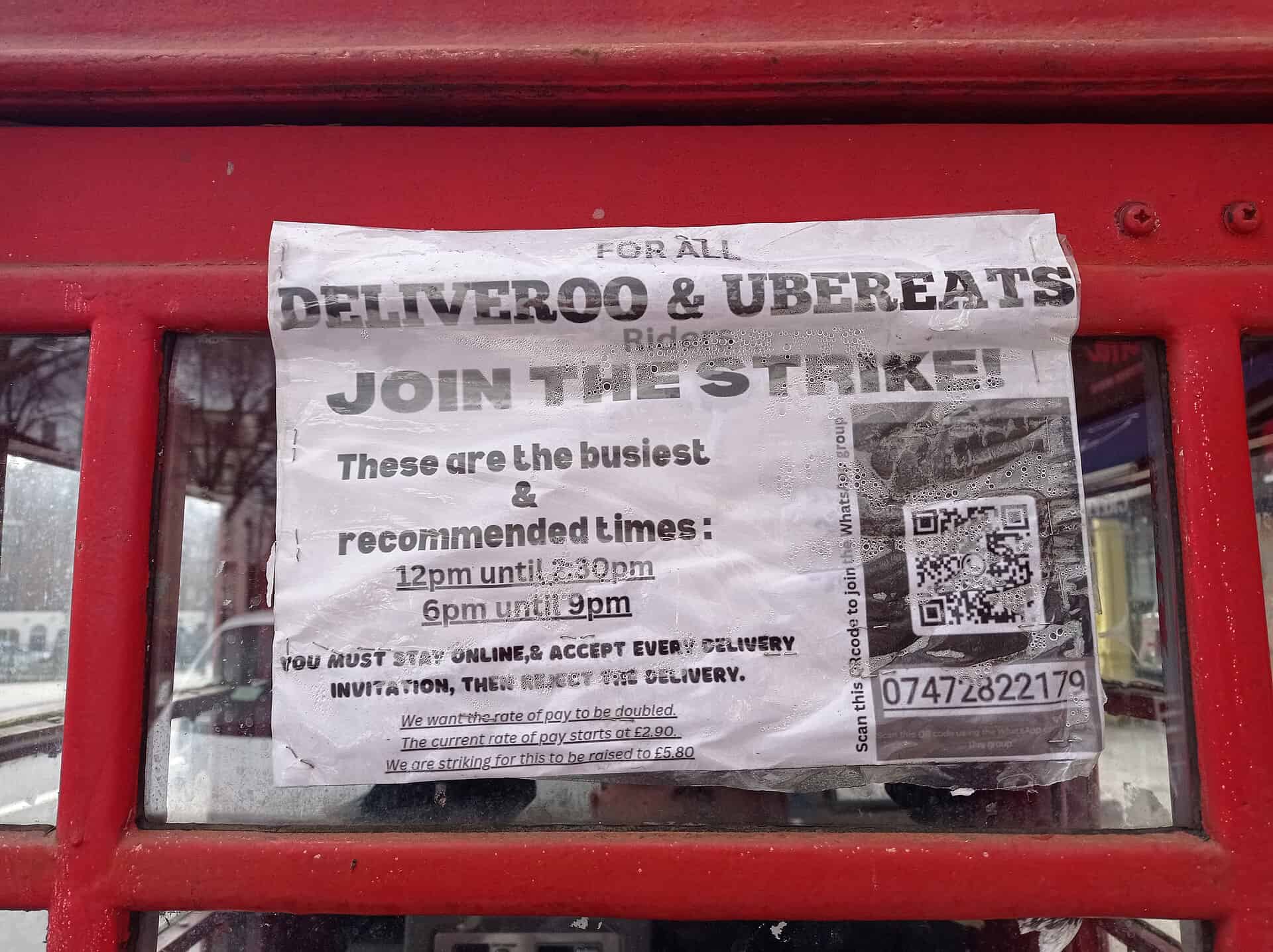
Service work is often solitary and mobile, and today it is mediated by digital devices and apps and involves no central workplace. Yet people are finding routes to common struggle that respond to these circumstances: sabotage, mutual aid, workers’ inquiries, info sharing about how to maximize time and safety, and more organized fights whose demands go beyond the hourly wage by some measure. Amazonians United, the Class Power on Zero-Hours project, and the efforts of hotel workers with UNITE HERE are among those that McClanahan mentions in the course of her work. That their tactics and priorities may deviate from what characterized the labor movement of previous eras is only natural, and more of a feature than a bug.

Notice on Islington phone box - Join the Deliveroo & Uber Eats strike. Feb 2024. Photo Credit: Philafrenzy via Wikimedia
Notice on Islington phone box – Join the Deliveroo & Uber Eats strike. Feb 2024.
Photo Credit: Philafrenzy via Wikimedia

Service worker unions are, she writes, “dispensing with the productivist language of ‘fair wages.’” They are seeking rights and protections for workers with disabilities, for queer and trans workers, and for noncitizens, and this means that they are “beginning to center so-called noneconomic demands concerning housing, policing, borders, and the climate crisis.”15McClanahan, Beneath the Wage, 13. Even traditional union campaigns are fighting for things that exceed “the idea of compensation equivalent to productivity,” responding instead to skyrocketing costs of living and to the intensifying pressures of work that is insecure, technologically managed, and subject to deskilling and automation.16McClanahan, Beneath the Wage, 226.

When graduate students in the University of California system built their most recent strike around the demand for a cost of living adjustment (COLA), they explained that the University of California is one of the state’s largest landlords, affecting ground rents and housing costs throughout the region, for people well beyond the campus community. “COLA is a political demand, not simply a wage demand,” they wrote.17Zach Hicks and Rebecca Gross, “No COLA, No Contract: On the Ground at the UC Strike,” Brooklyn Rail (December–January 2022–2023), https://brooklynrail.org/2022/12/field-notes/No-COLA/. They fought not only for themselves but for people everywhere facing deteriorating working conditions and intensifying cost pressures. And they fought in a way that was unbounded by the pursuit of hourly wage gains, demanding rent relief, childcare subsidies, and for “cops off campus,” because good working conditions require the ability to cover all of one’s living costs and to arrive at work without the looming presence of a police force. Study of service work “reveals the domination, precarity, and exhaustion concealed beneath all waged work under capital,” McClanahan writes.18McClanahan, Beneath the Wage, 15. Service worker labor struggles thus have the potential to reach—with and for all of us—beyond the workplace and into the whole of society, manifesting the antagonism between capital and labor rather than trying to soothe or placate it.

SHARE

HELLO, COMRADE

While logged in, you may access all print issues.

If you’d like to log out, click here:

NEED TO UPDATE YOUR DETAILS?

Support our Work

Gift Subscriptions, Renewals, and More