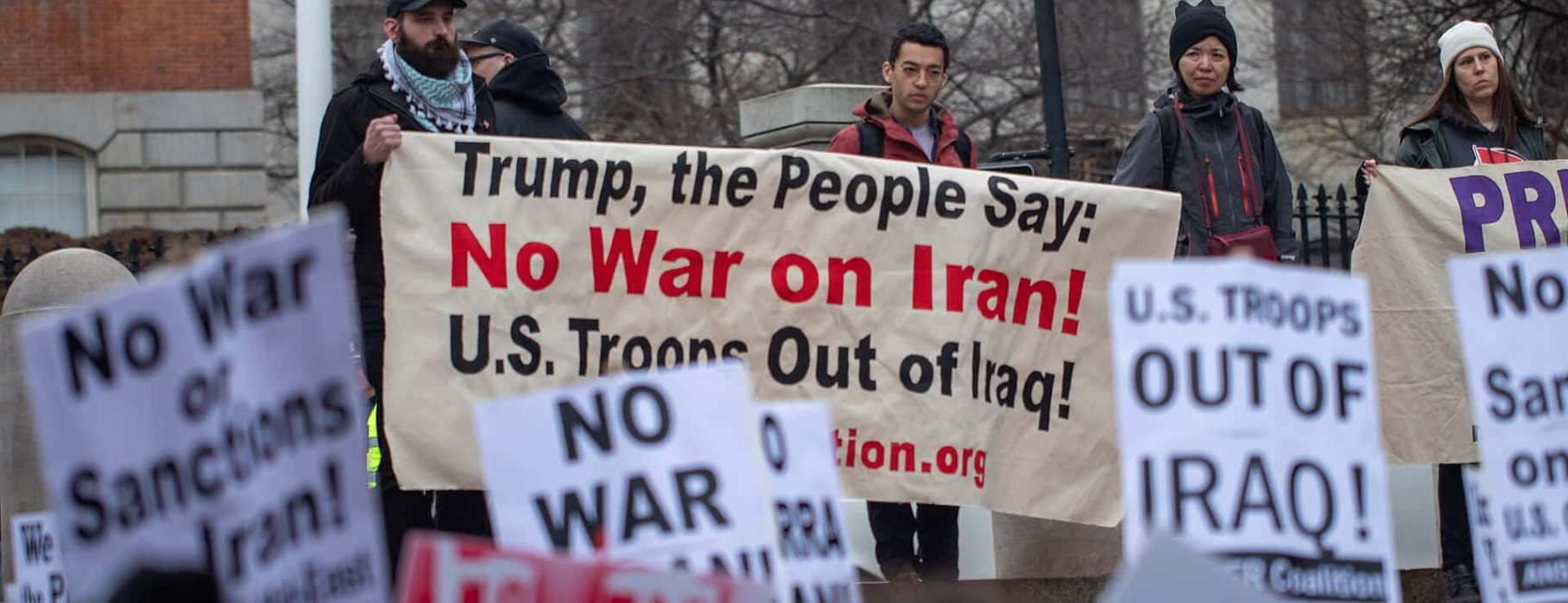
Who speaks for Iran?—and from where?
Geopolitics, Representation, and Solidarity
March 2, 2026
Prefatory Note (March 2026)
This article was completed several weeks before the ongoing US and Israeli military strikes on Iran, which began while nuclear negotiations between Iran and the United States were still underway. Shortly before the attacks, the Omani foreign minister—long a trusted intermediary—publicly indicated that talks had reached an advanced stage, with major concessions under discussion. Military action thus began not after the exhaustion of diplomacy, but in its midst. The strikes immediately widened the confrontation: within hours, Iran launched missiles toward US bases in Gulf Cooperation Council countries, carrying out retaliatory actions it had repeatedly warned would follow any direct attack.
The escalation did not remain confined to military installations but extended into densely inhabited urban centers. Coordinated US and Israeli aerial attacks struck Tehran, Isfahan, Shiraz, and several other cities, bringing the war directly into the civilian landscapes in which everyday life unfolds. Officials in Washington and Tel Aviv justified the operation in the language of “helping” the Iranian people even as bombs fell across major cities. Among the most widely mourned casualties are schoolgirls in the southern city of Minab, killed when a missile struck near their school. Their deaths exemplify a broader reality: wars described in military briefings as “targeted” or “precise” nonetheless unfold across inhabited environments where civilian life cannot be disentangled from the objects of military force. What doctrine names precision often appears, from the ground, as the conversion of civilian life into what is bureaucratically termed “collateral damage.”
The strikes culminated in the killing of Supreme Leader Ali Khamenei, senior commanders of the Islamic Revolutionary Guard Corps, and other central figures of the ruling apparatus. International media coverage shifted swiftly toward the spectacle of leadership decapitation and interstate war. Broadcasts showed mourning demonstrations organized by regime-aligned networks inside Iran alongside widely circulated images of diaspora gatherings abroad, where some participants danced and celebrated what they described as “the end of the dictator.” Between these poles, the heterogeneous civic mobilizations, labor struggles, and protest networks that had animated Iran’s political landscape in preceding months receded from view. War reordered the field of perception itself.
At the level of formal authority, the state moved quickly to project continuity. A provisional leadership council was formed, and senior officials reaffirmed institutional stability. Yet beyond these displays, the everyday management of society appears far more fragile. Reports indicate that in some facilities prison personnel abandoned their posts during bombardment, leaving detainees without reliable access to food, medical care, or communication, while disruptions to infrastructure, banking, and telecommunications have shifted attention inward, toward the immediate work of survival. Whatever its longer-term political consequences, war unmistakably narrows the conditions under which collective political life can be sustained. It reorganizes political time, compresses political horizons, and redirects attention from public mobilization to endurance.
The events unfolding alongside the publication of this article do not render its arguments obsolete; they reinforce them. Military aggression has clarified international lines of condemnation, allowing anti-imperialist actors who had struggled to articulate positions toward protests unfolding within an environment of domestic repression to speak with renewed certainty. Yet this clarity emerges precisely as war reshapes the terrain on which political life unfolds. Geopolitical intervention and domestic authoritarianism do not operate separately; they converge to reshape not only regimes, but the very conditions under which political voice, dissent, and collective agency can emerge—or be foreclosed.
Over the past decade, Iran has entered a new cycle of recurrent protest marked by increasingly frequent, geographically dispersed, and socially heterogeneous uprisings that reflect deepening economic crisis, political exclusion, and declining confidence in state institutions. What once appeared as localized unrest has taken on nationwide scope, bringing together workers, women, students, pensioners, and marginalized communities across Iran.1For an analysis of recent protest cycles in Iran, see Mohammad Ali Kadivar et al., “Contingency of Structures: Triggers and the Social Geography of Revolutionary Episodes in Iran, 2017–2022,” preprint, submitted November 29, 2025, https://doi.org/10.31235/osf.io/2y478_v1. A new round of mobilization coalesced in late 2025 amid intensifying inflation, austerity, and the aftershocks of the twelve-day war between Israel and Iran in June 2025.2For a discussion of the June 2025 war and its political implications, see Arash Davari and Nazanin Shahrokni, “Reflections on the June 2025 War (Dossier Introduction): Of Crisis and the Search for Political Grammar in Iran,” Jadaliyya, September 11, 2025, https://www.jadaliyya.com/Details/46892/Reflections-on-the-June-2025-War-Dossier-Introduction-Of-Crisis-and-the-Search-for-Political-Grammar-in-Iran. Protest activity escalated sharply on January 8 and 9, 2026, following a widely publicized appeal issued from exile by Reza Pahlavi, the son of Iran’s last monarch. Pahlavi has increasingly been elevated in international media and policy circles as a recognizable face of opposition and as part of broader efforts within diaspora and Western political arenas to consolidate a legible alternative to the Islamic Republic.3See Alex Shams, “Our Man for Tehran,” Boston Review, August 6, 2025, https://www.bostonreview.net/articles/our-man-for-tehran/. His appeal circulated alongside calls for demonstrations emerging from labor networks, student groups, and online activist channels as protests spread across multiple cities. State authorities responded with mass arrests, deploying lethal force against demonstrators, and imposing sweeping shutdowns of communication networks to contain dissent and obscure its visibility.
These events have unfolded within a narrowing political horizon shaped by two mutually reinforcing dynamics. Across opposition spaces, some actors have renewed calls for external intervention—invoking humanitarian rescue, intensified sanctions, or military pressure as instruments of political transformation.4Nasrin Sotoudeh, “The World Must Uphold International Law in Iran,” IranWire, January 30, 2026, https://iranwire.com/en/features/148406-nasrin-sotoudeh-the-world-must-uphold-international-law-in-iran/. The state, in turn, has seized upon both the existence of such calls and their public circulation to portray dissent as externally orchestrated, thereby justifying expanded surveillance and intensified authoritarian governance in the name of national sovereignty.
Between externalized visions of political change and the concomitant consolidation of coercive power by the state, democratic political possibility is increasingly compressed, as dissent is simultaneously delegitimized as foreign-driven and constrained through repression. Within this constricted political field, the subject in whose name political action is claimed—“the people”—becomes increasingly indeterminate. Competing actors invoke “the people” to authorize incompatible political projects: interventionist actors frame external pressure as acting on behalf of a suffering population, while the state claims to defend that same population against foreign threat and internal disorder. In both cases, “the people” appears less as a collective political actor than an object of representation invoked by international, state, and opposition actors to legitimize competing claims to authority even as ordinary people’s capacity for political participation is constrained through repression, economic precarity, and institutional closure.
Yet the people invoked in discourse remain present in practice. Inside Iran, intermittent demonstrations have continued, including renewed mobilization by university students following the reopening of campuses and commemorations marking the fortieth day after those killed—a deeply resonant temporal marker in Iranian political and religious life that has historically sustained protest cycles.5See Shahrokni and Sofos’s “Students in Tehran Protest Gender Segregration,” which illustrates how university campuses have repeatedly functioned as critical sites of political confrontation between students and state-aligned security actors. Nazanin Shahrokni and Spyros A. Sofos, “Students in Tehran Protest Gender Segregation in University Dining Hall,” Truthout, October 28, 2022, https://truthout.org/articles/students-in-tehran-protest-gender-segregation-in-university-dining-hall/.
Outside Iran political mobilization has unfolded under very different conditions, shaped less by the threat of immediate repression than by unequal access to the channels through which political claims gain visibility and influence. Demonstrations within diaspora communities reflect these asymmetries, as media access and institutional proximity determine whose narratives circulate. Monarchist formations and their allies have increasingly occupied this visible terrain, framing Iran’s crisis through the horizon of regime overthrow and geopolitical realignment while sidelining leftist, reformist, antiwar, and nonmonarchist opposition. The presence of Israeli and US flags alongside opposition imagery in some diaspora demonstrations has symbolically signaled alignment with Western geopolitical agendas, recasting Iran less as a site of internally rooted democratic struggle than as an object of strategic confrontation.6See Keshavarzian and Stewart’s analysis of the emergence of Iranian far-right currents, including monarchist revivalism and their alignment with external geopolitical actors and nationalist imaginaries. Hoornaz Keshavarzian and Nicole K. Stewart, “Make Iran Great Again: Apolitical Influencers and the Revival of a Romantic Patriarchal Nationalism,” Communication, Culture & Critique 18, no. 2 (2025): 164–75, https://doi.org/10.1093/ccc/tcaf005. As dissent inside Iran faces escalating repression, its external articulation is mediated through unequal transnational infrastructures. This mediation intensifies longstanding struggles over who speaks for Iran, whose voices circulate, and how political claims are reshaped as they move across global arenas.
These processes of selection and reframing do not operate only within mainstream media and policy circles; they also extend into progressive publics—antiwar and anti-imperialist networks, feminist collectives, scholarly communities, and diaspora activist circles— through which Iran is debated, interpreted, and acted upon. Collaborations forged in opposition to militarization, imperial intervention, authoritarian governance, and global inequality within these spaces have come under strain. Actors who once shared political ground now find themselves divided over how Iran should be understood, whose suffering should be foregrounded, and what constitutes responsible political alignment. These disagreements reflect not merely divergent political preferences but competing diagnoses of power itself—whether political urgency lies in confronting authoritarian repression within Iran or resisting external geopolitical domination, and how solidarity and political action should proceed when both forms of coercion remain simultaneously present.
This article examines how these divisions shape how solidarities are imagined and enacted across borders. It traces how sanctions, militarization, and authoritarian governance structure political life; how claims to represent “the Iranian people” flatten a differentiated social field; and how debate itself narrows under conditions of repression and geopolitical polarization. In doing so, it asks what solidarity can mean when imperial power and domestic authoritarianism operate simultaneously—and what forms of political relation remain possible when solidarity itself becomes a contested terrain.
Where We Speak From
If solidarity itself has become contested terrain, this is not only because conditions inside Iran have intensified, but because the interpretation of those conditions unfolds across unequal geopolitical fields. Calls to center the voices of Iranian protesters—often invoked as a moral imperative in moments of solidarity—do not arise in a vacuum. They are articulated within specific institutional and geopolitical locations that shape those voices’ reception and the political work they perform. The task, therefore, is to examine the infrastructures through which these voices circulate and how representation reconfigures political meaning once testimony travels beyond the conditions that produced it.
A veil burned in Tehran was a cry against state coercion—a fire aimed upward at power. A veil burned in the Dutch parliament in the name of solidarity with Iranian women protesters became a spectacle of state authority—a fire aimed downward at Muslim women. The same object, the same flame, but radically different political trajectories. These contrasting trajectories reveal a broader structure: meaning does not inhere in political acts themselves but is produced through the pathways of their circulation across distinct geopolitical fields shaped by different actors, institutional logics, and audiences.
Debates over how to interpret and represent Iranian protest, whose voices should be foregrounded, and what forms of solidarity are politically and ethically warranted circulate across multiple arenas, including academic, media, and policy environments in North American and European institutions. Acknowledging this location does not diminish the ethical commitments that animate such engagements; rather, it situates them within the geopolitical fields that shape them.
Once Iranian protest voices move beyond Iran, they enter infrastructures of knowledge that are anything but neutral: journals, social media platforms, newsrooms, funding regimes, activist networks, and policy forums embedded in global hierarchies of power. These institutional environments are sculpted by imperial histories, racialized security logics, and geopolitical confrontation. Institutional and geopolitical location shapes how testimony is translated into action—often in ways that detach it from the political conditions of its emergence and repurpose it within agendas that may constrain, redirect, or undermine the struggles from which it arose. The question, then, is not whether to support protest movements or amplify their voices, but how to do so without allowing that support to be translated into forms of power that work against them or against others in their name.
This dynamic becomes visible when we follow how particular stories travel across transnational circuits. The case of Sahar Khodayari (“Blue Girl”), who set herself on fire in 2019 after facing prosecution for attempting to enter a soccer stadium during Iran’s ban on women spectators, quickly became a global symbol of gender repression and provoked widespread outrage.7For an analysis of the transnational circulation and political afterlives of Khodayari’s death, see Nazanin Shahrokni and Spyros A. Sofos, “Mobilizing Pity: The Dialectics of Narrative Production and Erasure in the Case of Iran’s #BlueGirl,” Globalizations 19, no. 2 (2022): 205–19, https://doi.org/10.1080/14747731.2020.1864963. Yet it also transformed her into a highly portable political icon. As her image circulated, it was taken up by international media, human rights organizations, FIFA, diaspora activists, and eventually even the Iranian state itself—each mobilizing her story toward distinct political ends. In the process, a complex and sustained feminist struggle over access to public space and bodily autonomy was condensed into a singular narrative of victimhood, foregrounding individual suffering while obscuring decades of organizing by Iranian women who had challenged gender segregation in stadiums through protest, advocacy, and everyday acts of defiance. Stories do not simply travel; they are reorganized as they move through transnational infrastructures structured by unequal power.
The same processes of translation and appropriation work on images. During Iran’s Woman, Life, Freedom uprising in 2022, the removal and burning of the veil became a powerful symbol of refusal.8For a concise analysis of the Woman, Life, Freedom uprising and its implications for feminist solidarity, see Nazanin Shahrokni, “In Her Name: (Re)Imagining Feminist Solidarities in the Aftermath of the Iran Protests,” Feminist Studies 48, no. 3 (2022): 896–901, https://doi.org/10.1353/fem.2022.0065. In Iran, where veiling is compulsory, unveiled bodies appeared as a visual register of defiance, condensing demands for dignity, freedom, and bodily autonomy. Yet once those same images circulated in Europe and North America, they acquired different political functions. They were appropriated by far-right actors and folded into Islamophobic narratives targeting Muslim women broadly. A veil burned in Tehran was a cry against state coercion—a fire aimed upward at power. A veil burned in the Dutch parliament in the name of solidarity with Iranian women protesters became a spectacle of state authority—a fire aimed downward at Muslim women. The same object, the same flame, but radically different political trajectories. These contrasting trajectories reveal a broader structure: meaning does not inhere in political acts themselves but is produced through the pathways of their circulation across distinct geopolitical fields shaped by different actors, institutional logics, and audiences.
These dynamics of circulation shape interpretation itself. Across scholarly, activist, and public debates, political struggles in Iran are often approached through two dominant but analytically reductive interpretive tendencies, each animated by a concern with domination, violence, and justice. One, an anti-imperialist caution, foregrounds the risk that images and narratives of revolt will be appropriated to justify Western intervention, racialized securitization, or Islamophobic governance. This concern is real and urgent. Yet when it becomes the tacit limit of interpretation, a paradox emerges: the very imperial power being resisted comes to define the boundaries of what can be said. Acts of refusal appear legible primarily in relation to their possible geopolitical misuse, while the coercive conditions they confront domestically recede from view.
A countervailing tendency—an anti-authoritarian urgency—insists that the risk of imperial appropriation cannot function as a veto on confronting state violence. From this perspective, subordinating protest to its potential afterlives abroad recenters external anxieties and displaces the immediacy of repression. While understandable, this position can harden into closure when concerns about circulation and Islamophobic appropriation are dismissed as secondary or irrelevant—treating the harms enabled elsewhere as external to one’s responsibility. To take solidarity seriously, however, is to recognize that it entails responsibility for downstream effects, not just intention.
Rather than choosing between these axes, the task is to develop a language capable of holding their entanglement in view—to name both state and imperial violence, internal repression and external coercion, without allowing either to disappear from analysis. Such a language must remain grounded in the institutional, economic, and coercive arrangements through which these forces are enacted and experienced.
What remains insufficiently examined, however, are the material forces through which imperial pressure and authoritarian rule become articulated in everyday political life—through sanctions, militarization, and the reorganization of state power that together shape the terrain on which political struggle unfolds.
Against the Fiction of a Domestic Sphere
The forces shaping political life in Iran do not operate within a bounded domestic sphere. External coercion and authoritarian governance are not separate domains but mutually constitutive processes that reshape state power, economic life, and the conditions under which protest emerges. Treating them as analytically separable risks reproducing what social scientists have long critiqued as methodological nationalism—the assumption that the nation-state forms the natural container of explanation—even when political authority, economic constraint, and coercive power are produced through transnational circuits. Understanding the present therefore requires tracing how sanctions, militarization, and geopolitical confrontation reorganize governance from within, narrowing political horizons while strengthening the apparatus through which dissent is governed. Sanctions are among the clearest sites at which this entanglement becomes visible. In both political discourse and everyday survival, they have become a kind of shibboleth—invoked to signal alignment, assign responsibility, and delimit the terms through which Iranian suffering is interpreted and acted upon.
Sanctions regimes have been neither episodic nor marginal in Iran. US economic restrictions began in the late 1970s after the revolution and the hostage crisis, intensified intermittently through the 1990s and 2000s, and became far more comprehensive after 2010 in response to Iran’s nuclear program. The Trump administration’s 2018 withdrawal from the Joint Comprehensive Plan of Action (JCPOA)—the multilateral nuclear agreement signed in 2015 between Iran, the United States, and other world powers—reimposed and dramatically expanded secondary sanctions targeting Iran’s oil exports, banking system, and access to global finance. What has taken shape over more than a decade is thus not a temporary penalty but a prolonged regime of economic isolation that conditions state capacity, political calculation, and the texture of everyday life.9For a detailed account of the mechanisms and social effects of economic warfare, see Narges Bajoghli, Vali Nasr, Djavad Salehi-Isfahani, and Ali Vaez, How Sanctions Work: Iran and the Impact of Economic Warfare (Stanford: Stanford University Press, 2024).
Recognizing the structural force of sanctions does not absolve the Islamic Republic of responsibility. The state has repeatedly instrumentalized sanctions to deflect accountability for corruption, mismanagement, and repression, framing hardship as an externally imposed necessity while consolidating opaque systems of economic control. The analytic task, therefore, is not to adjudicate whether sanctions or the state are to blame, but to understand sanctions as a technology of power designed to generate social pressure and reorganize political-economic relations within society—one that operates through, and is in turn mediated by, authoritarian governance. This requires suspending the reflex that turns “sanctions” into a slogan and instead tracing how external coercion and state power become articulated in practice, coproducing the conditions of social injury rather than operating as competing causes.
Sanctions do not merely impoverish society from outside; they reshape governance within. As revenue contracts and economic channels narrow, austerity becomes entrenched, securitization normalized, and coercive discipline more readily deployed.
I approach sanctions through a broader concern with the conditions of collective life—not the sanctification of a nation or state, but the fragile infrastructures that make living together possible: shared resources, social ties, public institutions, and the everyday capacities through which people care for one another and imagine a future in common. Both sanctions and authoritarian rule have steadily corroded these conditions.10Shahrokni’s “Deleted Households” examines how sanctions are absorbed and managed at the household level, reshaping social reproduction, care, and everyday survival strategies. Nazanin Shahrokni, “Depleted Households: ‘Domesticating’ Economic Sanctions,” Humanity: An International Journal of Human Rights, Humanitarianism, and Development 14, no. 2 (2023): 293–308, https://doi.org/10.1353/hum.2023.a917002. Rather than choosing between them, we must trace how they operate in concert and in tension.
US policymakers have long described sanctions as an “effective” tool of economic statecraft because they are designed to constrict revenue, induce hardship, and generate social pressure on governing elites through the population. Sanctions are a deliberate project of social compression in which households are squeezed, livelihoods destabilized, and the everyday capacities that sustain collective life—employment, care, exchange, and trust—are progressively degraded.
The interaction between sanctions and domestic austerity was most visible during the Aban 98 protests in November 2019. Facing acute fiscal strain after intensified sanctions following the US withdrawal from the JCPOA, the government abruptly removed long-standing fuel subsidies, framing the move as economic necessity. Gasoline prices tripled or quadrupled overnight, triggering nationwide protests that were met with a violent crackdown, mass arrests, and a near total Internet shutdown. Within days, security forces had killed large numbers of protesters. Aban 98 revealed how external economic coercion and domestic governance converged: sanctions narrowed revenue and policy space, but it was the state’s decision to impose abrupt austerity and repress dissent that turned fiscal strain into lethal confrontation.
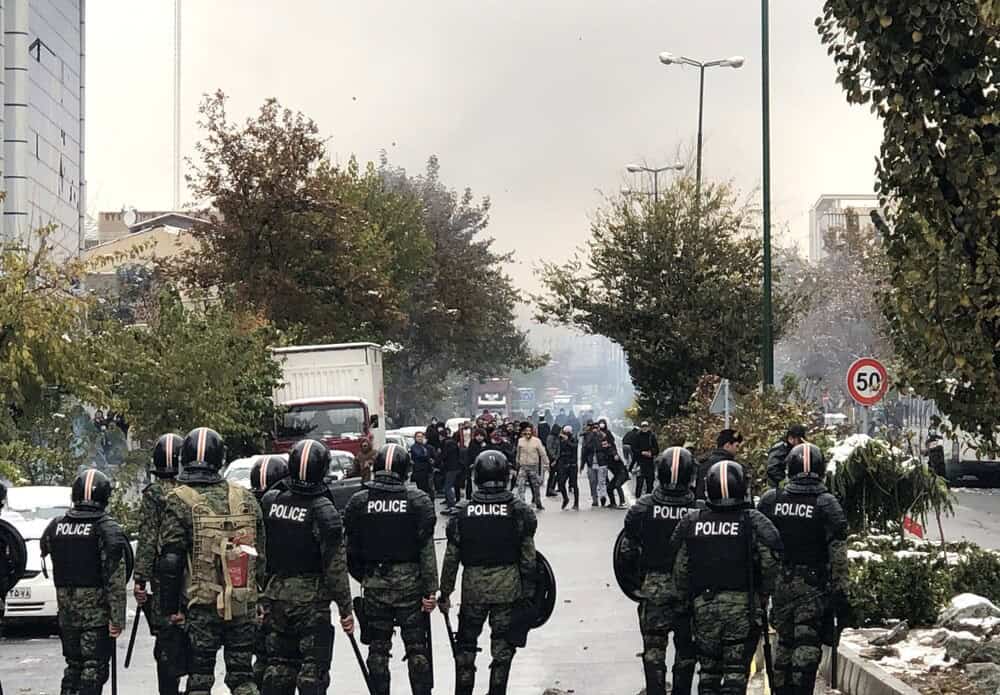
Photo Credit: Alireza Vahabzadeh via Wikimedia
These pressures extend beyond economic policy to the restructuring of state power itself. Sanctions have reshaped the institutional architecture of rule, accelerating the rise of security-linked institutions centered in and around the Islamic Revolutionary Guard Corps (IRGC). Financial isolation, restrictions on international transfers, and the securitization of economic life have funneled resources toward militarized economic circuits operating beyond public scrutiny, consolidating the IRGC as a fused military–economic complex of state and capital.11 See Kayhan Valadbaygi, “Neoliberalism and state formation in Iran,” Globalizations (2022): 1-15; Also see Valadbaygi’s “Beyond the IRGC,” documenting how sanctions, war mobilization, and postwar reconstruction enabled the IRGC to develop a vast network of companies, infrastructure projects, and patronage systems, consolidating its position as a major military–economic actor embedded across construction, energy, and strategic industries. Kayhan Valadbaygi, “Beyond the IRGC: The rise of Iran’s military-bonyad complex,” Clingendael, October 2, 2025, https://www.clingendael.org/publication/beyond-irgc-rise-irans-military-bonyad-complex. Over the past two decades, their authority has come to rest on mutually reinforcing foundations: battlefield experience in regional wars; command over transnational military and political networks; and control over strategic industries, infrastructure, and informal trade routes. Iranian authorities have invoked sanctions to deflect responsibility for economic hardship and justify austerity, yet sanctions regimes have simultaneously strengthened the coercive apparatus—narrowing economic horizons while expanding the institutional reach of security actors.
This consolidation has unfolded through Iran’s regional engagements. Interventions in Syria, Iraq, and Lebanon have functioned not only as theaters of conflict but as infrastructures of rule—training grounds, career pathways, and economic networks that elevate security elites and extend their influence inward. These engagements have supported regime survival by widening strategic leverage and helping the state weather sustained external pressure. Yet they have also deepened inequality and resentment at home, entangling ordinary Iranians in conflicts they did not choose and embedding governance within enduring conditions of militarization.
These institutional shifts reorganize everyday life. A security-centered state privileges surveillance, policing, and emergency authority while channeling resources toward military and quasimilitary bodies at the expense of social provision and labor protection. The result is a political economy in which coercive capacity expands alongside economic precarity, and ordinary life unfolds under conditions shaped by the interaction of geopolitical confrontation and domestic rule.
Understanding this reorganization requires looking beyond state institutions to the slower pressures of daily existence. Sanctions permeate everyday life: they shape access to banking, credit cards, online services, remittances, software, books, and medical supplies. These constraints reorganize social reproduction. In doing so, sanctions generate social compression: shrinking household margins, tightening time horizons, and deepening reliance on informal and securitized economic circuits.12 Farzanegan and Habibi’s “The Effect of International Sanctions” analyzes how sanctions contributed to the contraction and downward mobility of Iran’s middle class through declining real incomes, inflation, and labor market disruption. Mohammad Reza Farzanegan and Nader Habibi, “The Effect of International Sanctions on the Size of the Middle Class in Iran,” European Journal of Political Economy 90 (2025): 102749, https://doi.org/10.1016/j.ejpoleco.2025.102749. The possibilities of protest, endurance, withdrawal, or emigration are conditioned by this compression. Collective action is not extinguished, but reshaped: its duration shortens, risks intensify, infrastructures thin, and for some, exit begins to rival voice as a political horizon.
This compression unsettles the simple opposition between “sanctions versus the state.” Sanctions do not merely impoverish society from outside; they reshape governance within. As revenue contracts and economic channels narrow, austerity becomes entrenched, securitization normalized, and coercive discipline more readily deployed. Ordinary people absorb the cumulative costs of both external pressure and internal policy choice.
It is within this geopolitically compressed landscape that protest acquires its particular form—not only in its targets, but in its language. Demonstrations, strike demands, and slogans register structural conditions. When the chant “No to Gaza, no to Lebanon—my life for Iran” resurfaces, it condenses how regional militarization and geopolitical confrontation intrude into everyday life even when protest is directed at domestic repression. At the level of lived experience, these forces do not appear as separate domains; they converge in the organization of everyday life, and protest speech emerges from within that convergence.
This entanglement can generate a zero-sum perception in which the suffering of different populations appears to compete for recognition and resources, even when their subjection is structured by overlapping systems of power. Liberation comes to be imagined as subtraction rather than relation—as if justice for one necessarily requires abandonment of another. The slogan does not simply express hostility outward; it registers how geopolitical confrontation is lived domestically through redistribution, scarcity, and constraint.
For observers outside Iran, the chant has become an interpretive flashpoint. Interpretations often gravitate toward opposing poles. One response amplifies the slogan as transparent evidence of regime opposition, circulating it to underscore state illegitimacy while overlooking the geopolitical and economic conditions that render it intelligible. Another dismisses it outright as nationalist or reactionary, condemning it in the name of anti-imperialism or solidarity with Palestine without examining the domestic structures from which it arises. The first collapses structure into voice; the second collapses voice into moral judgment. Both detach protest language from the material field that produces it.
A more adequate analysis takes these expressions seriously enough to ask what conditions produce them. It recognizes protest speech as diagnostic: an effort to name how multiple forms of power converge. Analyses confined to a single axis risk misrecognizing both the sources of state power and the uneven constraints within which people act.
Yet these conditions do not produce a singular collective, or a unified political subject. Responsibility, vulnerability, and loss are distributed unevenly—and the category most often invoked to smooth over that unevenness is “the Iranian people.” This category, invoked to assign responsibility, justify intervention, or demand solidarity, can obscure the differentiated social terrain on whose behalf it claims to speak. The question that follows, therefore, is who is contained within the figure of “the Iranian people,” and how their unequal positions within this entangled field of power shape the meanings of protest, suffering, and political possibility.
Who Are “the Iranian People”?
The slogan discussed above already points to the uneven social terrain from which protest emerges. When protesters invoke “my life for Iran,” they speak from distinct locations within a field structured by sanctions, austerity, and coercive governance. The grievances condensed in protest language—falling wages, subsidy cuts, blocked mobility, foreclosed futures, and the risks of repression—do not fall evenly across society. Yet the phrase “the Iranian people,” so frequently invoked in policy and solidarity claims, compresses these unequal exposures into a singular political figure. What appears in political rhetoric as a unified national voice is, in practice, a socially differentiated field shaped by unequal access to protection, mobility, and security and oriented toward divergent stakes in the Iranian regime.
Accounts grounded in sustained engagement with interlocutors in Iran make visible how these divisions are navigated in practice. At one pole are those whose biographies remain tethered to institutions of the Islamic Republic. As discussed in the previous section, sustained geopolitical confrontation and sanctions did not merely constrain the state; they contributed to the consolidation of its security apparatus, elevating new cadres and strengthening institutions linked to the IRGC and allied networks. This consolidation has not operated only at the level of elite power, but has also broadened the regime’s social base through patronage and incorporation that bind segments of society to its institutional infrastructure. The expansion of security and parastate networks—particularly those linked to the Basij, a mass volunteer militia formally affiliated with the IRGC but functionally a gateway to material and symbolic capital—has drawn segments of economically marginalized youth into its orbit. For many, affiliation follows prolonged exclusion from formal labor markets and mobility pathways. Membership offers access to employment channels, educational opportunities, housing benefits, and communal networks organized through mosques and neighborhood institutions. In such cases, regime survival becomes intertwined with personal stability and identity, and political loyalty is sustained through both ideology and incorporation into circuits of protection, provision, and advancement within a securitized political economy.
Fragmentation persists within oppositional constituencies. Pluralist and democratic aspirations coexist uneasily with monarchist narratives that privilege a singular vision of national redemption centered on Reza Pahlavi, the exiled former crown prince. For some, particularly within diaspora media ecosystems and younger generations with no lived memory of the monarchy, the Pahlavi era is reframed less through its documented authoritarianism—including the pervasive surveillance by the SAVAK secret police, suppression of political dissent, and widening inequality during rapid modernization—than through a selective nostalgia emphasizing geopolitical alignment, secular nationalism, and economic stability. Its appeal lies not only in dynastic continuity but in the promise of reintegration into global circuits of mobility and legitimacy: a search for legibility and direction amid protracted uncertainty, a wager on rupture as redemption. In this vision, political transformation is often imagined as contingent upon external force. Calls for intensified sanctions, military strikes against state institutions, or international intervention framed through the language of humanitarian rescue circulate alongside appeals to foreign governments to recognize alternative leadership in exile. Sovereignty, in this framing, appears less as a constraint than as an obstacle to liberation, and geopolitical confrontation becomes the mechanism through which national renewal is imagined.
When a particular framing is treated as synonymous with “Iranian voices,” a part quietly stands in for the whole. We may choose to foreground specific voices, but that choice should be explicit.…Anything else turns selective representation into unacknowledged synecdoche, allowing the speaker’s political commitments to appear as neutral representation rather than situated intervention.
By contrast, the reformist cohort, shaped by the political openings and closures of the late 1990s and early 2000s, remains invested in institutional continuity, wagering on incremental transformation rather than rupture. Reformist intellectuals, civil society figures, student activists, and segments of the diaspora continue to advocate for negotiated change, constitutional reform, and national reconciliation, urging state authorities to heed popular demands while warning against the consequences of war or external intervention. Public statements issued by political prisoners, women’s rights advocates, and former reformist officials have repeatedly condemned both domestic repression and foreign military escalation, insisting that geopolitical confrontation strengthens security institutions and narrows the space for civic life. For many in this position, the imperative is to preserve political dialogue, however constrained, rather than risk its complete foreclosure through war or regime collapse imposed from outside.
A different cluster is shaped more directly through encounters with repression and loss. Their political consciousness is formed through lived experience of state violence across successive decades rather than abstract ideological alignment. This includes survivors and families of those executed during the mass prison purges of the 1980s, in which thousands of leftists and political dissidents were systematically killed; members of the Baháʼí community subjected to continuous surveillance, exclusion, and imprisonment; and the families of protesters detained, maimed, or executed in more recent waves of unrest—from the student uprisings of 1999 to the Green Movement of 2009; the Aban protests of 2019; the Woman, Life, Freedom uprising of 2022; and now the recent protests. For them, the state is not an abstract political structure but an enduring source of personal rupture and irreparable harm. Political horizons orient toward accountability, justice, and recognition and are organized around the demand that those responsible for violence be named and held answerable. In this position, the possibility of reconciliation without reckoning appears untenable, and regime continuity becomes incompatible with dignity and memory.
Between and beyond these poles lies a wide and shifting terrain shaped less by explicit ideological commitment than by the pursuit of livable futures. Some are animated by the erosion of social freedoms—seeking to inhabit public space without surveillance, censorship, or moral policing. These aspirations found powerful articulation in the song “Baraye,” whose litany of ordinary desires—for women to sing, for children to play, for streets free of fear—captured the diffuse longing for an ordinary life beyond the reach of constant supervision and constraint.13Shervin Hajipour’s “Baraye,” built from protesters’ statements and later earning a Grammy for Social Change, became a defining anthem of the Woman, Life, Freedom uprising and its global circulation. Teresa Nowakowski, “Iranian Protest Anthem That Led to Singer’s Arrest Wins a Grammy,” Smithsonian Magazine, February 7, 2023, https://www.smithsonianmag.com/smart-news/iranian-protest-anthem-that-led-to-singers-arrest-becomes-first-song-to-win-grammy-for-social-change-180981594/ Others are driven primarily by economic compression: inflation, subsidy removal, unpaid wages, and shrinking purchasing power. Elsewhere, grievances stem from ethnic and regional marginalization, where demands for recognition and equitable development intersect with histories of securitization and uneven governance. Still, for many, the dominant horizon is neither confrontation nor reform, but exit, as migration becomes a strategy of survival in response to futures perceived as foreclosed within the nation’s borders.
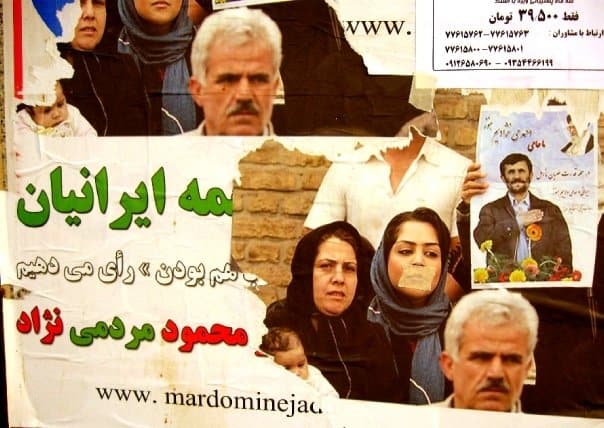
What cuts across these positions is not a shared political program but a shared affect: pervasive disillusionment with the Islamic Republic and fatigue with its everyday practices of rule. The prevailing mood is a brittle mix of cynicism toward authority, resentment with an increasingly unlivable status quo, and collective exhaustion. Yet this shared affect does not produce convergence; it refracts into divergent political projections, coping strategies, and calculations of risk.
The task, therefore, is not to reconcile difference into artificial unity, but to recognize how uneven experiences of coercion, patronage, exclusion, and loss shape the terrain within which any claim to speak “for the people” must be situated. The difficulty arises when one segment of society or one register of suffering is elevated as if it exhausted the collective. When a particular framing is treated as synonymous with “Iranian voices,” a part quietly stands in for the whole. We may choose to foreground specific voices, but that choice should be explicit: these are the voices we amplify, not the voice of the Iranian people. Anything else turns selective representation into unacknowledged synecdoche, allowing the speaker’s political commitments to appear as neutral representation rather than situated intervention. This is where the instability of solidarity claims becomes most visible: appeals to act in the name of “the Iranian people”—whether to justify intervention, advocate reform, condemn repression, or demand restraint—necessarily privilege certain experiences, constituencies, and imagined futures over others. Solidarity, in this sense, does not attach to a singular subject but moves across a fractured social field, where different groups confront distinct exposures to violence, protection, and abandonment. Only by remaining attentive to differentiation can we avoid speaking over Iranians while claiming to speak for them.
In Defense of Debate
If the preceding section showed that “the Iranian people” is a socially differentiated field—unevenly exposed to repression, economic precarity, institutional incorporation, and geopolitical pressure—then disagreement is not an aberration but an expected condition of political life. Divergent exposures produce divergent diagnoses, priorities, and political horizons. Yet once plurality is acknowledged, a second question emerges: how are disagreements within that landscape to be handled? If representation cannot presume unity, then neither can debate presume unanimity. The struggle over who speaks for “the people” quickly becomes a struggle over who defines the terms of legitimate inquiry—what qualifies as responsible narration, what is framed as normalizing violence, what is upheld as solidarity, and what is cast as betrayal.
What has become increasingly apparent in recent months is not simply disagreement about Iran, but a contraction of the conditions under which disagreement can be sustained. In moments of episodic violence—now both more frequent and more lethal, and unfolding under the persistent shadow of regional war—the pressure to take a clear position intensifies. That pressure circulates through petitions, open letters, institutional statements, teach-ins, and calls to action that crystallize around particular framings. These forms are often necessary interventions. Yet they tend to reward coherence and declarative clarity rather than methodological hesitation.
This dynamic does not remain external to scholarly life. It enters academic spaces through the infrastructures that mediate public debate. The cadence of digital platforms privileges declarative clarity over analytic uncertainty. Under such conditions, qualification is recast as equivocation, uncertainty becomes suspect, and methodological caution is read as moral distance. Analytic emphasis itself can be transformed into a loyalty signal, as though the framing one privileges were a declaration of allegiance rather than an intellectual judgment. The space for sustained reasoning narrows—not because disagreement disappears, but because the terms under which disagreement is permitted become increasingly rigid.
This contraction matters precisely because, as earlier sections have shown, the conditions shaping Iranian life emerge from the entanglement of geopolitical pressure and authoritarian governance. When inquiry narrows, that entanglement risks being flattened into singular explanations, moral binaries, or politically expedient narratives. Two examples—distinct yet structurally related—illustrate this point. The first concerns the narration of life under repression. Documenting those killed, wounded, detained, and disappeared remains indispensable. Naming victims resists erasure, counters desensitization, and challenges the bureaucratic reduction of violence to numbers. Yet an exclusive focus on spectacular rupture can eclipse other registers through which violence is lived.
Repression is not only evental; it structures labor, schooling, housing, consumption, and mobility. To document ordinary practices is not to dilute violence but to show how it saturates the material texture of existence. When analysis privileges only dramatic rupture—the viral image, the mass arrest, the body in the street—it narrows our understanding of how violence operates. Violence also shapes the quieter conditions under which resistance, retreat, calculation, and care take form. Attending to voices on the ground requires documenting not only defiance but also the material circumstances within which it is sustained, exhausted, or recalibrated.
In this context, attention to ordinary routines is sometimes said to risk normalizing repression, as though everyday life and violence were mutually exclusive. Yet for many Iranians, these domains are not separable. People continue working, shopping, repairing their homes, caring for elderly parents, queuing at banks or pharmacies, sending remittances, going to school, renewing documents, and marking birthdays not because life is normal, but because life persists in the midst of coercion. These acts unfold alongside securitized streets and checkpoints; in proximity to funerals and arrests; amid Internet shutdowns, wage delays, and rising prices; and against the constant backdrop of regional escalation and diplomatic maneuvering. Ordinary life is not outside war and repression; it is lived through it.
Sustaining life often requires holding contradictory registers together. One interlocutor, a teacher in a lower middle-class Tehran neighborhood, described how a dinner gathering—divided on war, regime change, and leadership—deliberately avoided argument. Instead, discussion turned to practical calculations: stockpiling food in anticipation of war, converting savings into gold, navigating Internet disruptions, and joking about coded language used on phones. Such conversations are political but not spectacular. They are grounded in material and coercive conditions—wages, prices, surveillance, censorship, and kinship obligations—and in the need to continue living alongside profound disagreement. Documenting these negotiations shows how people live inside catastrophe, not only against it.
When we cannot direct power, our task is to render it legible. Defending debate, in this sense, is not a defense of abstraction but of collective thinking under pressure—and of the possibility of sustaining political relation across disagreement. It is from within this fractured interpretive landscape that the question of solidarity emerges—not as a moral reflex, but as a situated practice shaped by power, circulation, and responsibility.
A comparable contraction of inquiry becomes visible in a different register: the handling of casualty figures during the January 2026 protests. Verification was extraordinarily difficult amid systematic restrictions on information (including Internet shutdowns, criminalized reporting, and limited access for journalists and monitors). Official Iranian figures place the death toll at roughly three thousand, while independent monitoring groups and diaspora-based documentation initiatives report several thousand confirmed deaths, and some medical sources and officials cited in international reporting suggest totals reaching into the tens of thousands. These disparities reflect the profound uncertainty created by Internet shutdowns and restricted access to verification.14Michael Loria, “How many protesters have been killed in Iran?” USA Today, February 20, 2026, https://www.usatoday.com/story/news/world/2026/02/20/how-many-protesters-have-been-killed-in-iran/88784701007/; Kay Armin Serjoie, Roxana Saberi, and Fatameh Jamalpour, “Iran Protest Death Toll Could Top 30, 000, According to Local Officials,” TIME, January 25, 2026, https://time.com/7357635/more-than-30000-killed-in-iran-say-senior-officials/.
In such conditions, numerical ranges reflect not only available evidence, but methodological thresholds, institutional practices, and political investments in either rendering loss visible or obscuring it. Comparable epistemic dynamics have unfolded elsewhere. Casualty figures in Gaza have likewise been subject to prolonged dispute shaped by restricted access, the destruction of documentation infrastructures, and intense political contestation over verification. In both contexts, numbers do not merely measure loss; they become sites through which authority, recognition, and legitimacy are negotiated.
Within the Iranian case, disagreements over figures were further sharpened by the political considerations shaping competing analytic horizons. For some observers, elevated estimates became ethically imperative within a primarily domestic frame: insisting on higher numbers was seen as necessary to resist erasure by the state and to prevent violence from slipping into statistical minimization and unaccountability. In this view, methodological caution risked reproducing familiar patterns through which state violence becomes diluted or deferred.
For others, skepticism toward elevated figures emerged from a differently scaled concern centered on geopolitical circulation. Their caution reflected anxiety about how numbers travel: how casualty figures could be folded into warmaking agendas, and how Western media and policy institutions appeared at times unusually willing to publicize unverified high counts in Iran while exercising greater caution or delay when reporting Palestinian casualties—figures that themselves have historically undergone successive upward revision as access improved.15Commentators have noted how Western media and officials have frequently accepted opposition-produced Iranian death toll estimates while systematically questioning Palestinian casualty figures in Gaza, revealing how credibility is often shaped less by evidentiary certainty than by geopolitical alignment. Ahmad Ibsais, “Iran, Gaza and the politics of counting the dead,” Al-Jazeera, January 14, 2026; see also Kaveh Rostamkhani, “Appropriating the death count: Manufacturing consent for an attack on Iran,” Al-Jazeera, January 30, 2026, https://www.aljazeera.com/opinions/2026/1/31/appropriating-the-death-count-manufacturing-consent-for-an-attack-on-iran/. From this perspective, methodological scrutiny was understood as an effort to resist the instrumentalization of suffering within global information regimes.
Indeed, under conditions of repression and blackout no precise tally is possible; errors are likely in both directions. That uncertainty is not a reason to foreclose debate; it is precisely what makes sustained methodological discussion necessary. The point is not simply to settle a figure, but to ask what different uses of numbers do in the world. Yet instead of opening such space, the dispute hardened. Figures shifted from objects of inquiry to markers of political alignment.
Together with the pressures surrounding how repression is narrated, these disputes reveal a shared pattern: both narrative and quantification can harden into moral tests that compress complexity. In one case, the archive is flattened by privileging spectacular rupture; in the other, method itself is recoded as allegiance.
These epistemic disputes, however, unfold within a prior normative framework that should not be obscured by methodological disagreement: the question of state accountability. Disagreement over tallies does not absolve governing authorities of responsibility. Even if armed actors or “provocateurs” were present within crowds, as officials have repeatedly claimed, this does not displace accountability. The state retains a monopoly over coercive authority and bears the primary obligation to protect its population. Responsibility therefore extends beyond individual acts of violence to include failures of prevention, the escalation of force, and the broader political and material conditions that produced unrest in the first place. This is especially salient given the state’s longstanding justification for regional interventions encapsulated in the refrain “If we don’t fight there, we will fight here.” External warfare was framed as necessary to secure domestic stability; yet the same authorities that invoked distant battlefields to justify militarization have not protected their citizens from lethal protest violence or from the economic and political conditions that produced unrest. The claim that security required projection outward did not prevent insecurity at home. Responsibility for governance—and for the lives shaped and lost within its exercise—remains internal to the structures of rule.
Taken together, these disputes over narrative and number expose a deeper struggle over epistemic authority: who is counted, who is believed, and who defines what qualifies as responsible argument. Numbers, images, and testimonies do not speak on their own; they acquire meaning through interpretive frameworks that determine which sources are credible and which claims are dismissed. Authority, in this sense, is never fixed. It is constructed and contested across institutions, media systems, and political struggles and continually stabilized through repetition, citation, and institutional endorsement. Protest movements in Iran, like insurgent struggles elsewhere, therefore confront both regimes of governance and regimes of legibility. When scholarly and public spaces treat particular framings as beyond question—whether by privileging certain metrics, dismissing inconvenient evidence, or narrowing the range of acceptable interpretation—they risk reproducing the very closures they seek to critique. In doing so, they constrain the political and intellectual openings that protest itself attempts to create.
These stakes clarify both the limits and the necessity of scholarly intervention. Academic argument rarely moves the levers of state power directly; it does not command armies, impose sanctions, or legislate policy. Yet scholarship operates on a different, quieter terrain: it shapes the interpretive field within which those forces are understood, justified, or contested. The concepts scholars circulate, the comparisons they authorize, and the silences they maintain help structure the thinkable and the foreclosed. In moments of upheaval, this interpretive labor becomes especially consequential, not because it resolves political struggle, but because it helps determine how that struggle is narrated, remembered, and acted upon.
When we cannot direct power, our task is to render it legible. Defending debate, in this sense, is not a defense of abstraction but of collective thinking under pressure—and of the possibility of sustaining political relation across disagreement. It is from within this fractured interpretive landscape that the question of solidarity emerges—not as a moral reflex, but as a situated practice shaped by power, circulation, and responsibility.
Solidarity as Relation, Not Contract
The tensions traced in the preceding sections have not remained analytic. They have hardened into real political cleavages—both among Iranians working within progressive and antiwar milieus, and in their relations with wider transnational publics. Disagreements over authoritarian violence, geopolitical confrontation, and representation have reorganized relationships among people who had collaborated for years. Interpretive fracture has not only altered how Iran is understood; it has altered how people relate to one another through Iran.
These fractures are striking given the histories of cooperation that preceded them. Progressive Iranian scholars and activists have long participated in transnational networks opposing war, racialized violence, deportation regimes, and imperial intervention—working alongside broader movements confronting militarism, colonial domination, and state repression.16See Moradian’s This Flame Within on Iranian diasporic participation in transnational anti-imperialist and antiwar movements. Manijeh Moradian, This Flame Within: Iranian Revolutionaries in the United States (Durham, NC: Duke University Press, 2022), https://doi.org/10.1515/9781478023463. Such alliances were never free of tension, yet they endured through a habitus of cooperation, mutual recognition, and a shared political vocabulary. What has shifted is not the disappearance of shared commitments, but the interpretive ground through which those commitments are now understood and enacted.
These divisions have thrown Iran’s difficult position within progressive spaces into sharp relief—compelling publics to confront imperial violence and authoritarian violence simultaneously. Earlier sections traced how this impasse emerges: geopolitical pressure and authoritarian governance operate through one another, while representation circulates through unequal infrastructures that privilege some voices over others. Under such conditions, solidarity itself becomes unstable—not because commitment disappears, but because the political terrain on which it is practiced fractures.
Before proceeding further, it is necessary to clarify what solidarity means in this context, because the term operates across distinct registers. One form involves solidarities with people inside Iran—relationships that carry direct material effects, such as building networks, channeling resources, providing protection, or sustaining infrastructures of care. These operate through proximity, organizational capacity, and risk.
A second form—central to this article—concerns solidarities enacted around Iran within progressive communities elsewhere, particularly in North America and Europe. Expressed through scholarship, protest, public statements, and political discourse, this mode operates primarily through representation. Its effects are indirect: it cannot directly alter material conditions on the ground but shapes narratives, interpretive frames, and political legitimacy.
When hesitation is met with declarations such as “I will remember your silence,” or its mirror—“you did not show up for us, so we will not show up for you”—solidarity is recast as a contract of reciprocal obligation: conditional, punitive, and easily withdrawn. Yet solidarity cannot endure as a contract; it endures only as a relationship sustained across disagreement, asymmetry, and shifting political terrain.
Distinguishing these modalities clarifies both the possibilities and limits of transnational solidarity. Representation can sustain attention, contest warmaking narratives, and preserve political memory, but it does not substitute for organized political force, nor does it grant direct leverage over authoritarian state structures. Its primary terrain is interpretive rather than institutional. Recognizing these limits is not a counsel of despair; it situates action within the narrow scope of its influence and clarifies why solidarity’s political effects vary across different struggles and sites of power.
This structural reality helps explain not only the uneven effects of solidarity, but also its uneven affects—why solidarities around Iran often feel morally urgent yet politically uncertain, and why expectations placed upon them frequently become misaligned or unrealistic, projecting onto them forms of leverage they cannot exercise. In struggles such as Palestine solidarity within Western contexts, protest frequently addresses institutions—governments, universities, corporations—directly implicated in violence and therefore potentially responsive to public pressure. Even when change is limited, there is a clear addressee and a recognizable, if fragile, pathway between protest and power. In the Iranian case, by contrast, transnational solidarity often unfolds at a distance from the institutions exercising immediate coercive authority. It is far less clear through what institutional channels rallies in Western capitals can materially affect the lives of people governed by an authoritarian state that is neither electorally accountable to them nor structurally responsive to Western public opinion. This does not render solidarity futile. It clarifies its terrain: its most tangible effects lie not in commanding outcomes inside Iran, but in shaping how Iran is understood, represented, and acted upon elsewhere.
For this reason, the central problem examined here is not solidarity with people in Iran—whose forms and risks differ fundamentally—but solidarity around Iran: how it is articulated, how it fractures, and how it might be sustained within interpretive and geopolitical asymmetry. If earlier sections of this article showed that speech is always situated—shaped by institutional location, geopolitical power, and circuits of circulation—then solidarity, too, must be understood as a situated practice rather than an abstract moral stance.
Over time, solidarity comes into view not as a moral debt that can be demanded, but as a relationship that must be cultivated. Political claims do not travel in a neutral field; they move across unequal geopolitical terrains where meanings are reshaped, appropriated, and repurposed. What appears as amplification in one location may become an instrument of securitization, warmaking, or nationalist mobilization in another. Solidarity therefore cannot be treated as declaration alone. It must reckon with the political afterlives of the claims it circulates and the unequal structures through which those claims acquire force.
Cultivating such a relationship requires remaining with discomfort—about how claims travel, how symbols of resistance are received beyond their original contexts, and how interventions produce effects beyond their intent. These tensions have been especially visible in recent debates surrounding Iran, where images, narratives, and solidaristic appeals circulate simultaneously through imperial and authoritarian structures. Disagreement or hesitation is not evidence of indifference or betrayal, but reflects actors differently positioned within overlapping fields of power, risk, and historical memory.
This perspective reshapes how hesitation and disagreement are interpreted. Divergent responses are shaped by geopolitical location, institutional exposure, and lived histories of violence and dispossession. At the same time, those who issue calls for solidarity cannot treat their speech as politically neutral. Images documenting repression or dramatizing defiance circulate through transnational media ecologies that may enable projects far removed from their original intent, including militarization, racialized securitization, or nationalist mobilization. Responsibility therefore lies neither in withdrawal nor unreflective amplification, but in recalibrating political speech as its effects become visible.
If transnational alliances are to be sustained, solidarity cannot be reduced to a ledger of reciprocal obligation—to tally who attended whose rally or issued which statement. Such accounting converts political relation into moral bookkeeping and absence into failure rather than a condition requiring interpretation. A more generative question turns inward: how representations travel, which histories are foregrounded, and how interpretive frames shape the possibilities of relation. Solidarity, in this sense, is not a test of loyalty but a situated practice shaped by circulation, asymmetry, and risk.
Actors encounter one another already positioned within overlapping geopolitical entanglements—histories of imperial intervention, authoritarian governance, racialization, sanctions, and displacement—that shape perception and response. For that reason, solidarity requires generosity: an effort to understand how others are located, what constraints they carry, and why a call that appears urgent from one position may register differently from another. Without such attentiveness, solidaristic appeals risk reproducing the hierarchies they seek to contest.
When hesitation is met with declarations such as “I will remember your silence,” or its mirror—“you did not show up for us, so we will not show up for you”—solidarity is recast as a contract of reciprocal obligation: conditional, punitive, and easily withdrawn. Yet solidarity cannot endure as a contract; it endures only as a relationship sustained across disagreement, asymmetry, and shifting political terrain. Contemporary struggles do not unfold in isolation. Sanctions regimes, militarization, authoritarian rule, and imperial power already bind societies together within shared, uneven structures of constraint. Solidarity does not connect separate causes; it unfolds within these entanglements.
From this perspective, solidarity must be understood differently. It is not grounded in identical analysis, synchronized outrage, or emotional unanimity—fantasies of political purity. Nor is it sentiment or slogan. Solidarity is a disciplined commitment to remain in relation under conditions that continually threaten relation itself. It requires sustaining engagement across disagreement, assuming responsibility for the effects of political speech, and resisting the pressures—emanating from both empire and authoritarian rule—that push actors toward isolation, certainty, and mutual abandonment. It is a political practice: the ongoing effort to think, speak, and act within a fractured world without allowing fracture to become the final condition of relation.