
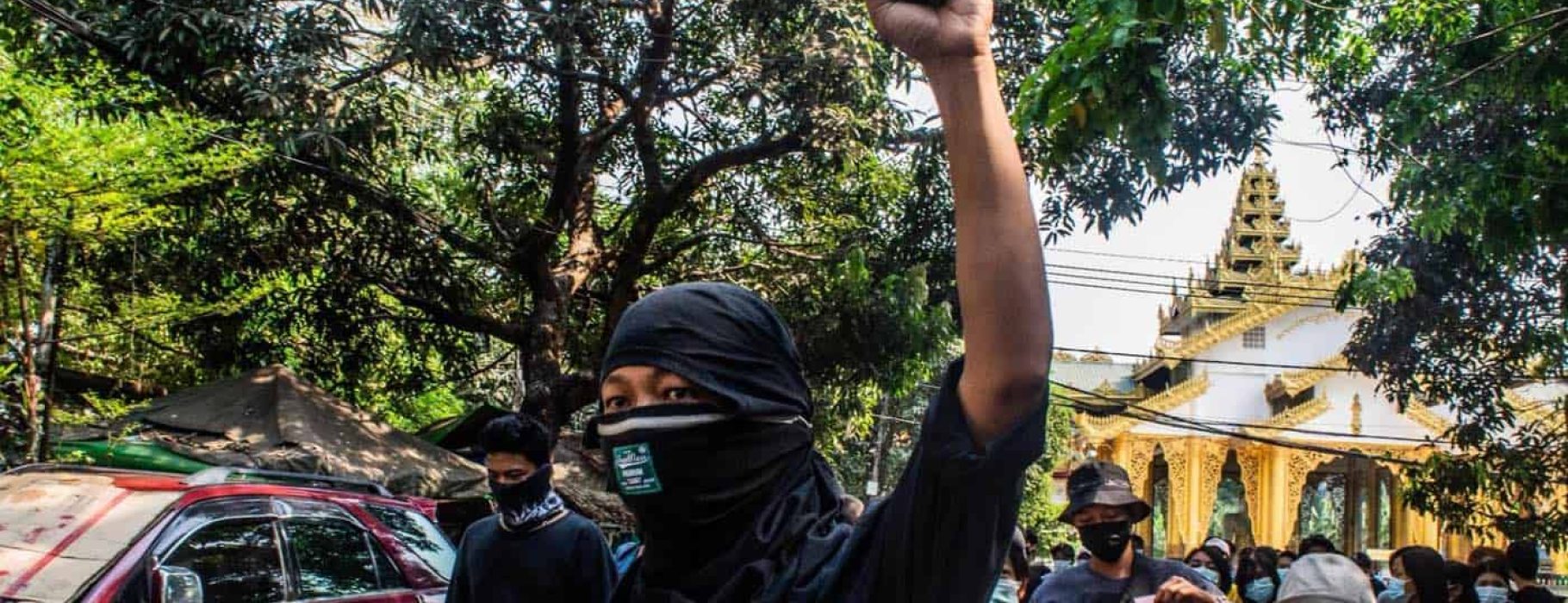
Against the backdrop of ICE occupations in multiple cities around the United States, we have marveled at the incredible organizing that has blossomed in response. Signal chats have created rapid response networks, relationships have evolved into mutual aid communities, and neighborhoods have developed lasting communication networks. As this sequence illustrates, emergency is the birth of invention as much as desire is.
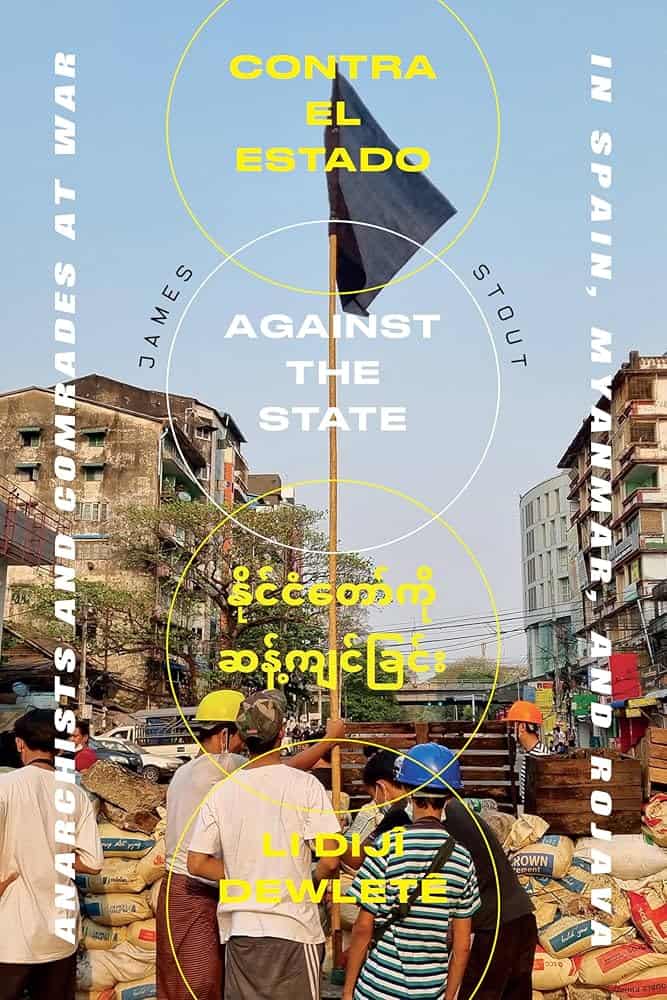 This is part of the energy that journalist, organizer, and scholar James Stout has tried to capture in his new book Against the State: Anarchists and Comrades at War in Spain, Myanmar, and Rojava (AK Press, 2026). The book exemplifies Stout’s extensive work on how anarchists, in making war, simultaneously make a new future for all of us. His own research started with the Spanish Civil War, whereas unions like the CNT understood demands for democracy as a chance to remake what was possible. Stout carried this history with him as he began to document the “democratic confederalist” experiment in Rojava and Myanmar. Rojava, of course, is the revolutionary region of northeastern Syrian Kurdistan influenced by the ideas of Kurdistan Workers Party (PKK) leader Abdullah Öcalan and American theorist Murray Bookchin. In Myanmar, he talked with the young volunteers who are participating in an armed struggle against the military junta currently controlling the country.
Stout’s work looks at how anarchist ideas sprout in these areas, sometimes under different names, and how a vision of a new way of living begins to thrive despite the desperate conditions of armed conflict. After years of research and on-the-ground reporting, Stout has fashioned these experiences into a lyrical and timely volume that crystalizes the hope and lessons of communities asking bigger questions amidst catastrophic conditions. Shane Burley spoke with Stout about his book, what the Spanish Civil War still has to teach us, and what we can learn from those currently fighting for autonomy and freedom in Rojava and Myanmar.
Punk music drew me into the revolution in Spain. I was really into The Clash and Manic Street Preachers, and, from there, reading George Orwell. From reading Orwell, I was lucky enough to be a young person in the golden age of really cheap flights in Europe.
So, a lot of it was just going to Spain and having that basis to understand the area. From there, it was talking to people, and I was lucky enough to be among the last generation that could talk to people who were in the Spanish Civil War.
And it was seeing the actual existence of the anarchist project. There is a continuous line, but there was also a lot of suppression of anarchism between 1939 and the early 2000s, when I was going there. And like many people, my interest in the Spanish Civil War started with interest in the international volunteers who joined the fighting. But pretty quickly, spending time in Catalonia, I became interested in this anarchist project. I was interested in why it wasn’t so present in the popular narratives of the Spanish Civil War. If you get the high-level textbook version, it read something like: many noble, well-intentioned people from around the world came to defend the Second Republic, state communism kind of fucked it, and they lost to the fascists.
The anarchists appear in that story, but only in this quixotic or tangential way. But the anarchists were clearly very important. When you read the history of Barcelona, you understand that the coup didn’t succeed there because of the anarchists.
I did my PhD on antifascism in Second Republic Catalonia: how the Catalan national project was explicitly antifascist. I found that really interesting, this idea of a nation defining itself through antifascism. I looked at how they built that through sport, specifically through constructing opposition to Berlin by hosting an Anti-Fascist Olympic that welcomed exiled German Jews and Black people from the USA and showed the strength and unity of the antifascist cause.
But it always sat with me: what was it like for the anarchists fighting? Because by that point I knew anarchists. Anarchism, in my experience, was meetings, long discussions, trying to find consensus. And you can’t find consensus when you’re being shot at. So, it really interested me intellectually. How did they do this?
As I engaged in mutual aid practices and organizing, I kept thinking: what could we learn from the Spanish anarchists? Because they were very effective. The more I read, the more I found they weren’t quixotic or naïve. They were extremely effective. They did it without the state, without capital. They armed themselves, equipped themselves, provisioned themselves.
That became an area of interest for years, reading accounts written by different fighters. The reasons I eventually wanted to write this book came after speaking to young people in Myanmar and hearing about their use of a sort of modified consensus organizing in their armed groups.
It first appeared when I started talking to these young people who were fighting in Myanmar after the military deposed the government following an election and staged a coup. Young people immediately went into the streets after the coup. They protested peacefully in massive numbers, and they were killed en masse.
They kept protesting. They kept trying to make their case. The more they died, the more they believed that the world powers, the so-called “rules-based world order,” would help them. Eventually they realized it wouldn’t.
They realized they had tried to speak to the state in the language of rights, and the state either didn’t understand them or wouldn’t listen. So, they had to speak to the state in the language it spoke to them. That language was violence. That was the only way they could force the state to hear them.
So, they took up arms. When they did, they organized in different ways. Some went to existing ethnic revolutionary organizations and said, “Can we join you? Can you organize us? Can you arm us? Can you train us?” Others formed their own units. They were affiliated with those organizations, fighting the same enemy, but remained distinct.
It was one of those units that I spoke to. I asked how they organized. These were very young people—they called themselves the Gen Z Army.1Daniele Bellocchio, “Myanmar’s Gen Z combatants: Guerrilla tactics against a military dictatorship,” El País, January 10 2025. https://english.elpais.com/international/2025-01-11/myanmars-gen-z-combatants-guerrilla-tactics-against-a-military-dictatorship.html I asked what their structure was.
What they described looked a lot like consensus organizing. They met, discussed, and if anyone objected, they didn’t do it unless they could address the objection. Sometimes people with more experience spoke more, and their opinions carried more weight, but it was very different from a traditional military model where someone gives orders.
That made me think. I didn’t have those nitty-gritty accounts from Spain. I had formal descriptions: sections, columns, delegates. But not what it felt like to choose a delegate or organize a section. These young people gave me that.
Their anarchism wasn’t explicit. They would never say, “We are anarchists.” But what they described would be very familiar to anarchists. Their way of organizing was instinctive. When state institutions collapsed and failed them, they organized in a way that treated everyone as equals, with dignity and respect.
That fascinated me. It made me think this kind of organizing might actually work under stress, in dark times. I’d seen consensus work at scale before, such as with Occupy and in mutual aid organizing. But this was different from the life and death situations they were in and how fast decisions needed to be made.
I went looking for literature on this and couldn’t find much. Around that time, I was talking to a close friend—the friend the book is dedicated to—who later died fighting in Ukraine after having fought in Myanmar. He joked that maybe this was why I’d spent all that time in grad school: to write something useful.
That’s when I decided to really pursue this as a project, bringing together Spain, Myanmar, and Rojava.
I thought a lot about Catalan national identity. I think that in the 1930s, nations were relatively new things, right? Nations come about with the printing press, with the decline of divine-right monarchy and universal religion. The nation emerges, and nations are often bourgeois projects. Nations are often simply ways to control people.
It was interesting to see this narrative of nation being used in Catalonia since it was based on the idea that we are an antifascist nation. By 1936, this Catalan project was explicitly antifascist.
The biggest Catalan party was the Republican Left of Catalonia. The Catalans were hosting what they explicitly called an Anti-Fascist Olympics, and they were doing so in a way that reflected an idea of the brotherhood of nations. Antifascism could see nations as siblings, not as rivals.
So at the Popular Olympics, the Basques came, the Galicians came, the Catalans came. Colonized peoples of North Africa were represented. It was very important to them that Black people from North America be represented. It was very important to them that Jewish people be represented outside of the states in which they held citizenship. Exiled German Jews weren’t going to come with a German flag, right? So, they came as the Yiddish Workers’ Sports Club.
This idea of a brotherhood of nations under antifascism, of “nation” not being an identity that had to be pitted against other nations, but something that could exist in mutual solidarity, I thought was really fascinating.
I remember asking very early on whether what the ethnic resistance organizations wanted in Myanmar was ethnonationalism, and they pushed back very strongly. That was my ignorance in asking that question, because that’s not what they want. What most of them will tell you they want is a federated system. Now, depending on who you ask and when you ask, you’ll get different answers about what a federated system looks like. But that’s not that different from what people want in Rojava either: self-governance, community governance, mutual respect, and power being brought closer to people.
I think we should be wary on the left of completely dismissing the idea of nations, while also not holding them up as the only way of political organizing or as relevant in every case. They want a world in which many worlds can exist that allows people to express their identity, which, in this case, includes nationalities that have been repressed.
For most of modern history, there has not been a Catalan state, apart from very brief periods during the Civil War. There has not been a Basque state, and there has not been a Karen or Karenni state. None of these national entities have had states in the modern era. Perhaps especially when people are excluded from state power because of their ethnicity or national identity, they are able to understand the nature of state power and the way it can be wielded as a tool to suppress freedoms.
I think that predisposes them, in some cases, toward libertarian politics.
Just to touch on this briefly: yes, you do see right-wingers trying to claim the Karenni. They’ll try to claim the Karenni Nationalities Defence Force (KNDF). And the KNDF guys will show up wearing patches that say, “I am an antifascist.” The right-wingers will say, “Oh no, you don’t get it.” But I’ve talked to these guys—I know them—and they’re like, we get it really well. They ask, “What’s wrong with these people? Why don’t they understand? We’re very clear about this. We’re antifascist. We believe in women’s liberation. We believe in queer liberation. And we believe in our own liberation.”
You can see this in the relationship between the KNDF and the Syrian Democratic Forces. For those who aren’t familiar, KNDF stands for Karenni Nationalities Defence Force. It’s interesting that “nationalities” is plural—non-singular.
The KNDF openly admired the revolution in Rojava. They’ve said in their statements that one of the things they admire is the women’s revolution there, and that’s something they aspire to. KNDF Battalion Five has a separate women’s unit. They’re very explicit that their struggle is progressive and that they don’t wish to leave anyone behind.
I’m not saying that every trans person in Myanmar is having a wonderful time, but there are trans women who live openly as women and are respected as such, in part due to this struggle, especially in the Karen homeland. I’m aware of trans women in other revolutionary organizations in Myanmar as well. I’m aware of queer people in those revolutionary organizations.
So yes, some people in the United States, like those not keyed into the national liberation struggles of those subject to the state’s power, understand the nation as an inherently exclusive concept. They might struggle to grasp this. But for these movements, the goal is liberation, and they don’t think anyone is free until everyone is free. It makes sense, then, for them to fight for their own liberation alongside the liberation of women and alongside the liberation of people subjugated because of gender identity or sexuality.
The experiment in Rojava began with the Arab Spring and the withdrawal of the Assad regime from Kurdish areas. But Kurdish friends use a mushroom analogy: the mushroom appears suddenly, but the mycelium has been spreading underground for decades.
They had been building dual power and mutual aid structures long before 2011. When the Assad regime withdrew, those structures surfaced.
As the Syrian civil war intensified into one of the most ferocious conflicts of this century, the Islamic State entered Syria and took vast territory. The Kurdish defense organizations, the YPG for men and the YPJ for women, found themselves fighting Assad’s forces, various jihadist groups, and ISIS.
They ended up in a strange alliance with the United States. The Syrian Democratic Forces grew and included Arab, Assyrian, Armenian, and Yazidi members. They’re often described as “the Kurds,” but that’s inaccurate. Even now, as some Arab areas leave the SDF, the Assyrians remain, the Armenians remain, and the Yazidis remain, and Arabs remain as well and also serve in the YPJ.
The world really noticed them in 2014 during the siege of Kobani. While millions were fleeing Syria, Kurds crossed borders to enter Syria and fight ISIS. For people who may not be familiar, the Kurdish nation is divided into regions known as Rojava, meaning west, Rojhilat, meaning east, and Bakur and Bashur. Bakur refers to northern Kurdistan in Turkey, and Bashur refers to southern Kurdistan. Kurds are coming from all of these places. It is harder to come from Iran, but people still do. They flow into Kobani across the Turkish border to fight ISIS.
They began receiving US air support, and with that assistance, they turned the tide in Kobani in what became a major front of the war. They started pushing back the Islamic State, something no one had managed to do up to that point. They then fought a campaign that continued until 2019 against the Islamic State.
One of the most important elements of that campaign, and something we should never forget, is what happened on Mount Sinjar, or Shengal in other languages. The Yazidis, an ethno-religious group whose religion is closely related to Zoroastrianism, were trapped there while the Islamic State surrounded them. The YPG, the YPJ, and other elements of the Kurdish Freedom Movement built a corridor with their bodies and their lives to evacuate those people.
The Yazidis were subjected to genocide by the Islamic State. Many more would have died if it had not been for that action. I see that moment through the lens of solidarity.
One YPG commander told me that it was a time when the states of the world had failed them. At that moment, the Obama administration wanted to fight the Islamic State primarily through drones and special forces because there was no appetite in the United States for more American deaths. There were US special forces on the mountain, from what I understand, and possibly British forces as well. I have never been able to get confirmation from either, and I likely never will, but it is worth noting.
What saved those people were volunteers from the YPG, the YPJ, and other Kurdish forces. They built that corridor, and they went on to defeat the territorial caliphate in 2019, fighting through places like Tabqa and Raqqa and many other areas. Unfortunately, that victory has since been partially reversed.
It feels like people are trying to figure it out.
When I am traveling, I often seek out punks or anarchists. I might end up in what used to be a squat house, although those do not really exist in the United States anymore, or at least not in the same way. But it feels like punks, in a way, like grandma punks. Even if people have never been in those spaces, they may not understand that punks are often the kindest people. We want to take care of each other. We want to be nice to each other. We mostly want to make tea for people and talk to them. We love to make tea and talk to people.
There is that sense of, we are all going to drink some tea and work it out.
At the same time, you can tell there are unresolved frictions. There are large prisons. Prisons are not something anarchists generally want or support. There is also the unresolved question of how to deal with the children of Islamic State fighters and the spouses of Islamic State fighters. Some of those people were active participants in the Islamic State and directly participated in a genocidal project. This issue remains unresolved, and some are currently on the run. Others were not even alive when the Islamic State had a territorial caliphate.
It is a huge mess, and it is one the international community has completely failed to address. There is a palpable tension whenever this comes up in conversation. There is also a fear that these camps have become factories for radicalization. Young people are growing up there, very understandably resentful. They have done nothing wrong, and they were born in prison. There is a great deal of concern around this.
Something I noticed in Kurdistan generally, but especially in Rojava, is that women look you in the eye. They walk in the street confidently and will come talk to you if they want to. They are not subjugated in the way some communities are. The gender revolution there is palpable and remarkable, especially coming out of the Islamic State, which was a violently misogynist project. It may have been the most extreme form of misogyny we have seen this century.
Seeing women carry themselves with dignity and clearly feel empowered made me very happy.
But there are still struggles. Things are still hard. They have not figured everything out, and I do not think they claim to have done so.
You also notice that the region was turned into the breadbasket of Syria by the Assad regime. Large parts of the forests and trees are gone. You see vast expanses of cleared land and oil fields. People are very aware of the damage that has been done. Ecology and care for the planet are central to the revolution, but the damage is still there.
And there have often been American troops present. People know those troops are not there to be friends, even if individual American soldiers may form friendships. Their mission is to keep ISIS away and to destroy the Islamic State, not to support the project being built in Rojava. That is difficult to balance, especially if you have fought side by side with these people against a common enemy. When Turkey attacks, or when the Syrian transitional government attacks, those troops remain in their bases and do nothing.
There is a palpable tension around that, but there is also a lot of joy.
I remember one night sitting in the place where we were staying while drone strikes were happening. We did not go out much at night because that was when the strikes occurred. People staying there suddenly took out a tambur, a Kurdish musical instrument that is sort of like a large banjo. They had a songbook. They played songs and explained what each one meant. We sang them, and they explained the meanings again. They showed me how to clap the rhythm. They gave me the words.
Then they handed me the instrument. It is tuned very differently from a guitar, which was confusing for me. I played something that sounded like “Seven Nation Army” because I could move up and down one string. They asked if it was a traditional song.
That moment was really beautiful.
I have also had the good fortune to be with Kurdish people in other difficult moments. In 2023, when the Biden administration was corralling migrants in freezing desert conditions for weeks at a time, I remember dancing around a campfire with Kurdish men in the cold, knowing they would sleep outside on hard ground that night.
The joy they bring to their revolution, and to other organizing spaces, is something I saw again this week, when Rojava is under severe threat. A friend sent me a video of people dancing around a fire in Qamishlo.
It’s something we could learn from. In places like Minneapolis right now, things are bad.2James Stout and Margaret Killjoy (hosts), It Could Happen Here, “Everyone vs ICE: On the Ground In Minnesota,” podcast, January 26, 2026, 56 minutes. https://www.iheart.com/podcast/105-it-could-happen-here-30717896/episode/everyone-vs-ice-on-the-ground-319435576/ Children are being taken from their families. And people debate whether it’s appropriate to have joy or celebration. But joy is part of survival. It builds togetherness.
That sense of joy was not something I expected to bring back from a place under constant bombardment—but I did.
I think a couple of things happen. There is a sense of togetherness and shared purpose that you only feel in really hard times. You feel it when you are being bombed.
One of the things I felt in Rojava was something I had never experienced before. I had never experienced what it is like to be on the other end of air domination. There is no Rojava air force. It is very unlikely that I will die in Rojava, but there is always the possibility that every time I go out, death could come from the sky and fall on my head. I just have to be unlucky, or in the wrong place, or with the wrong person.
I spoke to people for whom that had happened, to their family members and to their children. When that happens, there is a shared feeling of, well, that could have been me. They did nothing wrong. There was nothing different about them. Their child did not decide to fight. They did not pick up a gun. They did not put on a uniform. They were just in the market at the wrong time.
I think that kind of experience brings people together in a way that reduces bickering. There is a sense that when we are together, we can do incredible things.
All of these people—in Spain, in Myanmar, and in Rojava—took on the state and won. At one point, they were just people in the street. The state had tanks and planes and guns, and they did not. Through taking care of one another and organizing together, they pushed the state back. They made it retreat, and they liberated space.
The state is one of the most powerful creations in political history. It has almost made itself seem inevitable, natural to human beings. To say, no, we will not accept that, and to push it back through sheer force of will, with bodies and blood, makes it feel as though anything is possible.
It also creates a desire to respect that sacrifice by ensuring it was something worth dying for. That means building something beautiful.
I think that is part of it. A people that has fought for its liberation is hard to control. They know what control looks like, and they know the state does not have a permanent monopoly on violence. They know that monopoly can be taken back. Because of that, they are always harder to force into things to which they do not consent.
I do not think everyone comes in for ideological reasons. Some people do, but not everyone.
There were definitely people who came to Rojava for ideological reasons, and when that ideology did not line up with the realities on the ground or with local people, there was tension. But there were also people who came to Rojava to support the revolution, to learn from it, and to offer criticism from a place of solidarity, and that was massively appreciated.
People in Rojava honor their martyrs, the people who died in the struggle. They are everywhere. International martyrs were especially appreciated. I remember walking through a market in southern Kurdistan, in Iraq, and seeing a portrait of Anna Campbell, the British woman who was killed in a Turkish attack in, I believe, 2018. Her portrait was hanging on the wall of a market stall. The person who put it there probably did not know her personally, or if they did, it was only in passing. She was not a family member. I think all her family were in the UK. But someone had chosen to memorialize her four or five years later, as a sign of respect. Those people are cherished.
In Myanmar, you also see a lot of international volunteers. The important thing to understand about Myanmar is that it is inherently an international conflict. When Burman people go to fight alongside the Karen, they are international volunteers. I speak often with a young man who is Arakan, from the other side of Myanmar, who is fighting with the Karen. He is an international volunteer. He is not Karen. His first language is not Karen. His family is not Karen. But he is willing to risk his life for the freedom of the Karen people.
Because of that, there may be more international volunteering in Myanmar than almost anywhere else.
When we talk about Western volunteers, there is the Anti-Fascist Internationalist Front (AIF), and they are participating, in part, for ideological reasons.3Antifascist Internationalist Front, “Call to Action,” Myanmar Anti-Fascist Internationalist Front, October 15 2024. https://aifmyanmar.noblogs.org/ They understand the struggle as part of a global fight against fascism. And they are still appreciated. They are appreciated because people value seeing their struggle as part of a global struggle. They appreciate that people are willing to stand in solidarity with them, and they appreciate the connections to other movements. And, as I write in the book, you can’t outsource your liberation and so these internationalists are still accountable to those who are leading the fight.
There are also people who come for reasons that are less explicitly ideological. It is not that they have no ideology, but more that they believe dictatorships are wrong and that people deserve to live in freedom. They are willing to fight alongside them. Their ideologies may differ, but their willingness to risk their lives for someone else’s freedom is still deeply appreciated.
When we look at Spain, what is different is that the internationalists who fought with the Spanish anarchists understood this explicitly as an anarchist struggle. They came as anarchists. Borders were looser in that period, and anarchist groups were closely connected across countries. It was completely natural for French anarchists to come and fight alongside Spanish anarchists if the opportunity arose, because they were defending a revolution they believed in and felt a responsibility to participate in.
Of course, there were also Algerian anarchists, anarchists from the United States, anarchists from the United Kingdom, and others from all over the world who came to fight in Spain. At that time, anarchism was understood as a universal project, something for everyone. They felt it was their revolution too. Because anarchism in Spain was doctrinally close to what many of them practiced elsewhere, they saw the struggle as equally theirs. And there were others on the left fighting alongside them, Spain had its own socialist tradition, since the fight against Franco required a multitude.
People tended to group together primarily for language reasons and because others grouped through trade unions, especially since many had not been working in Spain before the war.
It is very easy, as an anarchist party in the United States, to say that they should not have done that, because those people are not the ones dying. We have all seen what the Islamic State did to people. The way the Islamic State was defeated involved bombs from planes. War forces people to make difficult compromises.
I do not think anyone would disagree that a series of extremely difficult decisions were made in Syria. Every time a bomb was dropped, that was a difficult decision. More civilians died in Syria than needed to because of the air war, because of the way the Islamic State was fought using drones and bombs. Not all those drones were called in by the Syrian Democratic Forces (SDF); many were called in by the United States. Nonetheless, dropping large bombs on cities is going to result in civilian casualties. That is undoubtedly undesirable.
I am not saying for a moment that this was perfect. It’s not. It was a terrible set of choices.
But I do not think anyone in Rojava who is being serious believes that the Americans are there in lockstep with the revolution. They know that the United States will use them for as long as they are useful, and then abandon them, as we have seen happen in recent weeks.
To suggest that they are an American asset in the region is ludicrous. They are not. They have openly called what is happening in Palestine a genocide. They are also sometimes described as an Israeli asset, which requires an almost creative imagination. If the SDF were backed by Israel, Turkey would not dare attack them. If they were an Israeli-backed force, Israel would not allow them to be destroyed.
Israel has occupied parts of Syria since al-Sharaa came to power, and he has done nothing about it. If Rojava were an Israeli asset, none of this would make sense.
I think these critiques either come from people who are naive or poorly informed. You can be neither of those things and still argue that they should not have allied with the United States, sure. But I do not think it is my place to tell them that they should have stood there and died for my ideological purity instead.
I was speaking to someone from a Rojavan confederation of women’s organizations called Kongra Star—their spokesperson Rîhan Loqo. She told me that in other revolutions—she mentioned the French Revolution and the Vietnamese revolution—the revolution had been with women, but when the revolution was over, they said, “Okay, that’s great, you can all go home now.” That wasn’t possible in Rojava because the revolution was women. Without the women, there is no revolution, there is no Rojava. They made the revolution; the revolution wasn’t made for them.
I like to use the example of Afghanistan. When the United States entered Afghanistan, they produced a lot of papers about the terrible conditions for women under the Taliban, and they used that to justify the invasion. For years afterward, they held meetings about Afghan women without Afghan women. Afghan men, American men, and sometimes American women met and talked about it.
Two decades later, with thousands of people dead, Afghan women are once again subjugated to the Taliban, because they were not the ones doing the liberating.
One of the people I met in Kurdistan said to me, “You can’t outsource your own liberation,” which I thought was a fantastic summation of how the Kurdish freedom movement understands women’s liberation.
In Spain, it was a little different. The anarchist movement was notionally feminist. There were a lot of feminists and women involved, and there were men within the anarchist movement who identified as feminists. But I do not think they lived that out consistently.
In some accounts, women are alongside men. They are fighting together, carrying arms at the front together, falling in love, liberating nuns and telling them they are free to go do what they want. It looks like people are really living out their ideals. In other texts, women are almost entirely absent, or sometimes they are expected to do domestic labor, which leads me to believe it was uneven.
There is a quote from a woman who was a communist fighter who said, “I didn’t come to join the revolution to die with a dishcloth in my hand.” I think that really sums it up. Women in Spain faced a double burden. They were allowed to fight, but they were also expected to perform domestic labor. They were expected to be the ones who cooked and cleaned within the unit.
That is a failure of the movement as a whole, and especially of the men within it. The more I reflect on my experiences, the more I think we cannot change the world if we cannot change men. If we cannot start there, then we should stop there. If we cannot stop men from being toxic to women, and if we cannot stop reproducing gender hierarchy, then we need to resolve that before we move on to anything else.
When I think about Myanmar, things are mixed. It depends on which group you are with and which unit you are in. There are units like the Myaung Women Warriors that are entirely composed of women. I remember seeing an image of a young woman firing a grenade launcher from a hip-fire position. She was probably in her late teens or early twenties. This was a society which, despite having Aung San Suu Kyi at the helm, was deeply misogynist. Two years earlier, it would have been unimaginable for her to see herself in that role.
There are units like the KNDF that have distinct women’s units, while openly acknowledging that they still have a long way to go before women are equal with men. There are also units where only men fight.
In some of the People’s Defence Forces, women run boot camps. Women run medic teams. There is an acknowledgment that capture is a more horrific prospect for women, for reasons I do not need to spell out. That reality is handled in different ways. In some places, it means people fight with the understanding that capture is not an option. In others, it means women take on frontline roles in specific capacities.
When I spoke to the Gen Z Army, they told me they initially fought together. They found that the men did not fight alongside women as equals, not in a condescending way, but because if a woman was injured, the men would instinctively try to rescue her. They would want to save her. Because of that, they reorganized, with women taking on specific roles such as medic duties.
Medics are not rear-echelon soldiers. They are on the front line. They rescue people under fire. They are not considered less brave or in less danger. It is simply a different position.
I remember one of the young people who had been involved in printing guns talking to me. He said, “In Myanmar, we have lots of girls, we have lots of gender stuff, lots of gender problems.” I do not think he was consciously referencing Judith Butler. He was just recognizing reality.
It is remarkable to hear a nineteen-year-old man speaking in his second language, someone who probably does not identify as a radical, say something like, “We had pretty fucked up gender perspectives a couple of years ago. I am still working on that myself. I am trying to be better.”
That gives me a great deal of hope. But I still want to see more change happen on the ground.
So, I was in Myanmar with people who were printing guns, and here people are printing whistles. It is different, obviously, but it is still cool that people have a means to create something.
I have this thesis about 3D printing, that it represents a vision of a better world. Maybe I am using my anarchist squint here, but I choose to believe it is evidence that people will create beautiful, interesting, and innovative things without the need for capital or profit. They will do it because it is inherently rewarding to make a better mousetrap and see your friends use that mousetrap and have better lives.
That is true with guns, and it is true with whistles.
I see a lot of what I heard about in Kurdistan happening here. The little mushroom, right? The people who have been organizing for decades suddenly stepping up and saying, yes, I know how to run the hell out of a meeting. I will facilitate this thousand-person Signal chat. I will help people find the place where they fit into this movement, because I have done this before.
Much like what happened in Kurdistan, we had a moment of liberation here with the George Floyd uprising. These pathways had been gradually built over time, and then they exploded. But they exploded because people had spent years doing hard work and learning how to facilitate that kind of moment.
What I take from that is the same sense of togetherness that keeps drawing me back to these places and experiences. The sense that we can do anything together if there are enough of us.
Right now, what we are seeing here reminds me of an analogy Bill Haywood used to make about a fist. The raised fist was a symbol of the IWW. If you pin down one finger, it is easy. But when all the fingers come together as a fist, you cannot push it down.
That is what it feels like here.
There is no safety in compliance. There is no safety in civility. You can be a white lady saying, hey, I am not mad at you, and you will still get shot. The only safety is in numbers. The only way out is together.
That is something I have experienced myself, and something I have heard people recount from Rojava and Myanmar. The only way we can do this is if all of us do it, and do it to the best of our ability, and really commit to liberation and to refusing oppression.
I think that is what people are doing here too.
I think people in Myanmar would probably acknowledge that there is a shared struggle there—many of them, not all of them. I talk to young people in Myanmar every day, and they ask me, what the hell is going on in Minneapolis? Are you okay? Are you safe?
I spoke to people in Kurdistan today who told me to be careful because they heard it was very cold here. These are people facing life and death situations, and yet they are in solidarity with the struggle here.
I do not think these struggles are that different. I think they can learn from each other.
As we build massive movements, we would do well to look at other massive movements. There are lessons there, especially from Kurdistan. If we do that correctly, it can help provide accountability and prevent fractures, because everyone knows movements that have fallen apart because people could not accept accountability.
Having procedures for airing grievances, for discussion, for sharing points we want people to respond to in solidarity, matters.
One story that really stuck with me came from friends in Rojava who were talking about a friend who had died. They said that one of the things they remembered about him was how he gave criticism with love. He cared about them. He wanted them to be better revolutionaries and better versions of themselves.
When they heard his criticism, they heard it as coming from someone who loved them and wanted the best for them. Now that he is gone, they say they are better people because of their time with him, and that in that sense, he is still with them.
Hopefully no one else will die here. But the ability to offer criticism out of love, to strengthen the movement and make people better, is something we should all build into our movements.
None of us could build it alone. We build it together.
What’s happening now is that the Syrian transitional government has begun what is clearly a long-planned campaign against the Syrian Democratic Forces (SDF) and against Rojava.
In the past few weeks, what they have done is turn many of the Arab tribes who had previously fought with the SDF, and within the SDF, against them. That has created a collapse of SDF front lines in majority Arab areas. The SDF pushed into those areas originally at the request of the Americans and then continued to administer them after the end of the territorial caliphate, while continuing to carry out anti-ISIS missions there.
But among some of that population there was an ethnic resentment of the SDF as a Kurdish project, and that resentment was fostered. That is what has ultimately played out. Over time, we will need to reflect on why there was not more buy-in and how more buy-in could have been achieved. But I do not think that is the discussion we should be having right now, at a time of such profound loss of life and when opponents are literally posting videos of executing Kurdish soldiers on social media.
What we are seeing now is the Syrian transitional government and its allied forces pushing further and further—not just into formerly contested areas, but increasingly into majority Kurdish areas. We are seeing them do what the Syrian National Army, a Turkish-backed group, has done before, which is to carry out very clear ethnic cleansing.
We are seeing executions of prisoners. We are seeing the desecration of fighters’ remains. We have seen, in particular, women fighters facing horrific abuse and death when captured.
The United States has completely abandoned Rojava, as many of us expected. Two major ISIS prisons have fallen, including al-Hol, which is by far the largest. Many ISIS detainees have escaped, meaning the threat of ISIS attacks is once again higher than it has been in a long time.
We are currently in a period of ceasefire, but Kobani still doesn’t have water or power. The conditions there are extremely difficult. People need food. People are struggling to access clean water. The SDF has lost major hydroelectric dams, which means electricity will once again be scarce in Rojava.
Turkey has also bombed Rojava’s electricity infrastructure. Part of the ongoing struggle of the movement has been rebuilding year after year, only to see that reconstruction destroyed by Turkish drone strikes.
Things are very difficult there.
At the same time, we have seen massive solidarity. Kurds from the Patriotic Union of Kurdistan (PUK) in southern Kurdistan, including their counterterrorism units, have entered the region. The PUK and the Kurdistan Regional Government (KRG) are split between the Barzani family and the Talabani family. The Talabanis are based in Sulaymaniyah in the east. The Talabani counterterrorism group has entered Rojava. The PUK are present in Hasakah, one of the majority Kurdish cities, though not exclusively Kurdish.
We have also seen Kurdish youth from northern Kurdistan, from Turkey, crossing the border to fight. It feels similar to the spirit we saw in Kobani in 2014. I have not seen this level of unity among different Kurdish groups in a very long time, and we are seeing that spirit of resistance again.
That does not mean that things are not very difficult for Rojava and for Kobani, or that the revolution is not in danger. It is. After this period of ceasefire, we will have to see how that danger manifests. This is a very difficult time for the revolution.
So, what can people do to support it?
People can write to members of Congress. There are a couple of Republican senators who have shown more backbone on this issue than many Democrats. Lindsey Graham, for example, says a lot. But has he done anything? Has he made any concrete difference? No, and no Kurdish person I’ve talked to believes they truly care for the Kurds and their freedom movement. Will any of them? I do not know. [After our interview Graham introduced the Save the Kurds Act, which is supposed to add sanctions to governments that endanger Kurdish people in various regions of Kurdistan, including Rojava, though far-right figures in the MAGA movement have opposed this.]4“Veteran US Senator to introduce ‘Save the Kurds’ bill targeting hostile governments, groups,” Fondation Institut kurde de Paris, January 28, 2026. https://www.institutkurde.org/en/info/veteran-us-senator-to-introduce-ssave-the-kurdss-bill-targeting-hostile-go-1232552493
People can fundraise for Heyva Sor, the Kurdish Red Crescent, and that does help.5Heyva Sor A Kurd, “Who We Are,” https://hskurd.org/?page_id=4296&lang=en There are people who have been displaced four times in the last five or six years, constantly fleeing genocidal violence. Those people need support.
Normally, I would say that people interested in supporting Rojava should go there. I do not think that is the case right now. It is a serious risk to your life. There is shelling. The possibility of attacks is high.
There are solidarity protests. Kurdish friends have sent me information about a solidarity protest in San Diego.6Instagram reel by Sam Doski (@sam_duhok1), “San Diego California Now kurdish protests supporting Rojava,” January 24, 2026. https://www.instagram.com/reels/DT6R-o1jX7z/
In the United States, the place to go is the Emergency Committee for Rojava.7Webpage of Emergency Committee for Rojava, https://www.defendrojava.org/ They are doing the organizing. When there is a need to call politicians, they will tell you which ones to call. If you have money to give, they will tell you where it will make the most difference. The people at the ECR are always a good place to look for that kind of information.
[Note: After we spoke there was a tentative ceasefire reached between the forces in Rojava and Damascus that will, ostensibly, integrate the region more fully into the new Syrian government while retaining some right to manage their own affairs. This does not erase the potential of violence emerging once again or ensure the Autonomous Administration of North and East Syria (AANES) retains its regional autonomy.]