
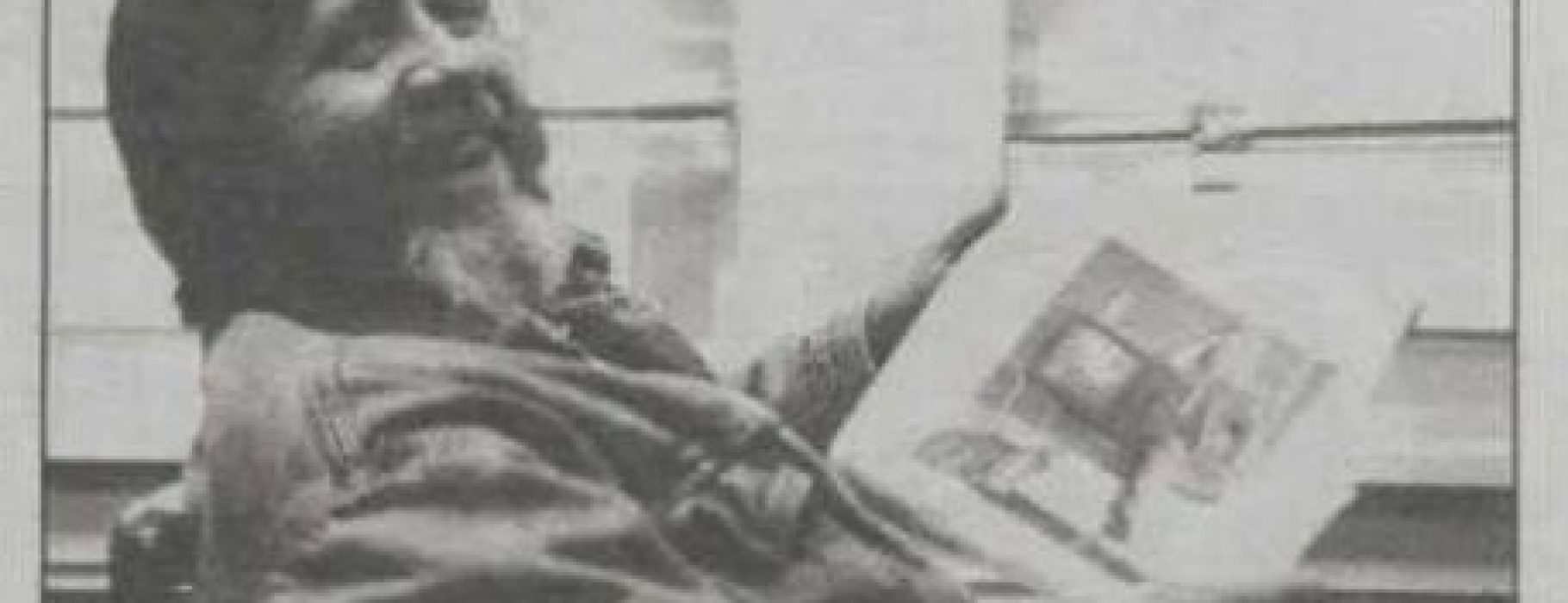
On Rick Roderick
Remembering the Texo-Marxist Philosopher, Teacher, and Posthumous Internet Celebrity
May 5, 2026
Near the beginning of his fascinating and heartfelt new memoir, Thomas Zigal writes: “Rick Roderick is the most famous American philosophy professor you’ve never heard of. If you Google his name and the word philosopher, you’ll find more than a hundred thousand hits, which is an astonishing amount of current interest in a university philosophy professor who died in 2002. American philosophy professors are as popular and well-known as American blacksmiths.”1Thomas Zigal, The Seasons of Rick Roderick (Fort Worth, TX: TCU Press, 2026), 8. The Seasons of Rick Roderick (TCU Press, 2026) is Zigal’s exploration of a lifelong friendship with this complicated man. At once a biography and a memoir, it examines the subject while also reflecting on the author’s many years of knowing him. Zigal came to know Roderick as a student at the University of Texas at Austin in 1969 and maintained a close personal friendship with him thereafter. Zigal is a novelist, not an academic philosopher, which means that he does not delve too deeply into Roderick’s research or teaching, but he does present a lucid, engaging, and very personal account of their relationship, while also delivering a portrait of the man in full: Rick Roderick, a passionate activist and admired professor who went on to garner posthumous fame online in a medium that barely existed during his own lifetime.
Roderick himself was a working-class kid from West Texas who somehow became a philosophy professor at Duke University, attaining this unlooked-for celebrity by odd circumstances. He was selected to deliver a series of relatively informal lectures on philosophy for The Teaching Company, which then sold these recorded courses on VHS videotapes to customers interested in the subject. Many years later (after Roderick’s death, in fact) various people uploaded electronic versions of those recordings to YouTube, where Roderick’s wit, erudition, “relatability,” and signature twanging accent found an enormous audience of admirers across the world. Roderick was also a committed Marxist, a Texo-Marxist as he called himself, and with his ever-burgeoning audience on the internet, he became, in Zigal’s phrase, “the Godfather of the Online Left.”2Zigal, The Seasons of Rick Roderick, 347. How all this happened makes for a fairly riveting tale.
From West Texas to the Ivory Tower
In the final year of his all too brief life, Roderick began writing an autobiography to be titled Bury Me Not. As Zigal relates, the title comes from an old cowboy song lyric: “Oh bury me not on the lone prairie/where the coyotes howl and the wind blows free.” Roderick only completed about fifty pages or so, chronicling his life story only up through his first year of college, but Zigal affirms that the notes had great promise, and he encouraged his friend to finish. A number of excerpts from Roderick’s unpublished draft are included in The Seasons of Rick Roderick. As Zigal puts it, “They explained his origin as a dirt-poor West Texas boy: A Portrait of the Philosopher as a Young Man.”3Zigal, The Seasons of Rick Roderick, 23.
The Seasons of Rick Roderick prints much of Roderick’s manuscript, in a Courier style typewriter font to make it easily distinguishable from Zigal’s prose, and these sections allow Rick to tell the tale of his youth in his own words. Roderick grew up in Tuscola, Texas, a tiny town of about three hundred people, located some twenty miles south of Abilene (that is, the “big city” nearby). In his own words, his mother was a beautician and his father was a con man. Both were heavy drinkers, which undoubtedly influenced his upbringing as well. He says he never called them mom and dad, but only by their first names, as they only called him Rick. His childhood memories speak mostly of longing and heartache, relieved somewhat by a love of baseball. As a teenager, he became a pretty good catcher and played on a controversially integrated club team coached by his father. Roderick’s commitment to civil rights and racial justice were there from the beginning, but the bigotry his teammates faced in the small towns of West Texas during the early 1960s underscored the urgency of the matter, undoubtedly nudging the future philosopher further to the left politically, even as a kid.
One tragic event occurred in high school that most likely haunted Roderick for the rest of his life. One night, while joyriding in his ’57 Chevy filled with carousing friends, girls they had “picked up”, loud music, and bottles of Dr. Pepper on a rainy Saturday night, Roderick became disoriented, and—taking a curve underneath a railroad overpass too fast—the car drifted. A girl in the back seat who had been leaning out the window was literally decapitated, struck by a steel bolt jutting from the trestle as the car passed. The death is horrible enough, but the manner of it—its gore and horror—cannot but have been traumatic, and Roderick’s guilt over the accident never fully dissipated. However, this also could be said to be a turning point in his career as a philosopher. Scarcely able to face the familiar world again, Roderick withdrew into books, even being allowed to complete his junior year from home. The local bookmobile run by the Abilene Public Library became his “lifeline.” As he put it:
They must have brought me two hundred books. I read Dostoyevsky, Tolstoy, Melville, Flaubert, Steinbeck, Hemingway, and the Brontë sisters. I read Copleston’s comprehensive History of Philosophy straight through. I read many of Plato’s Dialogues and Aristotle’s Nicomachean Ethics. I tried modern philosophy and read Descartes, Hume, and Kant with care. I devoured Nietzsche and Kierkegaard. They filled my damaged heart with a dark comfort.4Zigal, The Seasons of Rick Roderick, 68.
Reflecting on this moment, Zigal writes that “The car accident was the awakening of Rick’s intellectual life, but it also gave him soul.”5Zigal, The Seasons of Rick Roderick, 71.
After high school, Roderick enrolled at Hardin-Simmons University, a place that would have been called a “Bible College” in the past. Unsurprisingly, he did not fit in well there. The far more countercultural atmosphere of Austin suited him better, and he transferred to the University of Texas, where he would meet, become roommates, and ultimately form a lifelong friendship with Zigal. This was 1969, at the height of the Vietnam War and antiwar protests, along with all the restless energies and psychedelia associated with the era. Roderick’s interests in the human condition—stoked by literature and philosophy—combined with his political sensibilities, led him to Marxism. Zigal was the one who introduced him to the writings of Karl Marx, and he notes that Roderick’s immediate response to reading the Communist Manifesto was to say, “This makes perfect sense.” As Zigal concludes, “It was the beginning of his lifelong fascination with Marx and socialism, the subject that would shape his worldview and occupy his scholarly endeavors for the next three decades.”
Roderick’s interests in the human condition—stoked by literature and philosophy—combined with his political sensibilities, led him to Marxism. Zigal was the one who introduced him to the writings of Karl Marx, and he notes that Roderick’s immediate response to reading the Communist Manifesto was to say, “This makes perfect sense.”
Roderick would go on to graduate school, first at Baylor University for a Master’s, then back to the University of Texas for his PhD, where he studied under the direction of the Marxist theorist Douglas Kellner, a noted scholar of critical theory, including the work of Herbert Marcuse and other figures from the Frankfurt School. Zigal complains that Roderick’s writing during this period seemed turgid, too “academic,” and lacking his characteristic voice. He encouraged him to become “the Hunter S. Thompson of philosophy,” but Roderick “insisted he was playing the game required of him to establish his legitimacy in the academy. ‘You’ve got to show them you know what an omelette is before you start breaking eggs,’ he observed.”6Zigal, The Seasons of Rick Roderick, 213. Roderick would write his own dissertation on the work of the Frankfurt School’s contemporary leader, Jürgen Habermas, who had been a student of Theodor Adorno and Max Horkheimer and who at that time served as director of the Institute for Social Research that those theorists had helped to found in the 1920s. In other words, Roderick was doing “cutting edge” critical theory, looking at the most recent work in that field with an emphasis on the relations among philosophy, social theory, and political practice. This timely scholarship and relevance helped him get his first (and only) tenure track position as an assistant professor at Duke University, where I would encounter him. His erudition and energy ought to have made him right at home in that situation, as Duke was eager to expand his influence in the humanities while putting themselves on the map relative to other “elite” schools, but Roderick’s personal background and temperament made him feel out of place.
Teaching Philosophy
I met Rick (as he insisted I call him) when I was a 19-year-old freshman at Duke taking “Introduction to Philosophy” with him in 1988. That was well before his later celebrity, but long after the strange pathway Roderick had taken to get to that point, when he was in his third year at the university. I was a Philosophy major and, after taking my first course with Roderick, he became my advisor, both in an official capacity (for example, signing my course enrollment forms, overload approvals, and so on) and as a valued mentor. Given my interest at the time in existentialism and Marxist theory, it makes sense that I would be drawn to him, as really the only professor in the department at the time doing post-Kantian Continental philosophy. As it happened, I ended up taking five courses with him: “Intro to Philosophy,” “Nineteenth Century Philosophy,” “Marxism and Society,” “Twentieth Century Continental Philosophy,” and a graduate seminar on Hegel’s Phenomenology of Spirit. I also did an independent study on Nietzsche under his direction. As such, I feel well qualified to comment on Roderick the teacher, as well as the person I knew, albeit briefly, back in the day.
And a teacher he was. As almost everyone who knew him points out, Roderick was in his element when teaching, whether in a classroom setting or more informally interacting with individuals or groups. Part of this had to do with his immense learning and range of interests which, of course, included philosophy and politics, but also extended in all directions into literature and the arts, popular culture, scientific inquiry, abstract theory, and the most quotidian of practices. Any given conversation might range from Nietzsche’s debts to Spinoza, to speculations concerning the Iran Contra Scandal, and on to the question of where to get the best cheeseburger near East Campus (the answer to the latter, of course, was Wimpy’s Grill, just off Hillsborough Road, sadly no longer in business today). Roderick’s garrulousness and gregariousness was a big part of his personality, although I was unaware at the time of his personal sense of alienation and isolation, which he largely kept from his students and admirers, but—as Zigal’s memoir makes clear—was something that plagued him throughout his life. Nevertheless, the experience of being in one of Roderick’s classes, chatting with him among others in small groups or one-on-one was always exhilarating and rewarding, as I would invariably come away with new knowledge, new questions, and new motivation to explore further.
Roderick’s distinctive lecture style is on ample display in The Teaching Company series of videos that have become so popular in online circulation. I might describe his method as dialectical, which I am told could also be considered “rambling,” as Roderick frequently connects ideas from Plato or Hegel or Foucault to current events, recent movies, and general experiences in ways that can appear disjointed or “all over the place.” Yet, this is certainly part of the lectures’ appeal, since these exchanges made the substance of the given ideas under consideration all the more visible. I hesitate to call Roderick’s approach Socratic, for this term often indicates an almost badgering approach intended to undermine the arguments of one’s antagonists, forcing the interlocutors to recognize their own ignorance. Roderick’s dialogic style would more often elevate the sense of intellectual self worth of his students, even while challenging their “common sense” or complacency by situating these complex concepts in relation to more familiar examples from pop culture or everyday life. The frequent allusions to then-current events, which can today seem rather dated if not entirely forgotten, underscored the degree to which some concepts raised in a discussion of Aristotle, Descartes, or Kierkegaard had direct relevance and meaning to us in our own moment. Unsurprisingly, perhaps, this turned out to be immensely effective, all the more so when delivered in Roderick’s folksy, unpretentious manner of speech. If nothing else, Roderick proved that one could “do” philosophy with a Southern accent (which I confess that this appealed to me as a philosophy major born and raised in North Carolina), without any of the phonetic inflections or affectations associated with those coming from one Cambridge or another.
As Zigal reports in The Seasons of Rick Roderick, Thomas H. Rollins, the founder and CEO of The Teaching Company, selected Roderick based on a thorough scanning of student evaluations across a number of universities.7Zigal, The Seasons of Rick Roderick, 11. Rollins was looking for the best teachers he could find, but he also knew that they had to have stage presence and personality, such that they could engage with nonspecialist audiences while still presenting sophisticated discourses and ideas without trying to “dumb it down” in the process. Rollins, a Harvard educated lawyer and former chief counsel to the US Senate Committee on Labor and Human Resources, established The Teaching Company in order to provide access to college level courses for anyone with a VCR, lifetime learning opportunities for intellectually starved laypersons everywhere.8The company was sold to a private equity fund in 2006, and today operates as a streaming service under the name of The Great Courses Plus. In our time, perhaps, one thinks of the popularity of relatively brief TED Talks, or YouTube videos, vloggers, and other short form online presentations, but The Teaching Company aimed to offer full courses, each with about seven or eight hours of material. The teachers had to be able to sustain such entertainment. As Rollins told the New York Times, “I have listened to hundreds of lectures and reviewed hundreds of ‘student course manuals’ in order to find the most exciting teachers in the country.” In only five years at Duke, Roderick had established such a high reputation for his teaching and such popularity with students that he became a natural choice to be included in The Teaching Company’s growing list.
Roderick’s dialogic style would more often elevate the sense of intellectual self worth of his students, even while challenging their “common sense” or complacency by situating these complex concepts in relation to more familiar examples from pop culture or everyday life.
Roderick wound up delivering three distinct courses, each with eight lectures of about 45 minutes or so. His first course, “Philosophy and Human Values” (1990), offered a sweeping survey of the history of Western philosophy from Socrates to postmodern thought.9“Rick Roderick on Socrates and the Life of Inquiry [Full Length],” YouTube video, 46:19, posted by “The Partially Examined Life,” August 26, 2012, https://www.youtube.com/watch?v=XQ_hUxuumk0&list=PL6676C3E8A487FEE6. The success of this course led him to develop another, “Nietzsche and the Postmodern Condition” (1991), which had the distinct advantage of focusing on a single thinker and his ideas.10“Rick Roderick on Nietzsche as Myth and Myth-maker [Full Length],” YouTube video, 47:21, posted by “The Partially Examined Life, January 28, 2012, https://www.youtube.com/watch?v=kjFiU9nDQD4&list=PLA20B690583E9931C. Roderick later delivered a third series of lectures bearing the evocative title “The Self Under Siege” (1993).11“Rick Roderick on the Masters of Suspicion [Full Length],” YouTube video, 48:02, posted by “the Partially Examined Life,” January 25, 2012, https://www.youtube.com/watch?v=4wetwETy4u0&list=PLA34681B9BE88F5AA. There he began with the unholy trinity that the French philosopher Paul Ricoeur had labeled “masters of suspicion”—that is, Marx, Nietzsche, and Freud—before turning to a number of twentieth-century thinkers (for example, Heidegger, Sartre, Marcuse, Habermas, Foucault, Derrida, and Baudrillard) whose philosophical investigations of the conditions of subjectivity in the modern or postmodern world have shaped our thinking on such matters today.
The lectures in this last course are somewhat uneven, with Roderick occasionally indulging in his verbal perambulations a bit too much, arguably, but this may also have had to do with difficulties he was experiencing in his personal life at the time. Shortly before he would have filmed those lectures, Roderick had been denied tenure at Duke, which meant that he would soon face the prospect of unemployment.
Nevertheless, these lectures have enjoyed immense popularity, with hundreds of thousands of views and a global fandom. As the grainy VHS videotapes made in the early 1990s found their way onto the internet in digitized form, they began to be appreciated by wider audiences and new generations of eager viewers, who became enchanted with Roderick’s easygoing manner, humor, social commentary, and knack for making abstruse philosophical concepts seem as relevant and understandable as the latest blockbuster movies. Delivering these lectures some fifteen years before YouTube even came into being, Roderick managed to become something of an internet celebrity in the twenty-first century.
Texo-Marxism at the End of History
A curious addendum to Roderick’s legend in recent years is the online confusion between him and the Slovenian Marxist philosopher Slavoj Žižek. I have seen a number of references and visual memes in which Rick’s face is labeled with the name Žižek or vice-versa. In fairness, between the haircut, greying beards, physiognomy, and subject matter—that is, their discussions of Marxism, critical theory, and poststructuralism—I can see why some casual observers might mistake the Texan philosophy professor for the “Giant of Ljubljana.” The latter, Žižek, has also been labeled the “Elvis of Critical Theory,” whereas I came across a reference to Roderick as the “Bill Hicks of Philosophy.”12For those who may not recall, Bill Hicks was a brilliant, often foul mouthed comedian from the 1980s whose jokes struck hard at deep political levels. Presumably, the styles of Roderick and Žižek, along with their philosophical shared interests in critical theory, make their occasional moments of mistaken identity all the more delicious to fans of each. Žižek’s facility with blending mainstream popular culture with discussions of Hegel, Marx, or Freud is certainly reminiscent of Roderick in his prime. Indeed, Žižek’s analysis of the ideology critique involved in John Carpenter’s They Live (1988) in his 2012 documentary The Pervert’s Guide to Ideology reminded me of the many discussions Rick and I had about that movie shortly after it came out. We agreed that it was probably the most lucid and realistic explanation of the Reagan Era ever presented on the screen.
The lectures for The Teaching Company were not supposed to be political, but Roderick’s leftist perspective and incisive political commentary are on display throughout. Roderick’s commitments to social justice and his opposition to injustices of all kinds were likely formed in his earliest years and nourished throughout his adolescence, but, as noted above, he discovered Marx and Marxism only in college. His graduate advisor, Doug Kellner, was a Marxist scholar not only steeped in critical theory but increasingly in media studies as well. Kellner’s first book was Herbert Marcuse and the Crisis of Marxism (1984), a title that rhetorically parallels the formulation of Roderick’s own dissertation, which was directed by Kellner and became Roderick’s first and only book, Habermas and the Foundations of Critical Theory (1986).13Rick Roderick, Habermas and the Foundations of Critical Theory (New York: St. Martin’s Press, 1986). Jürgen Habermas, who died earlier this year at the age of 96, was a leading member of the Frankfurt School, the most prominent early members of which included Horkheimer, Adorno, and Marcuse. Roderick’s study, one of the first to focus on Habermas’s career, provided a superb introduction to the Frankfurt School while also analyzing Habermas’s own philosophical developments to that point, including the not yet translated volumes of Theory of Communicative Action (1981). By then, Habermas himself was moving away from his earlier Marxist positions, a shift criticized by Roderick who clearly foresaw the weaknesses of Habermas’s theories when confronted with the rise of neoliberalism. Earlier, when Roderick was still in graduate school, he and Kellner coauthored a lengthy review essay, “Recent Literature on Critical Theory” (1981) published in New German Critique, and Roderick remained an ardent political critic even in his more philosophical reflections.14Douglas Kellner and Rick Roderick, “Recent Literature on Critical Theory,” New German Critique, no. 23 (1981): 141–70, https://doi.org/10.2307/487945.
While at the University of Texas, Roderick also studied with the radical Marxist economist Harry Cleaver, whose work was profoundly influenced by and also contributed to “autonomist Marxism,” chiefly associated with the operaismo (or workerism) movement in Italy, whose major theorists included Antonio Negri, Mario Tronti, and Mariarosa Dalla Costa. A translator of Negri’s Marx Beyond Marx: Lessons of the Grundrisse (1984), Cleaver was the author of Reading Capital Politically (1979), whose title was itself a rebuke to the perceived lack of political force in Louis Althusser’s Reading Capital (1968) and other such theory. Roderick himself, I believe, honored this spirit in one of his few published articles, “Reading Derrida Politically (Contra Rorty)” (1987), in which he delves into the work of what was then considered to be a notoriously apolitical deconstructionist in order to show the radical potential of deconstruction for political philosophy.15Rick Roderick, “Reading Derrida Politically (Contra Rorty),” Praxis 8, no. 4 (1986): 442–49, available at https://www.ceeol.com/search/article-detail?id=98747.
Indeed, Roderick viewed philosophy as itself political in its various efforts to disclose truths and to dispel ideological mystifications (including those of philosophy itself, at times), and he brought this sense of activism to his academic work as well as in real world protests or marches. For example, I recall once complaining to him about how boring my “Logic” course had been, and he insisted on its importance, saying: “Logic is like basic training; you need it to prepare you for the actual combat later, which is what philosophy is.” He also frequently remarked that “books are weapons” and “words are bullets,” which did not mean that he confused theory with practice—we all know Marx’s chiastic adage, that “the weapon of criticism cannot, of course, replace criticism of the weapon”—but, rather, Roderick embraced the active role that philosophy can play in our struggles to change the world.
Roderick insisted that ordinary folk get their fair chance at the good life, and that includes the life of the mind.
Some may think it odd that a Baby Boomer from Texas should be a Marxist at all, given the state’s understandable reputation for conservatism. But Texas does have its own rich, if sometimes forgotten, traditions of left wing activism. My former colleague, historian Thomas Alter, has become a victim of the political putsches of our own time.16https://defendtomalter.org/. He has written eloquently of the united energies of agrarians and laborers in forming the Texas Socialist Party at the turn of the century, and elements of that radicalism—some of which traces their origins to radical German refugees from the revolutions of 1848 settling the state in the mid-nineteenth century—lingered on in the political unconscious of many residents, albeit often tinctured with a strong antiauthoritarianism and “rugged individualism” associated with the region. With his working class and small town background, Roderick grew up with some of that attitude even before the radicalization of the 1960s and the discovery of Marx’s writings. I recall he used to refer to himself as a Texo-Marxist at times, a term meant to express that rebellious spirit that at the same time joins itself with collective struggles for liberation. I also suspect that Roderick used the label in a more joking way, to highlight the ways that his Marxist philosophizing could be performed quite well with a West Texas accent (thank you very much). I remember him saying, “If Derrida thinks that ‘Hegel’ rhymes with ‘eagle,’ then nobody can complain about the way I speak!”17Derrida, in his 1974 book Glas [recently retranslated as Clang], had made much of the homophony between the French pronunciation of Hegel’s name and the French word aigle or “eagle.” This whimsy carries with it traces of an activist’s truculence, insofar as Roderick insisted that ordinary folk get their fair chance at the good life, and that includes the life of the mind.
It may also seem odd to some readers to think of this Marxist firebrand and critical theorist working at an elite, Southern, private school like Duke, but at this time the university was expanding in multiple ways that included aggressive recruitment of leading scholars in the humanities and social sciences, many of whom were radically reshaping academic discourses in their time. In 1985, the same year that Roderick arrived to be the “Continental guy” in the relatively staid, traditional Philosophy department, the leading Marxist literary and cultural critic Fredric Jameson was hired as chair of Comparative Literature, which quickly transformed into the Graduate Program in Literature, with its primary focus shifting from comparatism to critical theory. Frank Lentricchia, who was still a Marxist critic at that time, was a key figure in the English Department, and other areas of the humanities and social sciences boasted impressive scholars with left leaning political backgrounds in those days. In 1983, Duke had established “Perspectives on Marxism and Society,” an interdisciplinary certificate program devoted to the study of Marxist theory, later directed by Jameson and eventually by Michael Hardt before it was “sundowned” in 2019 (by the way, I completed the program in 1990, so yes, according to Duke University, I am a “certified” Marxist!). Durham itself was a blue collar, industrial city, with a “majority minority” population, and while that frequently led to town versus gown controversies (Duke was undeniably an elite international institution insulated from much of the local community), there were also lines of alliance and solidarity. As a Marxist in that place and time, therefore, Roderick was not quite as eccentric as one might think, even if he continued to stand out in various ways.
With the fall of the Berlin Wall in December of 1989 and the subsequent collapse of the Iron Curtain, this moment also witnessed widespread anti Marxist triumphalism, as the Cold War was declared over and the capitalist West proclaimed victory. In a famous article that circulated widely in the media, the conservative pundit Francis Fukuyama named this moment the “End of History,” enlisting Hegel’s concept in the service of an neoliberal program for a new world order. That made for a rather heady time to be studying Hegel’s Phenomenology with Roderick or Marx’s Grundrisse with Jameson, I can confirm. But I also recall one of my more radical professors in the History Department celebrating these developments and insisting that this would ultimately benefit the left, for he said it would finally be possible to criticize injustices without being “redbaited,” while also allowing the critique of exploitation in those countries that putatively represented “actually existing socialism” to be heard without its being tainted as mere anticommunist propaganda. Living through the “end of history,” in that sense, was somewhat exhilarating intellectually. In retrospect, we know many fellow travelers abandoned Marxist theory around that time, but Roderick did not. In fact, he affirmed that Marxism, as the critical science of capitalism, was needed more than ever in a world where capitalism was becoming more global.
Publish or Perish
Roderick was therefore not alone in having a Marxist background and teaching at Duke during this period, but his mien and comportment certainly stood out. I mentioned the thick Texas accent, which was noticeable to begin with, but Roderick also maintained an exuberance and vocality that some might characterize as “in your face.” When it came to public events, campus protests, marches, or activism more generally Roderick could be a very loud, recognizable presence. For example, he was especially active in the drive to hire more Black faculty members and in support of the Duke University food service workers seeking better wages and conditions, as well as protesting the presence of CIA recruiters on campus, among other causes. This also extended to less overtly political matters, such as his complaints about the exploitation of the labor of students themselves, particularly student athletes at a school that was mad for basketball in particular (having been raised a Duke fan since birth, I confess my own ongoing mania for the Blue Devils across numerous sports). Roderick was himself a sports fan, but this did not mean that he was uncritical of the system, and many Duke athletes flocked to his classes. For instance, I know Quinn Snyder, Duke’s point guard at the time and currently the coach of the NBA’s Atlanta Hawks, counted Roderick as a good friend, as well as a teacher—something Zigal mentions in The Seasons of Rick Roderick. Roderick was a presence on campus at Duke University, and could not go unnoticed there.
He affirmed that Marxism, as the critical science of capitalism, was needed more than ever in a world where capitalism was becoming more global.
Roderick was not entirely alone among faculty appearing in public spaces, of course, but if there was a cause on campus that might be considered left wing, Roderick was there, and often taking on a leading role in speaking out. He also refused to shy away from making comments on the record or from being interviewed, so his name and words frequently appeared in the student newspaper, The Chronicle, among other media reporting on some controversy or other. Student groups would thus seek him out, eager for his support of this or that cause, inviting him to speak, or otherwise importuning him. To the best of my knowledge, Roderick never turned them down. For better or worse (often worse, perhaps). Given his busy schedule, it may have been detrimental to his own interests to take on these additional tasks. Yet, Roderick always made time for students, activists, and the good fight.
Roderick’s voluble outspokenness, along with the intimation that other philosophy professors resented his popularity with students, is sometimes believed to be the reason he was not awarded tenure by Duke University. It is possible that there is some truth to these surmises, but the most plausible reason Roderick was denied tenure had to do with a lack of publications. Normally, having published a scholarly monograph might be considered sufficient research “output,” so long as there is also evidence of a continuing research program, but Roderick’s book on Habermas was probably not given full credit since it was so clearly based on his dissertation and therefore written prior to his arrival at Duke. Roderick’s only other peer-reviewed scholarship published while at the university was the “Reading Derrida Politically” article, which in itself would not have been nearly enough (at my own university, which is not an elite research institution, we in English are required to have a minimum of five peer reviewed articles just to be eligible for tenure, for example). Roderick needed a second book, or failing that, at least four or five more refereed articles in academic journals. Given his public notoriety, many of his friends suspect that the department or the university was looking for excuses to get rid of him, and denying tenure would certainly provide that opportunity. News of the decision, which entailed his dismissal the following year, led to student protests and, I believe, even a petition to have his case reviewed further or to reverse the outcome, as Roderick was clearly one of the most popular teachers on campus. However, the inexorable logic behind the proverbial academic policy of “publish or perish” likely sealed his fate.
Professionally, this turned out to be the end of Roderick’s career. At the time, I was not fully aware of the situation. When Roderick left Durham in 1993, I was in graduate school in Pittsburgh, and I lost touch with him shortly thereafter. Roderick briefly taught as an adjunct professor in the Los Angeles area, before returning to Austin, where he attempted to scrabble together a living. Zigal’s depiction of this time in Roderick’s life reveals increasing desperation and anxiety, even as Rick maintained elements of hope and joie de vivre. I do not wish to get into specifics of his personal life, even those touched on by Zigal, but I can only observe that it is a terrible shame that such a gifted teacher could not find a position in which to practice his craft in those years. He hoped to write more, and though he was at work on an autobiography at the time of his death, I do not know if he planned to engage with philosophy or political criticism further at that point. Roderick died of a heart attack at age 52 in 2002.
Conclusion
I certainly do not wish to leave readers with the impression that Roderick was some sort of saint. Hagiography did not suit him at all, and he would be the last person to want to see some monumental effigy erected on his behalf. He could be extremely irascible, irritating, and utterly confounding; he could be his own worst enemy in ways that frustrated those who loved him the most. Professionally, he could lapse into bad behavior, occasionally “phoning it in” for class lectures and seeming underprepared or, worse, uninterested. One can see hints of that in his last course for The Teaching Company, “The Self Under Siege,” which has many moments of brilliance, but at times can seem like a series of non sequiturs or ad hoc improvisations having little to do with the thinkers under consideration. (Zigal discloses that this led to the end of Roderick’s association with The Teaching Company, whose owner became fed up with Roderick’s apparent lack of professionalism during those sessions.) Ultimately, perhaps, some of the darkness Roderick had carried with him from his troubled youth came to color his ability to deal with others in these times. But this is undeniably part of his persona, which for good or for ill made him an inspiring teacher, dear friend, and fierce opponent of injustice.
Toward the end of The Seasons of Rick Roderick, while reflecting on Roderick’s development as a thinker, teacher, and person, Zigal admits that he cannot pinpoint the moment when the garrulous kid from West Texas became the philosopher he turned out to be. “This is a memoir of my friendship with him,” Zigal writes, “not a scholarly treatise. All I could do was tell you a few things I observed over the years and hope you’ll find your way to his recorded lectures. Because those lectures are where you’ll be grandly challenged and greatly entertained, I promise.”18Zigal, The Seasons of Rick Roderick, 342. I can vouch for that as well. I hope that Zigal’s superb memoir will generate new and renewed interest in Rick Roderick’s work, and I trust others will find his online lectures illuminating, inspiring, and a lot of fun.
On that score, Roderick was adamant: Marxism and revolutionary activity should be fun, and he would often quote the apocryphal line attributed (or misattributed) to Emma Goldman: I don’t want to be part of a revolution that has no dancing. He also liked to cite the passage from The Eighteenth Brumaire about proletarian revolutions that seem inevitably to fail, with their apparent defeats, regroupings, self-criticism, and reorganizations—a grand rhetorical sequence that culminates in Marx exclaiming, “here is the rose. Dance here!” The idea is that we keep fighting the good fight, in theory and in practice, until such time as there is no alternative to our situation but to transform it. That joyful wisdom, the revolutionary dance, and exuberant lust for a better life are all part of Rick Roderick’s legacy for us, as we face our own dark times.