
Managing Contradictions at the Border
Outsourcing Coercion Between Bangladesh and India
April 7, 2026
The current escalation between India and Bangladesh is often framed in media and policy commentary as a matter of diplomatic breakdown or communal tension.1See, for example, “India to withdraw diplomats’ families from Bangladesh, source says,” Reuters, January 21, 2026 https://www.reuters.com/world/asia-pacific/india-withdraw-diplomats-families-bangladesh-source-says-2026-01-21/ ; Kallol Bhattacherjee, “India faces its greatest strategic challenge in Bangladesh since 1971,” Hindu, December 18, 2025 https://www.thehindu.com/news/national/india-faces-its-greatest-strategic-challenge-in-bangladesh-since-1971-parliamentary-committee-on-external-affairs/article70412853.ece. Such framings, while familiar, obscure more than they reveal. Rather than signaling a breakdown, the unfolding escalation reflects the management of domestic and regional contradictions through borders, security, and migration control. In both countries, distinct internal conditions have converged into a volatile conjuncture shaping the present moment.
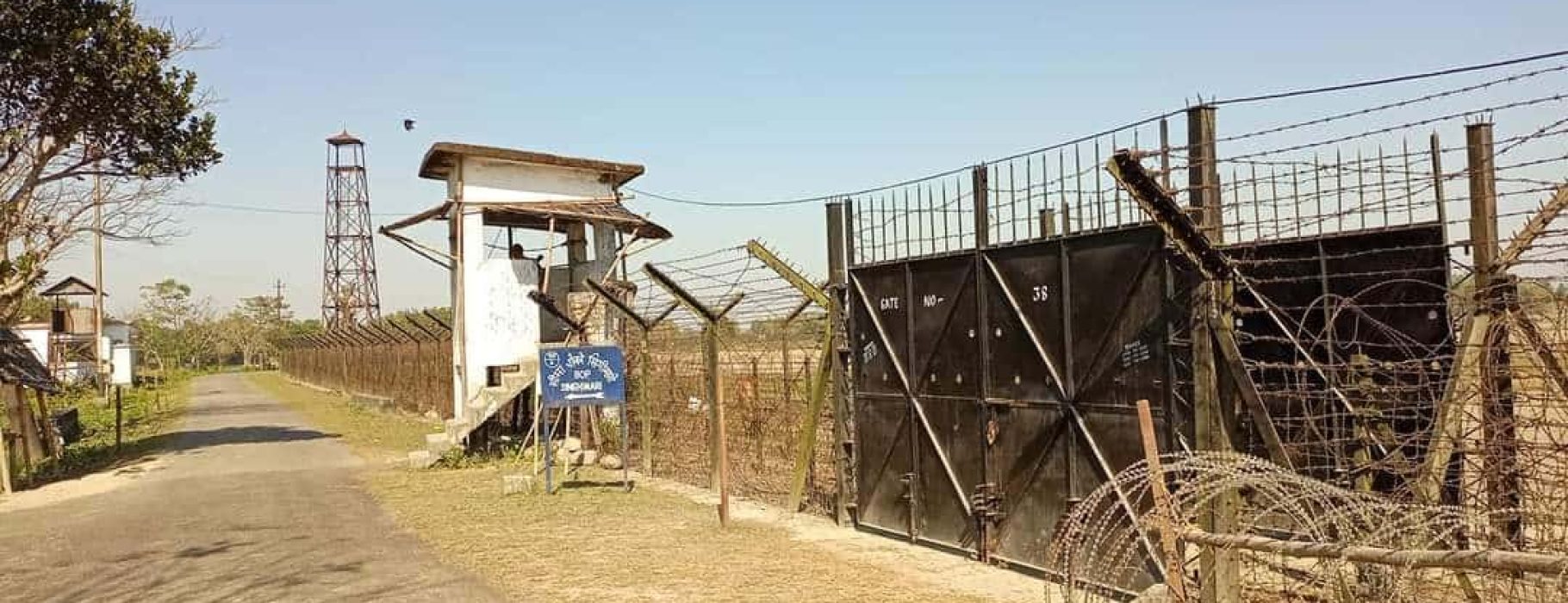
Over the last several months, tensions between India and Bangladesh have intensified across multiple fronts. Along their shared border, increased enforcement, fencing, and surveillance have been accompanied by reports of violent “pushbacks,” shootings, and the detention of suspected undocumented migrants. Reports of individuals being forcibly taken to the border and pushed into contested zones (sometimes at gunpoint) have drawn scrutiny from journalists and human rights observers.2Arshad Ahmad and Mahibul Hoque, “‘Foreigners for both nations’: India pushing Muslims ‘back’ to Bangladesh,” Al Jazeera, June 24, 2025, https://www.aljazeera.com/news/2025/6/24/foreigners-for-both-nations-india-pushing-muslims-back-to-bangladesh. These developments have unfolded alongside disputes over India’s deportation practices and treatment of Bengali-speaking populations, as well as economic frictions such as the withdrawal of key transit arrangements directly impacting Bangladeshi trade.3Manoj Kumar and Ruma Paul, “India withdraws transshipment facility for Bangladesh exports via land borders,” Reuters, April 9, 2025 https://www.reuters.com/world/india/india-withdraws-transhipment-facility-bangladesh-exports-via-land-borders-2025-04-09/. Often presented as isolated incidents or mere policy disagreements, these developments are better understood as part of a broader escalation, one that takes shape through distinct but interconnected dynamics within each country.
In India, this broader escalation has taken shape alongside the consolidation of Hindutva as a governing ideology, the expansion of a security state, and the increasing precaritization of the economy.4Christophe Jaffrelot, The Hindu Nationalist Movement in India (New York: Columbia University Press, 1998). Job insecurity, financial distress, and saturated informal labor markets generate contradictions that cannot be resolved through growth alone. Against this backdrop, heightened border enforcement and antagonism toward neighboring Bangladesh function more as instruments of displacement than as defensive necessities. This pattern has long been noted in critical accounts of postcolonial security and territorial nationalism. As Thomas Blom Hansen argues, Hindutva “connect[s] meaningfully with everyday anxieties of security, a sense of disorder, and…the ambivalence of modern life.”5Thomas Blom Hansen, The Saffron Wave: Democracy and Hindu Nationalism in Modern India (Princeton, NJ: Princeton University Press, 1999). Security bureaucracies are mobilized, surveillance is legitimized, and structural economic failures are reframed as problems of borders, infiltration, and internal threats.6Sankaran Krishna, Postcolonial Insecurities: India, Sri Lanka, and the Question of Nationhood (Oxford: Oxford University Press, 2000). India’s geoeconomic positioning across trade corridors, ports, and regional energy routes makes this strategy easier to sustain, allowing the state to project strength outward while avoiding the costs of open conflict.
Bangladesh, under an interim government whose legitimacy remains contested, is navigating a far more fragile moment in the wake of the 2024 ouster of Sheikh Hasina.7“Bangladesh’s Sheikh Hasina Forced to Resign: What Happened and What’s Next?” Al Jazeera, August 5, 2024, https://www.aljazeera.com/news/2024/8/5/bangladeshs-sheikh-hasina-forced-to-resign-what-happened-and-whats-next. The country’s heavy reliance on export-oriented growth, most notably in garment production, renders it especially vulnerable to shifts in global capital and regional power. The garment industry operates simultaneously as a mechanism for disciplining the working class and as Bangladesh’s primary exposure to imperial supply chains.8Naila Kabeer, The Power to Choose: Bangladeshi Women and Labour Market Decisions in London and Dhaka (London: Verso, 2000). Meanwhile, the state absorbs shocks, disciplines labor, and sustains outward flows of value, often at the expense of its own population. The country functions as a strategic buffer zone shaped by Indian, US, Chinese, and Gulf capital, with sovereignty exercised under tight constraints as global production networks reorganize state power around circulation and security.9Deborah Cowen, The Deadly Life of Logistics: Mapping Violence in Global Trade (Minneapolis: University of Minnesota Press, 2014), https://doi.org/10.5749/minnesota/9780816680870.001.0001. The costs of this positioning fall most directly on workers whose labor is indispensable yet disposable.
Particularly in recent years, Bangladeshi workers have faced intensifying pressures as a result of this positioning. Fluctuations in global demand amid broader economic uncertainty and competitive sourcing strategies wielded by multinational brands have driven down margins and heightened labor discipline. Periodic waves of factory closures, the delay or outright cessation of wage payments, and mass layoffs have all become routine. Efforts to raise wages or improve conditions are often met with repression, as strikes and protests are contained through a combination of state intervention and employer coordination. At the same time, maintaining Bangladesh’s position in global supply chains reinforces a model where labor stays cheap, flexible, and expendable, leaving workers essential to production and structurally disposable.10See, for example, Annie Kelly and Redwan Ahmed, “Workers for fast fashion brands fear starvation as they fight for higher wages,” Guardian, November 7, 2023, https://www.theguardian.com/global-development/2023/nov/07/workers-for-fast-fashion-brands-fear-starvation-as-they-fight-for-higher-wages; Mohammad Imon Kazi, “The Chaos of Wage Theft in Bangladesh’s Garment Sector Requires Global Accountability,” Diplomat, March 31, 2025, https://thediplomat.com/2025/03/the-chaos-of-wage-theft-in-bangladeshs-garment-sector-requires-global-accountability/ ; “Bangladesh: 10,000 garment workers protest over three months of withheld salaries since August 5 due to political unrest,” Business and Human Rights Centre, October 14, 2024, https://www.business-humanrights.org/en/latest-news/bangladesh-10000-garment-workers-protest-over-three-months-of-withheld-salaries-since-august-5-due-to-political-unrest/.
Markets alone cannot generate the level of coercion required to manage surplus labor, dissent, or uneven development. The security state fills that gap. Law enforcement and border agencies, surveillance regimes, and counterterror frameworks operate in concert. Together, they carry out forms of violence that many segments of capital, at least rhetorically, disavow, even as others remain directly aligned with or benefit from them. Repression is cushioned within the language of legality and “national security.” By outsourcing coercion to technocratic institutions, ruling classes can preserve a liberal veneer while retaining the capacity to discipline populations through force. The line between market and state breaks down in practice, even as its appearance is carefully maintained.
These dynamics sit within a broader global economic reconfiguration marked by intensified militarization in the Indo-Pacific and selective US supply-chain restructuring.11United States Department of War, National Defense Strategy of the United States of America (Washington, DC: Department of War, January 23, 2026), available at https://media.defense.gov/2026/Jan/23/2003864773/-1/-1/0/2026-NATIONAL-DEFENSE-STRATEGY.PDF; United Nations Conference on Trade and Development (UNCTAD), Trade and Development Report 2025: On the Brink – Trade, Finance and the Reshaping of the Global Economy (Geneva: UNCTAD, 2025), available at https://unctad.org/system/files/official-document/tdr2025_en.pdf.
Semiconductor production has been concentrated in Japan and Taiwan, electronics assembly diffused across Vietnam and India, and garment sourcing increasingly shifted toward Bangladesh. Despite the rhetoric of “decoupling” or “re-regionalization,” Chinese capital, components, logistics, and financing remain deeply embedded across these networks.12Zhi Wang et al., “Measuring FDI and Trade-Related Interdependence across Countries: The Case of the United States and China,” (working Paper, Center on China’s Economy and Institutions, Freeman Spogli Institute and Stanford Institute for Economic and Policy Research, Stanford University, Stanford CA, 2025), https://fsi9-prod.s3.us-west-1.amazonaws.com/s3fs-public/2026-02/us-china_interdependence_2.1.26_0.pdf; Wei Luo, Siyuan Kang, and Qian Di, “Global Supply Chain Reallocation and Shift under Triple Crises: A U.S.-China Perspective,” preprint, submitted August 9, 2025,
https://doi.org/10.48550/arXiv.2508.06828. Rather than eliminating dependency, this uneven restructuring redistributes it. States are left managing sharper pressures over surplus labor, political legitimacy, and alignment within an imperial order.13Samir Amin, Unequal Development: An Essay on the Social Formations of Peripheral Capitalism (New York: Monthly Review Press, 1976). It is within this material context, not in abstractions of religious or cultural animosity, that rising nationalism must be situated. This reframes how the present escalation is understood, particularly within the imperial core. There, security, humanitarian, and nationalist narratives go beyond obscuring the material forces at work, and actively organize how they are perceived, managed, and reproduced—for example, in media and policy accounts that frame border tensions as diplomatic crises or humanitarian emergencies rather than as mechanisms for managing labor, migration, and uneven development.14Anbarasan Ethirajan, “Crisis in India-Bangladesh relations spirals amid violent protests,” BBC, December 23, 2025, https://www.bbc.com/news/articles/c4gekjjqn1ro ; Tora Agarwala, “India intensifies expulsion of suspected foreigners to Bangladesh,” Reuters, June 10, 2025, https://www.reuters.com/world/asia-pacific/india-intensifies-expulsion-suspected-foreigners-bangladesh-2025-06-10/.
Ideology, the Security State, and the Management of Grievance
“Hindutva” refers to a form of Hindu nationalist ideology that seeks to establish India as a fundamentally Hindu political project, often through the exclusion or marginalization of religious minorities. In recent years, it has become the dominant ideological framework of the Indian state under the Bharatiya Janata Party (BJP), shaping political discourse and governance. As an ideological tool, Hindutva absorbs economic grievance by offering a collective outlet that redirects material frustrations away from capital. Rising unemployment and declining social mobility are acknowledged only to be reinterpreted through communal frames, in which Muslims, migrants, and “anti-nationals” become targets for resentment.15Rana Ayyub, Gujarat Files: Anatomy of a Cover-Up (CreateSpace Independent Publishing, 2016); Christophe Jaffrelot, Modi’s India: Hindu Nationalism and the Rise of Ethnic Democracy (Princeton, NJ: Princeton University Press, 2021), https://doi.org/10.1515/9780691223094. This operation leaves the structures of accumulation intact. For that reason, such movements often enjoy tacit or explicit support from dominant fractions of capital, stabilizing exploitation through reactionary nationalism.
This is not to suggest the absence of Islamist or other reactionary political currents within Bangladesh, but these do not occupy the same governing positions as Hindutva in India and therefore play a different role in shaping the present escalation.16On Islamist political currents in Bangladesh and their role within the country’s political development, see Ali Riaz, Bangladesh: A Political History Since Independence (London: I.B. Tauris, 2016), https://doi.org/10.5040/9781350985452. While such currents have at times shaped political life, they do not currently constitute a consolidated governing project comparable to Hindutva in India.
Markets alone cannot generate the level of coercion required to manage surplus labor, dissent, or uneven development. The security state fills that gap. Law enforcement and border agencies, surveillance regimes, and counterterror frameworks operate in concert. Together, they carry out forms of violence that many segments of capital, at least rhetorically, disavow, even as others remain directly aligned with or benefit from them. Repression is cushioned within the language of legality and “national security.” By outsourcing coercion to technocratic institutions, ruling classes can preserve a liberal veneer while retaining the capacity to discipline populations through force. The line between market and state breaks down in practice, even as its appearance is carefully maintained. Within the current Indian context, Hindutva provides an ideological framework through which these coercive practices are legitimized and selectively directed. It furnishes the categories of “anti-national,” “outsider,” and “infiltrator,” such that policing and exclusion are deemed acceptable and necessary.
Citizenship itself becomes a differentiated mechanism of discipline that no longer functions as a safeguard against exploitation. The mere existence of undocumented workers functions as a cautionary horizon, an implicit demonstration of how far citizens may fall. Under Hindutva, even formal citizenship no longer guarantees security. Hierarchies of religion, caste, and loyalty increasingly determine whose rights are honored and whose are revocable. For instance, Muslim citizens are frequently positioned as conditionally belonging. Their claims to protection are more readily suspended or undermined.17A. G. Noorani, The RSS and the BJP: A Division of Labour (New Delhi: LeftWord Books, 2000); Ashis Nandy, The Intimate Enemy: Loss and Recovery of Self under Colonialism (Oxford: Oxford University Press, 1983). The line separating citizen from underclass erodes accordingly, as large segments of the population are governed as though they were already disposable.
Borders as Mechanisms of Capital
Nowhere is this disciplinary logic more visible than at the border. India’s vast informal labor markets benefit directly from the presence of undocumented Bangladeshi workers precisely because their labor is rendered criminal and precarious. Construction, domestic work, sanitation, street vending, and app-mediated gig labor all rely on a workforce that is abundant, cheap, and easily discarded. Far from deterring migrant labor, criminalization transforms it into a more disciplined and controllable workforce. Legal vulnerability delivers workers to landlords, contractors, and intermediaries able to extract maximum surplus with minimal obligation. The result is a structurally entrenched underclass—one that underwrites economic growth while remaining officially unacknowledged, comparable in certain respects to undocumented labor in the United States, though shaped by its own distinct historical and political configuration.18Sandro Mezzadra and Brett Neilson, Border as Method, or, the Multiplication of Labor (Durham, NC: Duke University Press, 2013), https://doi.org/10.2307/j.ctv1131cvw.
Deportability is one of the most effective ways capital keeps wages low. The constant threat of detention or removal suppresses resistance. Migrant workers who attempt to organize, demand unpaid wages, or challenge unsafe conditions do so under the shadow of expulsion from both the workplace and the country. Remittances, family obligations, and uncertainty of reentry become instruments of leverage, binding workers to silence. Deportation, in this sense, operates as a technology of control, securing compliance without the need for overt repression.19Genevieve LeBaron and Nicola Phillips, “States and the Political Economy of Unfree Labour,” New Political Economy 24, no. 1 (2018), https://doi.org/10.1080/13563467.2017.1420642. In the context of the India-Bangladesh border, amplified anti-migrant rhetoric and enforcement are central mechanisms of the present escalation, disciplining labor through the language of security.
The effects of border violence extend well beyond migrant populations themselves. Spectacles of enforcement—fencing, shootings, pushbacks—operate pedagogically, signaling to citizens what awaits those who fall out of line.20Saskia Sassen, Expulsions: Brutality and Complexity in the Global Economy (Cambridge, MA: Harvard University Press, 2014), https://doi.org/10.2307/j.ctt6wpqz2. As in the United States, such violence reassures citizens that their own precarity could be worse, while also warning that dissent, disorder, or deviation carries consequences. Fear attempts to neutralize militancy by teaching populations that survival depends on obedience.
This phenomenon is not new. The contemporary function of borders in South Asia cannot be separated from their colonial origins. Beyond territorial division, partition inaugurated regimes of violence, documentation, and exclusion to manage newly surplus populations. From the mass displacements of 1947 to contemporary fencing and biometric regimes, borders have repeatedly served as instruments for sorting labor, fragmenting class solidarities, and enforcing uneven development. The present escalation belongs to a much longer history in which mobility is treated as threat and immobility as discipline.21Yasmin Khan, The Great Partition: The Making of India and Pakistan (New Haven, CT: Yale University Press, 2017); Vazira Fazila-Yacoobali Zamindar, The Long Partition and the Making of Modern South Asia (New York: Columbia University Press, 2007).
The Left on the Ground: Necessary Interventions, Structural Limits
Left organizations in the region have identified key elements of this dynamic, even as their frameworks and emphases diverge. The Communist Party of India (Marxist), for instance, has explicitly condemned the inhuman pushbacks and deportations of suspected Bangladeshi migrants carried out by Indian authorities. CPI(M) statements have called for migrants to be treated through established legal procedures rather than identified on the basis of religion, directly challenging communalized immigration enforcement that has disproportionately targeted Bengali-speaking Muslims. This includes individuals legally appealing their status who have nonetheless been forcibly removed.22“Statement on the Escalating Hostilities in Bangladesh,” Communist Party of India – (Marxist-Leninist) Liberation, December 20, 2025, https://cpiml.org/english/statements/statement-on-the-escalating-hostilities-in-bangladesh.
Seen this way, violence at the frontier does not signal a breakdown of order. It is one of its routine effects. Border enforcement, deportation, and selective immobility keep surplus populations in line while enforcing geopolitical alignment amid intensifying regional and global competition.
CPI(M) interventions have also raised concerns about how rising religious nationalism is affecting bilateral relations, urging both the Indian government and Bangladesh’s interim authorities to ensure the safety of minorities affected by violence since the fall of Sheikh Hasina’s government. These positions matter. They reject communal scapegoating and insist on procedural dignity at a moment when both are under sustained attack. But these limits reflect the structural constraints under which movements operate—constraints that no amount of rhetorical clarity alone can dissolve.
They also expose a persistent limitation in how these dynamics are understood. Migration, border violence, and economic coercion are frequently framed as policy failures or ethical breaches—giving rise to demands for stronger state intervention, the restoration of order, and the protection of minorities through legal and institutional means—rather than as intrinsic features of a capitalist political economy. Appeals to state responsibility, negotiation, and bilateral restraint presume a relatively level playing field between capitalist states, despite their unequal positioning within global production and power hierarchies. What remains underdeveloped is a material analysis of borders as sites where labor and migration are managed, and where the position of capitalist states within imperial hierarchies is actively produced.
Bangladeshi left and labor-oriented perspectives extend this critique in a different register. India’s role in this dynamic is primarily economic, with policy decisions that deepen preexisting structural vulnerabilities. The withdrawal of a key transhipment facility that had allowed Bangladeshi exports to transit via Indian land borders illustrates how trade infrastructure can be weaponized to tighten dependency within global supply chains. This is especially significant in an economy so dependent on garment exports. It raises trade costs, disrupts export flows, and further constrains Bangladesh’s already precarious position in global markets.23Manoj Kumar and Ruma Paul, “India Withdraws Transhipment Facility for Bangladesh Exports via Land Borders,” Reuters, April 9, 2025, https://www.reuters.com/world/india/india-withdraws-transhipment-facility-bangladesh-exports-via-land-borders-2025-04-09/.
Analyses from academic and policy circles echo these concerns: protests over border fencing, diplomatic friction following India’s muted response to extradition requests, and broader anxieties around sovereignty and unequal strategic alignment.24Abhaya Srivastava and Ruma Paul, “India to Withdraw Diplomats’ Families from Bangladesh, Source Says,” Reuters, January 21, 2026, https://www.reuters.com/world/asia-pacific/india-withdraw-diplomats-families-bangladesh-source-says-2026-01-21/. Taken together, these interventions provide essential correctives to both nationalist and liberal accounts. Without foregrounding the material function of borders themselves, even principled critiques risk mistaking the symptoms of escalation for its causes.
Geopolitics from Below
For garment workers in Bangladesh, geopolitics registers directly in everyday life. It appears as stagnant wages, ever-intensifying production quotas, and deteriorating working conditions. Decisions made in corporate offices and trade negotiations materialize on factory floors as longer hours and thinner margins for survival. Global demand, whether organic or algorithmically engineered, translates into relentless pressure to produce more for less—even where formal regulatory frameworks are supposed to apply.25Fair Labor Association, Wage Trends: Bangladesh (Washington, DC: Fair Labor Association, January 2024), available at https ://www.fairlabor.org/resource/fair-labor-associations-bangladesh-wage-trends-report-and-recommendations/.
Describing Bangladesh as a buffer state highlights the constraints under which its formal sovereignty is exercised. Export dependence, debt exposure, and strategic positioning render the country acutely sensitive to pressure from regional and global powers. Its place within garment supply chains makes it indispensable to global capital while limiting its political leverage.26United Nations Conference on Trade and Development (UNCTAD), Trade and Development Report 2025: On the Brink – Trade, Finance and the Reshaping of the Global Economy (Geneva: UNCTAD, 2025), availalbe at https://unctad.org/system/files/official-document/tdr2025_en.pdf. For example, shifting sourcing strategies by multinational firms under “China+1” dynamics can rapidly reallocate production orders across borders in response to cost fluctuations or geopolitical developments.27“China+1” refers to a recent strategy among multinational firms to reduce overreliance on Chinese labor by incorporating at least one additional country as a secondary manufacturing hub. In practice, this has increased demand for cheap labor in countries such as Bangladesh, effectively repositioning them within new circuits of accumulation they do not control. Dependence on external capital flows and demand remains intact, even as global firms derisk and stabilize profit margins. When labor conditions in one country become “unfavorable” in the eyes of these firms, production is redirected to alternative low-cost sites, leaving export economies such as Bangladesh highly exposed to decisions made by external actors and a labor force that is globally integrated yet structurally disposable.28Shab Enam Khan, “Bangladesh’s economic future amid shifting geopolitics of supply chain,” Financial Express, December 8, 2025, https://thefinancialexpress.com.bd/economy/bangladesh/bangladeshs-economic-future-amid-shifting-geopolitics-of-supply-chain.
A structurally similar dynamic is visible across large segments of India’s working class, particularly among migrant construction workers, informal manufacturing laborers, and platform-based gig workers concentrated in urban centers. Like garment workers in Bangladesh, these workers occupy positions that are indispensable to accumulation yet organized to remain politically weak. Subcontracting, casualization, and geographic mobility fragment solidarity while keeping wages low and labor replaceable. Their work feeds regional and global circuits of value—logistics corridors, urban consumption, informal manufacturing—while their conditions are framed as individual misfortune instead of something produced by the system itself.29Jan Breman, At Work in the Informal Economy of India (New Delhi: Oxford University Press, 2013).
Across borders, these workers occupy similar positions within an economic order structured around informality and disposability. Bangladeshi garment workers are rendered competitive with other sites of global garment production through suppressed wages and political constraints. Indian informal workers are rendered compliant through precarity, debt, and the ever-present threat of exclusion from housing, employment, and citizenship itself. In both cases, the language of national interest obscures a deeper convergence by recasting shared material conditions as matters of national competition, encouraging workers to interpret the situation through rivalry and threat rather than through their shared position within the same structure of exploitation.30David Harvey, The New Imperialism (Oxford: Oxford University Press, 2003), https://doi.org/10.1093/oso/9780199264315.001.0001.
The escalation between India and Bangladesh depends not only on border management and diplomatic posturing but on the active fragmentation of these shared material conditions. National antagonism redirects frustration away from capital and toward neighboring populations facing variations of the same exploitation.
What The Escalation Reveals
Taking the escalation between India and Bangladesh seriously means abandoning the language of diplomatic miscalculation or episodic failure in favor of a clearer account of how the crisis is administered. Borders, migration regimes, and security infrastructures sit at the center of the relationship between the two states. They are the primary mechanisms through which class power is exercised and contradictions are contained.31Mezzadra and Neilson, Border as Method. At the India-Bangladesh border, this takes the form of surveillance, fencing, and enforcement regimes that restrict movement, criminalize migration, and subject labor to intensified control and precarity.
Seen this way, violence at the frontier does not signal a breakdown of order. It is one of its routine effects. Border enforcement, deportation, and selective immobility keep surplus populations in line while enforcing geopolitical alignment amid intensifying regional and global competition. Nationalist escalation performs essential ideological work, redirecting material grievances away from capital and toward populations occupying structurally similar positions within the same political economy.32Achille Mbembe, Necropolitics (Durham, NC: Duke University Press, 2019).
Even within a system structured around managed antagonism, escalation still carries significant risk. Miscalculation or overreach can produce outcomes that exceed the intentions of those involved, including the possibility of broader regional conflict. Explanations centered on cultural or religious antagonism misrecognize both the origins and function of the present tensions. A regional order is taking shape in which mobility is criminalized, labor made disposable, and antagonism actively managed to reproduce the conditions of accumulation. Borders, in this context, do more than divide states. They fracture solidarities that might otherwise expose the shared material foundations of the crisis.33Benedict Anderson, Imagined Communities (London: Verso, 1983); Frantz Fanon, The Wretched of the Earth (New York: Grove Press, 2004).