
Alien Planet, Dead Labor

Review of Hellworld: The Human Species and the Planetary Factory

October 16, 2026

doi.org/10.63478/P4CAO4TM
cover
Hellworld: The Human Species and the Planetary Factory
by Phil A, Neel
Brill
2026

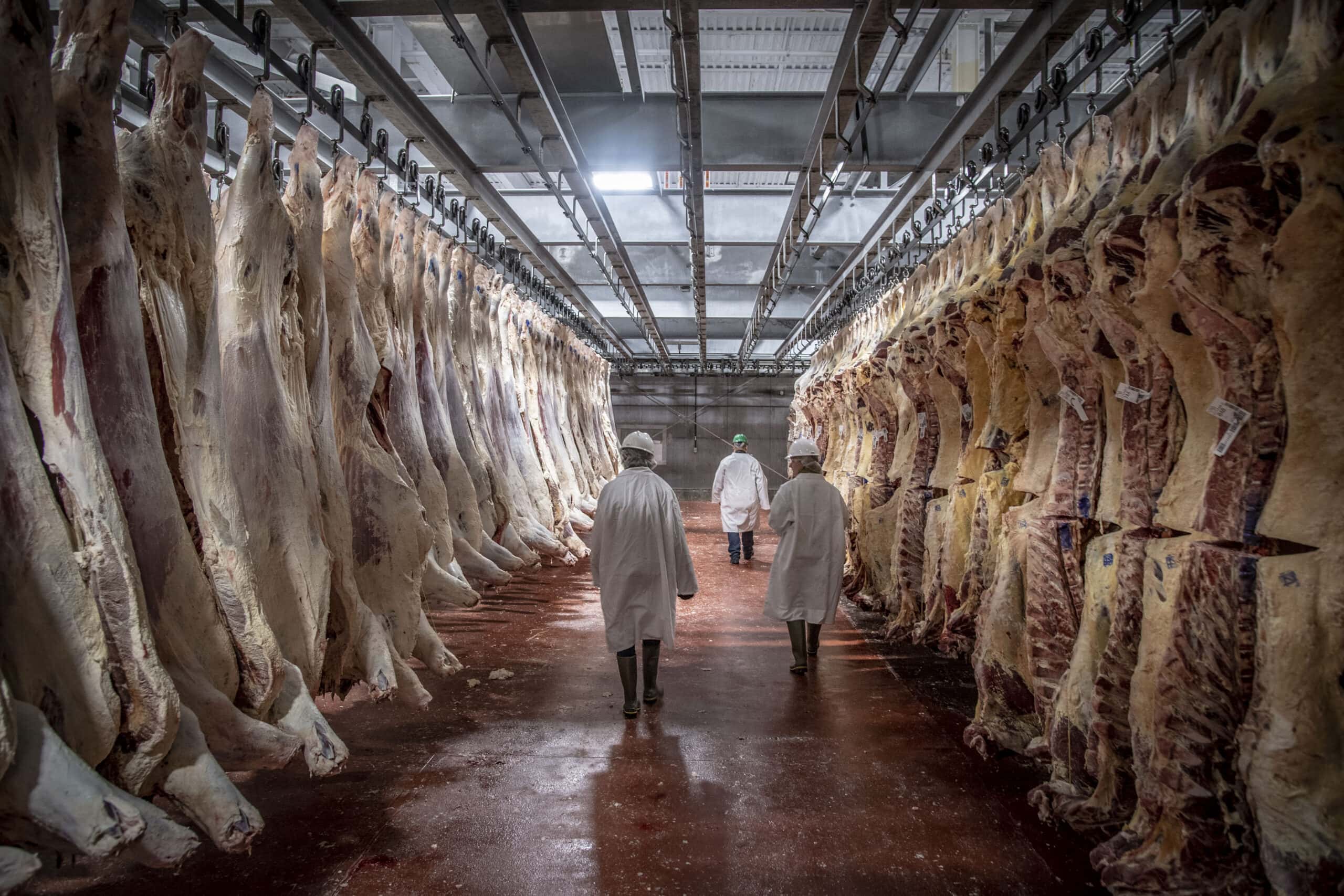
Smithfield Foods is the world’s third-largest pork producer. Its processing facility in Tar Heel, North Carolina, is the largest in the world—a collection of parking lots, slurry lagoons, and a million square feet of buildings spread over 880 acres along an unremarkable stretch of Highway 87, twenty miles south of Fayetteville. Its heavily automated disassembly lines slaughter thirty-five thousand hogs every day and turn out two billion pounds of pork every year. An immense assemblage of computer vision systems, AI-assisted robots, and “smart” conveyors splits carcasses, pulls ribs, and trims bellies with inhuman speed and precision. In 2013, Smithfield changed hands: the Luter family of southern Virginia handed over their century-old, “all-American” enterprise to WH Group, the Chinese food-processing company led by Wan Long, a billionaire from Henan and a pioneer of his own country’s pork industry. Eight years later, a father-son feud tore through WH Group’s succession plan, briefly rattling the global meat industry and the firm’s stock value alike.

The Introduction to Phil A. Neel’s Hellworld tells this story as an allegory of the transformations it seeks to decipher—“the apparent decline of the US, the apparent rise of China, the apparently all-encompassing power of capitalism over our lives.”1Phil A. Neel, Hellworld: The Human Species and the Planetary Factory (Leiden: Brill, 2026), xx. Yet, as the qualifier attests, these are merely historically specific forms of appearance of capital’s expansionary drive as a “form of social organization…wherein masses of material and billions of bodies are made to accord with supervening imperatives set by an overarching ‘logic’ operating at an emergent level of agency, beyond the control of even the most powerful individuals who embody it.”2Neel, Hellworld, xxi. At a more fundamental level, Smithfield’s gargantuan hog factory is a metaphor made flesh: proof of capital’s strange power to bend countless life processes to a “logic” that seems to run on its own. Hellworld takes us on a journey into the alien—and alienated—world wrought by capital: into the bowels of its technical apparatus, the “planet-strangling horror of fixed capital” that exerts a despotic power over the conditions of human existence.

Neel has been tarrying with this horror for several years. An economic geographer by training, his efforts have taken him to a despoiled hamlet in the Pacific Northwest, a trailer park in rural Nevada, Foxconn’s megafactory in Shenzhen, a farm on the outskirts of Bangkok, the uswahilini of Dar es Salaam, and the Tanzanian port town of Bagomoyo. Across two books and a growing number of essays, interviews, and journal articles, Neel has emerged as one of the most distinctive voices on the communist left, marshaling a rare combination of analytical rigor and writerly flair to lay bare the inner workings of the capitalist world economy.

His first book, Hinterland (2018), sought to identify revolutionary scissures in the United States’s post-industrial landscape by traversing the “sunken continent” splayed between big-city agglomerations.3Phil A. Neel, Hinterland: America’s New Landscape of Class and Conflict (London: Reaktion Books, 2018). Using a simple spatial typology (core, near hinterland, and far hinterland), Hinterland developed a conjunctural interpretation of production and proletarian life. Its major argument was that the concentrations of wealth and people in the United States’s cities are grounded upon expansive hinterlands that are occulted from popular and scholarly view: sites of extraction, agroindustrial production, and primary processing (far hinterland) as well as the gradated peripheries of cities (near hinterland) comprised of industrial districts, warehouses, logistics hubs, and working-class suburbs. A combination of memoir, reportage, and political analysis, Hinterland was a searing portrait of abjection and social collapse unfolding in the long shadows of the United States’s urban centers. Since its publication, Hinterland has become a totem of the post-2008 ultraleft.

Hellworld is a radical expansion of Neel’s field of vision. It elaborates upon many of the themes he has explored over the past decade, combining insights from Hinterland with research from his 2021 doctoral dissertation, “Global China, Global Crisis: Falling Profitability, Rising Capital Exports, and the Formation of New Territorial Industrial Complexes.”4Phil A. Neel, “Global China, Global Crisis: Falling Profitability, Rising Capital Exports and the Formation of New Territorial Complexes,” (PhD diss., University of Washington, 2021). The result is one of the most audacious works of Marxist scholarship in recent memory: a book that dares, against every case for modesty, to attempt a totalizing account of capitalist society.
…though it is an artifact of this epistemic churn, Hellworld is distinctive in doubling down on capital as both explanandum and explanans. It turns on the gambit that our understanding of capital is not totalizing enough.

By its very nature, Hellworld is a mammoth, maddened book, spanning nearly eight hundred pages and organized into two parts and twelve main chapters. Its length is justified by its prodigious scope. Geographically, China and East Africa form its primary axis, with lengthy excursions into Hong Kong, Thailand, and the United States. Then there are its more “esoteric” and synthetic chapters, which variously assemble a conceptual lexicon, present genealogical and historical surveys, and establish what might be called a framework. Methodologically, Hellworld resurrects the postdisciplinary promise of historical materialism—readers will encounter ethnography, old-fashioned industrial geography, macroeconomic analysis, post-Maoist political philosophy, critical musicology, obscure internet subcultures, and, if one pays attention, even a fleeting excursus into Jain metaphysics. But more than anything else, Hellworld is a horror story of unrelenting intensity. “This book is a test in endurance,” admits the prefatory reading guide. Its inclusion attests to the protean quality of what follows. 

The Planet as Fixed Capital

The problem with capital is that it is invisible. This poses a challenge for its critics, especially for those committed to the notion of totality. “No one ha[s] ever seen this totality, nor is capitalism ever visible as such, but only in its symptoms,” Fredric Jameson once observed. Thus, any attempt to represent it is bound to be a “combination of diverse and heterogeneous modes of construction and expression…a mixture of approaches that signals the multiple perspectives from which one must approach such a totality and none of which exhaust it.”5Fredric Jameson, Representing ‘Capital’: A Reading of Volume One (New York: Verso, 2014), 6. For Jameson, totality is, above all, a method of cognizing the historical development of capitalist society. It is based on the presupposition that the whole is as inexpressible as it is irreducible, a condition that calls forth a confrontation between thought and its historicity. Writing in the early 1990s, Jameson argued that the “mechanisms and dynamics” of late capitalism “cannot be detected on the surfaces scanned by satellites, and therefore stand as a fundamental representational problem—indeed, a problem of a historically new and original type.”6Fredric Jameson, The Geopolitical Aesthetic: Cinema and Space in the World System (Bloomington: Indiana University Press, 1992), 2.

Hellworld proceeds from the intuition that capital’s “social” totality is now commensurate with the biogeophysical planet itself—not a world-system but a capitalist earth-system whose structural dynamics might indeed be detected by satellites and sensors. China’s dramatic ascendance marks the inauguration of this new totality, signaling the evolution of capitalist society from a “merely global system” to a planetary one, “operating as a geospheric force in and of itself.”7Neel, Hellworld, 41. What is being named here, of course, is the epistemological problem of the present conjuncture, portended by Jameson at the end of the last century. The first two decades of this century have thus seen a proliferation of concepts and keywords that seek to grapple with this new totality: “hyperobjects,” “polycrisis,” and “planetarity,” to name just a few. One of the features of this climate of social thought is the claim that the magnitude of the present crises exceeds what capital and “capitalocentric” social theories can explain.8A view recently echoed by Adam Tooze in his claim that the radical novelty of the present situation confounds “classical” social theories, including “capitalocentric” ones. Adam Tooze, “Chartbook 343: Polycrisis and the Critique of Capitalocentrism,” Chartbook (substack), January 6, 2026, https://adamtooze.substack.com/p/chartbook-343-polycrisis-and-the. And though it is an artifact of this epistemic churn, Hellworld is distinctive in doubling down on capital as both explanandum and explanans. It turns on the gambit that our understanding of capital is not totalizing enough. Meanwhile, capital’s totalization is so complete that “to directly perceive ‘capital,’ as such, is to be annihilated in the mad threshing of its serrated flesh.”9Neel, Hellworld, 9. Its presence is “so overwhelmingly sensible” as to nullify apperception. Jameson’s problem is thus turned on its head: capital’s totality is so fully felt that it resists being thought at all.

US Department of Agriculture (USDA) meat inspectors and graders perform their mission. Photo Credit: USDA photo by Preston Keres. Original public domain image from Flickr
US Department of Agriculture (USDA) meat inspectors and graders perform their mission.
USDA photo by Preston Keres. Original public domain image from Flickr

The chapters comprising Part One assemble the theoretical and literary resources to make sense of this problem. Chapter Two reconstructs the earth scientist Peter Haff’s concept of the “technosphere” to show that the autonomous, agentic properties he assigns to the planetary system of human-made technological artifacts are effects of capital’s emergent logic. This alienated form of appearance, the technosphere, reveals itself to be no more—and no less—than objectified, dead labor deposited onto the planet’s lithosphere during the course of capital’s self-expansion. “The supervening force entraining human life to its purpose is not, actually, technical—at least not directly so,” Neel writes. “Instead, the planetary system only appears to us in the immediate form of ‘technical equipment,’ ‘instruments,’ and ‘installations.’” Capital’s planet-scaled apparatus is, in other words, a dissimulation produced by its social relations, “just as the commodity, at first sight a trivial thing, forms the starting point for the analysis of capital’s abstract laws of motion, so too might the geospheric mass of all commodities—as the materialized form of appearance of capitalist society—offer a point of departure for mapping out the tectonic structure of the planetary productive complex set into motion by those laws.”10Neel, Hellworld, 96.

Quantifications of anthropogenic mass are counterposed with conventional economic data to show that this structure develops according to a determinate pattern: its growth spurts correspond to periods of “the fastest overall output and productivity growth.”11Neel, Hellworld, 106. Haff’s concept thus identifies the phenomenon, but misdiagnoses its causes, for the piling up of layers upon layers of fixed capital is nothing but a necessary tendency of capital. And insofar as the technosphere has “agency,” it is derived from the imperatives of a “specifically capitalist system of social domination.”12Neel, Hellword, 113. What emerges in these early chapters is a vision of a planet sheathed in an exoskeleton secreted by the inhuman, alien force that is self-valorizing value. Neel likens this process to “xenoformation”— “the dark impulses of accumulation resculpting the very crust of the planet into inhuman, inhospitable territories attuned to the endless circuit of capital hurtling through its feverish seasons.”13Neel, Hellworld, 9.

Capital as Subject

Marx called capital an “automatic subject” (automatisches Subjekt) due to its ability to move autonomously. Even though it is made up of a social substance, value, “by virtue of being value…has acquired the occult ability to add value to itself.”14Karl Marx, Capital Volume I, Penguin Classics (London: Penguin Books in association with New Left Review, 1990), 255. The notion of value as an independently acting “agent” has spawned generations of debate and whole interpretive traditions: the Wertkritik School, Théorie Communiste, and various strands of “value-form” theory. While Hellworld’s theoretical edifice rests on a notion of capital as an automatic subject, it rejects the thoroughgoing capital-logic determinism of many value-form approaches and recuperates a more obscure, materialist variant of value theory associated with the militant Neapolitan left-communist Amadeo Bordiga (a founder of the Italian Communist Party and an early, inveterate critic of Soviet “state capitalism”). 

In a 1957 essay, based on a reading of Marx’s “Fragment on Machines,” Bordiga described capital as “a Beast without a soul and, even, without life, but that devours and kills living labour, the labour of the living, and the living themselves” and a monster whose body takes the form of “objectified labor, fixed capital.”15Amadeo Bordiga, “Who’s Afraid of Automation?” in The Science and Passion of Communism: Selected Writings of Amadeo Bordiga (1912–1965), ed. Pietro Basso (Chicago: Haymarket, 2020 [1957]), 467, https://doi.org/10.1163/9789004421653, quoted in Neel, Hellworld, 197.  Just as Marx had looked at the nascent machinery of his time as an embodiment of capital’s power over living labor, Bordiga drew on his observations of industrial automation in the 1950s to posit a near future in which the scale of “fixed installations” and the pace of their proliferation would allow capital to totalize its domination over human beings and their environments. Dead labor, after first enslaving living labor, would eventually overcome the need for humans altogether, functioning as an automatic, self-reproducing system. The French philosopher Jacques Camatte, Bordiga’s most influential disciple, likened this condition to “domestication,” whereby the “autonomization of value” had resulted in the total subsumption of society and subjectivity. In becoming the “dominant subject of the production process,” capital had replaced the “community of man” with its own “material community.”16Jacques Camatte, Capital and community: the results of the immediate process of production and the economic work of Marx (London: Unpopular books, 1988 [1976]), available at: https://www.marxists.org/archive/camatte/capcom/ch06.htm.

Neel draws on this subterranean current of value-form Marxism—its theoretical content and literary style—to cultivate what can only be described as a Gothic poetics of the Capitalocene. He luxuriates in a baroque form of macabre realism that plays up the quotidian horror of a society based on exchange value. “The ruddy brown mucus strings from your flailing arms like a web,” he writes, invoking a gruesome type of industrial accident associated with livestock factories. “Every breath burns. Your body becomes a ceremonial vessel filled with thrashing flames. Imagine the feeling. Imagine the bio-industrial effluent filling your ears, your mouth, your nostrils.”17Neel, Hellworld, 35.

Technical capacity is piled atop previously developed blocs, reproducing a generalized inability to realize returns on investments.…The implication is that global deindustrialization…is not the end of industrial capitalism, but its world-historical apotheosis.

Throughout, Neel uses the Gothic style as a deliberate mode of figuration, recalling Marx’s metaphors and more recent experiments in “Dark” or Gothic Marxism. The turgid category of fixed capital is transmuted into a grotesque, vital presence; capital becomes an occult force that blinds us to the perverse alterity of the very environments we unthinkingly inhabit. The chapters in Part One introduce the reader to a range of ideologemes drawn from Western esotericism and Victorian mysticism: capital is likened to an “egregore,” a spirit entity conjured by ritual that eventually begins to control its conjurers and their rituals. The economy is likened to an occult world-bestriding creature that looms over us but also lives within us, an “eldritch horror” with strange trophic habits. Its tissues are made up of firms, which, in turn, are composed of “cells of fixed capital” and “easily interchanged fluid elements” such as raw materials and human labor. Industrial agglomerations are its critical organs and sectoral supply chains are the connective tissues that tie them together into “organ systems spanning the planet.”18Neel, Hellworld, 144. Metaphors are often pushed past their breaking points, and the style can be, as Neel himself admits, overwrought.

For Neel, capital’s structure of social domination is quite literally inscribed in the material world, the self-perpetuating planet-spanning technical apparatus from which there is no escape. And yet, even as it sculpts the planet according to its own logic, capital is not, in fact, a demiurge but something much more terrifying: an emergent force that lives—and can die—by the social practices of human beings. Capital’s subjectivity, on closer inspection, is a mirage. Far from being epiphenomenal to capital’s material community, class struggle is in fact constitutive of it.

Deindustrialization and the Planetary Geography of Value

Beneath the Gothicism sits a rather more prosaic economic argument: capital accumulation drives a rise in the organic composition of capital—the ratio of constant to variable capital—as a result of the competitive drive to increase labor productivity. As firms invest in technical improvements, the ratio of constant to variable capital rises. By cheapening the goods workers consume, rising productivity reduces the necessary labor time, thereby enlarging the portion of the working day that yields surplus value—what Marx called relative surplus value. The same process, however, displaces living labor from the production process and generates a tendentially growing relative surplus population: masses of workers rendered superfluous to capital’s self-expansion, even as they remain reliant on capital and the market for their survival.

Neel argues that the competitive drive to maximize relative surplus value operates as a lever on the world economy. It affects processes up and down the value chain, restructuring the division of labor and transforming places that have little to do with industrial production qua manufacturing. An increase in relative surplus value in any particular location “cascades through the entire planetary production complex.”19Neel, Hellworld, 202. Under conditions of overcapacity and intensifying intercapitalist struggle, “the competition to become the next site for industrialization becomes an increasingly zero-sum affair.”20Phil Neel with Komite, “Hostile Brother: New Territories of Value and Violence,” Brooklyn Rail, November 2023, https://brooklynrail.org/2023/11/field-notes/Phil-Neel-with-Komite/. What ensues is a kind of territorial hopscotch. The gravitational centers of manufacturing are displaced over progressively shorter intervals of time—a process that gives rise to what the geographers Michael Storper and Richard Walker, two of Neel’s theoretical touchstones, called the “inconstant geography of capitalism.”21Michael Storper and Richard Walker, The Capitalist Imperative: Territory, Technology, and Industrial Growth (Basil Blackwell, 1989), chapter 1. Even the “late developers” run into overcapacity and declining profitability. Technical capacity is piled atop previously developed blocs, reproducing a generalized inability to realize returns on investments, even as the whip of competition keeps spurring technological change and overaccumulation. The implication is that global deindustrialization—expressed in ever-faster rounds of industrial relocation, the falling share of employment in manufacturing, transregional labor arbitrage, and the expansion of service work—is not the end of industrial capitalism, but its world-historical apotheosis.

Neel traces the evolution of the planetary factory through the condensates left behind by cycles of territorial development—restructurings that periodically shift capital’s regional centers of gravity, producing new concentrations of industry and destroying old ones, while scrambling the webs of infrastructure, logistics, and finance that undergird them. The chapters dealing with Neel’s main field sites—the industrial agglomerations of Shenzhen and the broader Pearl River Delta (Chapter Three), and Dar es Salaam (Chapters Ten and Eleven)—dramatize the spirals of exploitation, superexploitation, and abjection that propel capitalist development through a close inspection of its political and cultural excrescences.

Extending Robert Brenner’s influential account of the Long Downturn, Neel argues that China’s developmental trajectory in the twenty-first century has tended towards the “global norm” of chronic overcapacity, declining profitability, a falling industrial share of fixed capital investment, and (since 2012) a decline in the manufacturing share of total employment. Based on estimates of gross fixed capital formation in the past two decades, Neel shows that the share of investment in industrial machinery steadily declined relative to investment in the built environment, particularly in infrastructure and housing. Meanwhile, mechanization and automation intensified at the higher ends of the value chain, driving a dramatic increase in service-sector employment in China’s urban-industrial zones. By the early 2010s, “the global wave of deindustrialization had arrived” even as China was on its way to becoming the global center of industrial production.22Neel, Hellworld, 126.

This contradictory process manifests at different spatial scales, both within regions and, most strikingly, between them. This is illustrated through a discussion of cultural forms that refract the polarizations between China’s sunbelt and rustbelt regions: the late Xu Lizhi’s poetry, composed from within the belly of Foxconn’s industrial behemoth in Shenzhen; Geng Jun’s portrayals of the rustbelt landscapes of Dongbei, China’s paradigmatic post-industrial region; and hanmai (“shouting into the mic”), the low-fidelity, livestreamed rant-rap born in the Northeast, which gives voice to plebeian male disaffection—a vernacular music of Chinese deindustrialization. “Xu’s poetry and Geng’s films,” writes Neel, “are something like living sculptures of real subsumption, designed to capture the social mechanics of relative surplus value extraction, albeit from opposite ends.”23Neel, Hellworld, 252.

Rather than treat China as a deus ex machina, Neel seeks to deprovincialize its postreform trajectory and assess it through the general categories of capitalist development, such that it becomes legible as a story of firms, competition, and class formation and fragmentation, unfolding within a planetary forcefield of production and circulation that produces a distinct, multiscalar geography of uneven development. For Neel, the world-historical significance of China’s integration is the fact of integration itself: the breathtakingly rapid incorporation of Chinese firms into planetary value chains—increasingly at the most advanced stages of the production process—and the corresponding increase in outbound capital flows.

Premature or persistent deindustrialization, whether in Tanzania or Kenya, is not an anomaly; it is a predictable result of value production. As Neel repeatedly emphasizes, the rising organic composition of capital anywhere sheds industrial labor everywhere.

The chapters on China prime the reader for those that trace Tanzania’s developmental arc over the second half of the twentieth century, both within the broader context of African postcolonial development and against the more expansive backdrop of the 1970s world economy. The promise of postcolonial national development—emblematized by Nyerere’s ujamaa policies—was hamstrung from the outset by a series of structural factors, including an overreliance on metropolitan capital and state capture by a comprador “subaltern elite” that together facilitated the “multilateralization of imperialist domination” during the postcolonial period.24Neel, Hellworld, 645–46.  Even when successful import-substitution industrialization strategies were instituted, they did not enable industrial self-reliance; they made countries “more dependent on trade, rather than less.”25Neel, Hellworld, 642. By the turn of the century, having been battered by waves of structural adjustment administered by US-led multilateral institutions, most countries in sub-Saharan Africa were worse off than they had been thirty years earlier.

Neel sets this trajectory against postcolonial developmental debates, opening with a fascinating discussion of Dar es Salaam’s heyday as a center of Marxist thought, and against macroeconomic cases such as Ethiopia’s to critique Arthur Lewis’s “dual sector” and W.W. Rostow’s “take-off” models of economic development. This leads into an alternative explanation for Africa’s subordinate position in the global economic hierarchy. Drawing on Ruy Mauro Marini’s value theoretic reconstruction of dependency theory, Neel argues that the sectoral and geographical unevenness is a necessary and permanent condition of value production—“underdevelopment produced in particular areas” is the “condition of the development of capitalist society as a whole.”26Neel, Hellworld, 671. Because relative surplus value depends on cheapening the wage-goods that workers consume, productivity gains in subsistence goods anywhere devalue labor-power everywhere, translating productivity increases in one region into rising rates of surplus value in another. At the same time, this mechanism of transfer necessarily entails driving down the cost of labor-power in some areas below the cost of its reproduction—in a word, super-exploitation. “Unequal exchange,” Neel thus writes, “is merely the epiphenomenal appearance of the inherently uneven production of relative surplus value.”27Neel, Hellworld, 672.  Imperialism, on this account, is understood as the stabilization and coordination of unevenly composed capitals—different organic compositions across regions, sectors, and firms—into a single, stratified hierarchy of value production.

Neel’s analysis of the East African end of these value chains focuses on how, where, and in what form Chinese capital touches the ground in Dar es Salaam. His own survey of Chinese-owned firms finds them to be “relatively small-scale private companies operating manufacturing and warehousing facilities in and around Dar es Salaam.”28Neel, Hellworld, 618.

Contrary to popular narratives of Chinese neocolonialism in Africa, Neel argues that the presence of Chinese capital is an ordinary form of crisis displacement in which capital facing overcapacity and declining profitability at home seeks profitable outlets abroad, rather than the result of a consolidated imperial strategy. In Dar es Salaam, this manifests as the occasional Chinese-owned export-oriented industrial facility floating amid the vast, informal uswahilini. Meanwhile, Neel shows that the preponderance of Chinese-owned firms is involved in the local construction sector—in the production and warehousing of building materials—rather than high-value-added export manufacturing.

Premature or persistent deindustrialization, whether in Tanzania or Kenya, is not an anomaly; it is a predictable result of value production. As Neel repeatedly emphasizes, the rising organic composition of capital anywhere sheds industrial labor everywhere. “The process of deindustrialization,” he writes, “is therefore better understood as something more like the uneven distribution of the rising organic composition of capital,” not only between nation-states but also within them.29Neel, Hellworld, 684. The upshot of this argument is that specific national development trajectories are historical-geographical crystallizations of the tendencies and countertendencies of value production that can “only be understood at a total social scale.”30Neel, Hellworld, 675. Thus, phenomena such as the persistence of Tanzania’s vast informal economy and the expansion of highly underpaid, digitally mediated service work across much of Africa and Asia are expressions of the “continual reproduction of a surplus proletariat that serves as the social and material substrate of planetary production itself.”31Neel, Hellworld, 684.

Neel’s economic analysis shares a common thread with the work of Endnotes and Chuang, prominent partisans of the communization current who have mobilized Marx’s concept of surplus populations to diagnose the state of the working class amid the deindustrialization of work. An occasional Endnotes contributor, Neel dedicates a cluster of chapters (mainly five, seven, and nine) to the question of class struggle and revolutionary subjectivity. Here, the macrostructural analyses serve as a foil for another, more intimate register that bespeaks Neel’s proximity to many of the struggles he writes about.

Revolutionary Subjects?

In a memorable passage in Hinterland, Neel recounted visiting Ferguson weeks after Michael Brown’s murder, soon after the first uprising had died down. “We weren’t really there to agitate,” he wrote, “but simply to observe how politics and repression might play out in our era’s first major revolt in the American hinterland.…The driving questions were, how does a riot grow in this decentralized space, and what limits its growth? Can a new communist politics emerge from capitalist sprawl?”32Neel, Hinterland, 136. The question is posed more expansively, but answered somewhat less persuasively, in Hellworld. Neel argues that there is no essential class subject of the revolutionary vanguard; there is no privileged class fraction waiting to be activated by an adequately hard-nosed, anti-identitarian economic populism and no segment of the working class—for instance, the male factory worker—predisposed to serving as the agentive force of revolution. There exists “no strict homology between a demographic group’s structural position within the productive apparatus and its propensity to gain any sort of revolutionary consciousness.”33Neel, Hinterland, 231. In the planetary factory, the proletariat is unified only by its separation.

Much ink has been spilled on the contingent nature of class struggle under contemporary capitalism. From the riot to the occupation to the encampment, from “circulation struggles” to conflicts in the sphere of social reproduction, it is now commonplace that the terrains and subjects of revolutionary struggle will not resemble those of the past. The relationship between productive subjectivity and revolutionary subjectivity—the gambit of traditional communism—has been sundered by the relentless march of relative surplus value, whose extractive apparatus works through the desocialization of labor and the fragmentation of collective agency.

In Hinterland, Neel used the figure of the football ultra to meditate on the animating role of militant cells in twenty-first-century insurrections in North Africa, Europe, and the United States. These ultras were united by something “other than basic political agreement”: an “oath of action” that enabled them to play a pivotal role in advancing unrest. Their effectiveness stemmed not from a political program articulated in advance, but from their tactical competence, organizational prowess, and propensity to generate intense bursts of militant power. The principle that united them was their fidelity to each other and, most importantly, “to the unrest itself.” The oath as an organizing principle, Neel suggested, could ground a protocommunist politics of action: “the inclusive, flowing unity of those who wish to push the rift open, to spread it further, to extend it longer, or to ensure that the potential spreads.”34Neel, Hinterland, 155.

Neel repeatedly tries to pry apart the tightly woven determinism of value-form theories, searching…for the emancipatory and revolutionary energies latent within capital’s own crisis-riven movement. This takes him onto shakier ground…

Chapter seven of Hellworld takes stock of the 2014 and 2019­–20 protests in Hong Kong, charting the various factions and figures that coalesced into the pan-democracy movement. The core dynamic, Neel argues, was a generative tug-of-war between those committed to nonviolent protest on the terrain of civil society and those who pushed against its limits, deploying violence through riots, arson, and property destruction. In their own assessment of the 2019–20 protests, Chuang referred to the latter as “frontliners”: small factions who developed new methods of confronting the police and defending against state violence, and, in the process, articulated durable, mutualistic relations of solidarity with the broader movement.35“Welcome to the Frontlines: Beyond Violence and Nonviolence,” Chuang, June 8, 2020, https://chuangcn.org/2020/06/frontlines/.

Saying that the Hong Kong uprisings failed would miss the point. They were always bound to fail. How they would fail—the conditions and consequences of their failure—was the question. Towards the end of the uprising, as the spiral of violence and counterviolence intensified, the deadlock became the goal. This was encapsulated in the Cantonese term, laam chau (“burnism”), which came to designate a logic of mutually assured destruction embodied in the increasingly violent tactics of the so-called scorched earth protestors. As the dragnet of state repression expanded to nonviolent protestors, laam chau migrated from the frontline and became a slogan for the larger movement. “Among many young people, this awakened a productive, if vindictive, nihilism that largely abandoned strategic questions…in a pyrrhic wave of proletarian rage, raw, tragic, and ephemeral.”36Neel, Hellworld, 396. The result was the legitimation of violence and the separation of a popular struggle for democracy from the norms of liberal democracy. “Political positions emerge from tactical action rather than the discursive imposition of moral or ideological arguments,” Neel argues in a recent essay outlining a theory of the party.37Phil A. Neel, “Theory of the Party,” Ill Will, September 6, 2025, https://illwill.com/theory-of-the-party. The insurrection is the crucible of “feral subjectivities,” not the other way around. The frontline is generative of the programmatic strategy, not the other way around.

Across the political-strategic portions of Hellworld, one senses a laborious attempt to hold structure and subjectivity together, without collapsing one into the other. Neel maintains a fidelity to a “logical” account of capital and a corresponding structural-systemic explanation of its law-like mechanism. And yet, he rejects the most radical (or debilitating) conclusions of the value-form tradition by maintaining an orthodox commitment to the centrality of class antagonism as determinative of capital’s social forms; the automatic subject is a form of appearance to be broken down into its social constituents. The point of “documenting the mundane experience of our hellworld,” Neel writes early on, is to “liquidate the illusion of [capital’s] omnipotence.”38Neel, Hellworld, 32.

Neel repeatedly tries to pry apart the tightly woven determinism of value-form theories, searching—again and again—for the emancipatory and revolutionary energies latent within capital’s own crisis-riven movement. This takes him onto shakier ground, as he tries to make sense of recent global uprisings, from Hong Kong to the “Red Shirt” occupation in Thailand. In his detailed retelling of the latter, Neel reaches for the concept of the “non-movement” and Alain Badiou’s philosophy of the event (événement) to grasp their chaotic indeterminacy. The occupation is characterized as a complex channeling of a “largely proletarian rabble,” a “conflictual collision of many subsistence struggles” with “‘evental’ potential.”39Neel, Hellworld, 553. Elsewhere, Neel turns to the South African political theorist Michael Neocosmos, whose adaptation of Badiou’s philosophy and Sylvain Lazarus’s anthropology of politics yields an anti-expressivist theory of revolutionary subjectivity—one in which emancipatory politics are produced by the “excessive,” rather than expressive, character of struggles. Reading these chapters, one is left with the feeling that, faced with the steady decomposition of the working class into heterogeneous “classes of labor,” the question of revolutionary subjectivity poses a representational challenge as much as a strategic one—the obverse irrepresentability of capital’s monstrous megastructure.40I borrow this concept from Henry Bernstein, “Classes of Labour,” Journal of Peasant Studies 53, no. 2 (2026): 474–82, https://doi.org/10.1080/03066150.2025.2511326. The kernel of a solution arrives in the form of a Bordigist concept, which Neel repurposes towards a dialectic of structural determination and subjectification.

In a 1860 letter to his friend, the German poet and revolutionary Ferdinand Freiligrath, Marx was emphatic that the Communist League, “like the société des saisons in Paris and a hundred other societies, was simply an episode in the history of a party that is everywhere springing up naturally out of the soil of modern society.”41Letter to Ferdinand Frediligrath, February 29, 1860  in Marx- Engels Collected Works, Volume 41 (New York: International Publishers and Lawrence and Wishart, 1985), 82, available at: https://wikirouge.net/texts/en/Letter_to_Ferdinand_Freiligrath,_February_29,_1860. Bordiga took this and a few other lines from the letter and developed from them the concept of the “historical party,” which Neel defines as “the name for the repeated regeneration of political subjectivity by the conflictual reproduction of capitalist society itself.”42Neel, Hellworld, 374. Set against the “formal party,” the historical party is the tendency of class antagonism to keep throwing up rebellion, generation after generation, because capitalist social domination continually reproduces the conditions that provoke it.

Neel interprets the global unrest of the 2010s as a punctual upsurge of the historical party, coalitions of diverse fractions of the nonowning class called into action—and sometimes driven to insurrection—by contextually specific events. Autochthonous struggles were cross-articulated through shared targets (for example, the neoliberal-authoritarian state), through the replication of tactics or the diffusion of symbols. These were not, he is clear, expressions of class struggle or revolutionary subjectivity. Rather, they were vehicles for the “antepolitical stage” of subjectivation that channeled inchoate intuitions into a basic rejection of the present state of affairs.43Neel, Hellworld, 377.  “In each instance,” Neel wrote in an early essay, “the only thing that was agreed upon was that the system was fundamentally fucked, and it was this aspect alone that transformed the riots from mere attempts at reform into truly historical procedures.”44“Why Riot?,” Void Network, May 30, 2014, https://voidnetwork.gr/2014/05/30/why-riot-by-phil-a-neel-ultra-magazine/.

Ultimately, the historical party is Neel’s device for holding the structure-subject dyad together. It exists as a distillate of the capitalist form of social domination whose “vitality” rises and falls with capitalism’s structural transformations. Yet it is also irreducibly a container of subjective excess that provides the raw material for political subjectivity, but can never guarantee its coalescence into a program or a party. The image of a dark ocean of “invariant communist content” roiling under the surface of capitalist society, lapping at its technical apparatus, accords well with Neel’s account of the xenoformed alien planet.45Neel, Hellworld, 753. And yet, one can’t help but conclude that this immanentist vision of communism cannot bear the full weight of what Neel has built. Hellworld’s greatest achievement, in the end, is a Promethean portrait of the horror that is the capitalist mode of production.


SHARE

HELLO, COMRADE

While logged in, you may access all print issues.

If you’d like to log out, click here:

NEED TO UPDATE YOUR DETAILS?

Support our Work

Gift Subscriptions, Renewals, and More