
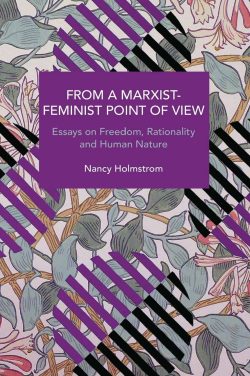
Nancy Holmstrom’s From a Marxist-Feminist Point of View: Essays on Freedom, Rationality and Human Nature is a collection of essays written across several decades by a philosopher whose commitment to theoretically and politically integrating Marxism and feminism has remained unfashionably steady across half a century of shifting intellectual trends. Emerita Professor of Philosophy at Rutgers University-Newark, Holmstrom has spent her career doing what analytic philosophy in its mainstream forms has largely refused to do: taking the political and economic structures that condition human life seriously and asking what philosophy—rigorously practiced—has to say about them. The book announces its ambition plainly. As Holmstrom writes in her introduction, the essays integrate her intellectual work with “the values I have been committed to all my life: freedom, justice and equality.”1Nancy Holmstrom, From a Marxist-Feminist Point of View: Essays on Freedom, Rationality, and Human Nature (Chicago: Haymarket 2025), 1, https://doi.org/10.1163/9789004703292. What distinguishes this collection is that the integration is genuine. In Holmstrom’s case, the political commitments are not context for the philosophical work—they are its content.
The volume is organized into four thematic parts—“Modes of Production,” “Rationality,” “Freedom,” and “Human Nature/Women’s Nature”—unified by a sustained engagement with Marx’s concept of the mode of production and a normative commitment to freedom, equality, and social justice. Holmstrom is explicit that the sections are not independent but represent different theoretical angles on the same underlying question: how does capitalism structure social life, subjectivity, gender, and the horizon of emancipation? Together they constitute a systematic Marxist Feminist perspective.
The opening section, “Modes of Production,” establishes the theoretical framework that underpins the entire collection. In “Developing Marx’s Mode of Production Theory,” Holmstrom argues that Marx provides the quintessential methodological tool for understanding historical and social change: different societies are structured by distinct ways of organizing production and extracting surplus labor, and these structures shape political institutions, social relations, and forms of oppression. Crucially, exploitation is not unique to capitalism but characteristic of all class societies; what distinguishes capitalism is the specific mechanism through which surplus labor is extracted—wage labor within a competitive market system—and it is this specificity that holds the key to understanding the system as a whole.
The author’s treatment of Marxist and Socialist Feminist theory is particularly valuable here. In “Marxist/Socialist Feminist Theory and Practice in the USA Today,” Holmstrom engages critically with dual-systems theories of both capitalism and patriarchy and with the concept of intersectionality, proposing in their place what she calls a “framework model”—a nonreductive, single system approach in which the capitalist mode of production is foundational, but not mechanically determinative of gender or racial oppression. This model, she argues, preserves Marxism’s explanatory power while recognizing the autonomy and specificity of other forms of domination, avoiding both the reduction of sexism to class and the proliferation of incommensurable systems that end in explanatory pluralism.
The author addresses two additional debates central to feminist debates. “Women’s Work, the Family and Capitalism” revisits the domestic labor debate with sustained attention to Marx’s own categories, arguing that unpaid reproductive labor, though it does not produce surplus value in the strict sense, remains central to the reproduction of the labor force and therefore to capitalism’s functioning. The essay “Sex, Work and Capitalism” further addresses the question of the status of sex work under capitalism, which I return to below.