
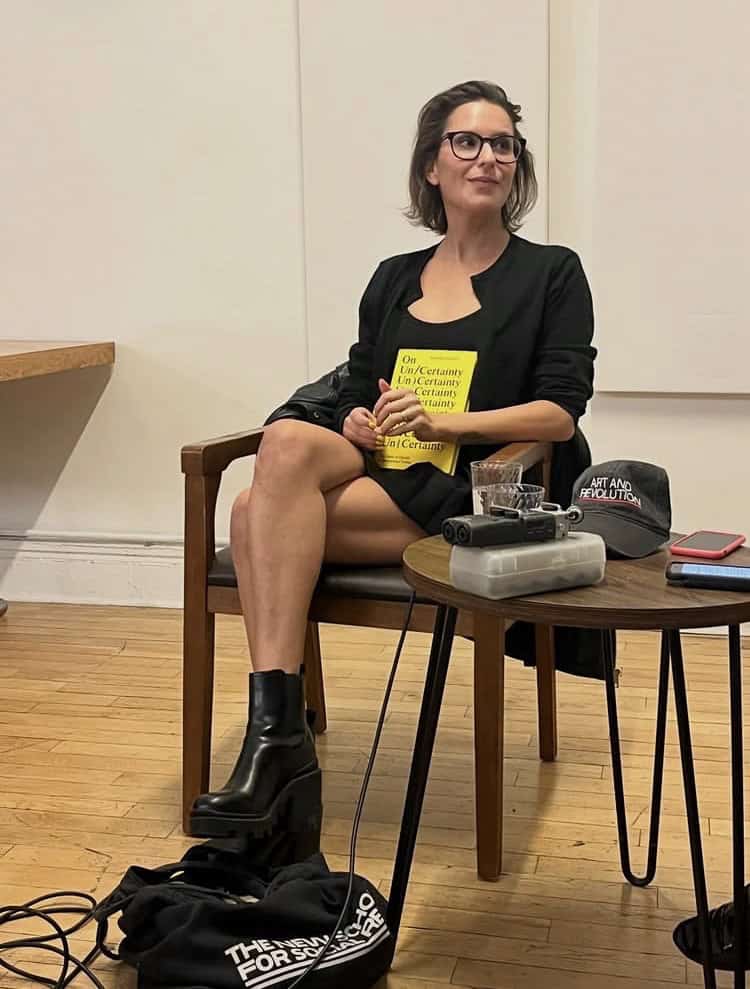
Natasha Lennard doesn’t know how much longer they’ll let her keep her job teaching journalism at The New School for Social Research in New York City. But then, millions of us, if we’re lucky enough to have jobs, don’t know how much longer we’ll keep ours either. Many of us are also unsure if we’ll survive the next public health crisis, or if our electoral system will remain minimally intact, or what climate-change disasters will hit us next. If we, ourselves, are not living with dread and uncertainty, it’s safe to say our world is. This is why Natasha wrote On Un/Certainty: The Uses of Doubt in Dangerous Times.1Natasha Lennard, On Un/Certainty: The Uses of Doubt in Dangerous Times (New York: Verso, 2026).
On Un/Certainty asks us to realize how much of our dread is subtly curated by immense systems of power, which we’re inclined to take for granted. To lay the groundwork for this awareness, Natasha turns to the philosopher Ludwig Wittgenstein to help her identify “pernicious certainties” that order our world, such as white supremacy and border regimes that create genocidal nation states. Her hope is that, once we see how we’ve held such realities semi-consciously, we can move them into conscious ways of knowing. We might then become less afraid, even a little empowered. I talked to Natasha about her book at The New School.
Natasha Lennard is a British-born, Brooklyn-based writer. She is a professor of critical journalism at the New School for Social Research in New York and a columnist for the Intercept. Her work has appeared in the Nation, Bookforum, Dissent, and the New York Times, among others. She is the author of On Un/Certainty: The Uses of Doubt in Dangerous Times and Being Numerous: Essays on Non-Fascist Life, and coauthor of Violence: Humans in Dark Times.
Knowledge Versus Certainty
Natasha Lennard: “We live in uncertain times.” It’s like a refrain. I’m interested in what it means to talk about uncertain times, and how that can produce this idea of totalizing doubt. The fact that this discourse, without much precision, so readily spreads—in mainstream media, then in independent media and beyond—can distract from what is held in place in these moments of change. Who benefits and who’s harmed? I think what can happen with the common talk of “uncertainty” is a failure to pay attention to what is, in fact, organizing uncertainties; how they produce and reproduce structures of power.
During the COVID pandemic, there was a lot of deeply understandable fear and uncertainty about this novel coronavirus. But there were also clear indications of which groups of people suffered in which ways from this pandemic—and who will likely suffer in future pandemics. There were well-trodden paths directing the shape of these uncertainties along historic lines of discrimination, via race, class, and gender. What I try to point to in this book are what I call toxic or pernicious certainties that are not, in fact, subject to this supposed “totalizing doubt.” I think paying attention to them is really key.
susie day: Why do you need Wittgenstein to help you say this?
NL: It’s an unusual choice; Wittgenstein was by no means a leftist or an explicit political writer. Marxist thinkers, like Perry Anderson, have famously denounced Wittgensteinian philosophy as inherently conservative. But Wittgenstein, to me, has always been helpful in urging us to look at the work that our language games play in the world, and the ways in which we step into presumptions and inculcated ways of being. Wittgenstein’s later work especially attends to this; specifically, On Certainty, his collected notes published after he died.
He draws a distinction between what he calls activities and practices of certainty, compared to activities and practices of knowledge, knowing, and doubting. I find that to be useful in these so-called uncertain times. He points out that being certain of something is not the same—and doesn’t look the same in the world—as learning and knowing and gathering information and proving and having evidence about something. So the class of beliefs or propositions or convictions that Wittgenstein calls certainties are those things that are beyond our doubting; they order our world. But they are also not things that we come to know through inquiry, through gathering evidence and further proof.
Many of the certainties Wittgenstein talks about are basic things like the existence of external objects or that the world existed long before our births. We don’t learn these things as explicit posits of knowledge, but we hold them certain in order to make sense of the world. I find this useful, because we can apply it to these posits of ideology that do function very much like Wittgenstein’s world-ordering certainties. These certainties form what Wittgenstein calls the riverbed of our thoughts; they create these hinges on which other practices turn. So, certainty rather than knowledge, as Wittgenstein drew that distinction, is an underused way of understanding why some of these commitments that order the world are so hard to budge.
Presumptions Behind Life-Destroying Violence
sd: Wittgenstein didn’t point out pernicious certainties, but you do. What’s an example of a pernicious certainty?
NL: One example would be enforced gender binaries—the certainty that there’s only one fixed and binary way of being gendered in the world: man or woman, biologically determined and immutable. Another is property logics, the idea of property as an expectation of the continued ability to exclude others. This undergirds so much of the five hundred years of “global racial empire,” to use a phrase from Olúfẹ́mi Táíwò.2Olúfẹ́mi O. Táíwò, “Reconsidering Reparations,” Law and Political Economy Project (blog), February 21, 2023, https://lpeproject.org/blog/reconsidering-reparations/. It also informs border regimes and border rule as something that is held as a certainty. We can’t talk about geopolitics or the world order without assuming exclusionary nation states. These things are not learned as sites of knowledge; they’re held certain.
sd: So a pernicious certainty comes from top-down power?
NL: It tends to. But I don’t mean to suggest that there’s some devious plot—that fascist leaders of elite technocapital are sitting around boardrooms, deciding to spread “uncertain times discourse.” These certainties are the ideological architecture of power, passed down through power structures. The way in which they are held certain is a function of maintaining power.
I say that they’re pernicious as an empirical claim. For instance, we see that exclusionary bordered nation states and the presumption of border rule consistently produce immense amounts of life-destroying violence. I don’t just mean the excesses of Donald Trump’s ICE regime; we’ve seen the same exclusionary violence enacted by Israel’s bordering regime, by the presumption of border rule profoundly upheld by Bill Clinton, Barack Obama, and Joe Biden. In the same way, trans-exclusionary gender politics is a kind of violence that forces thousands of people who don’t conform to this binary ideology to suffer. These are pernicious certainties because they produce hierarchies that hold certain groups more vulnerable to pain and death.
sd: These certainties result in inequality and injustice. But could equality and justice also become certainties?
NL: I would like them to be; that’s the thing. There are also banal, nice certainties. One of the cute examples I use in the book is, “Is there any wine left in the bottle? Because I want some wine.” I’m holding certain that physical objects—the bottle, the wine—exist. And, in our everyday practices that reflect what we hold certain, many of us—in a way I think is liberatory and wonderful—hold certain that, for example, trans women are women; that borders can fall; that the exclusionary nation state is not a necessary way of organizing the world.
We might be inculcated into a world that holds certain the need for borders and gender binarism. Through our practices, our activism, our organizing, we can build forms of life together that disrupt those pernicious certainties. It’s not because we sit around and say, “Let’s make a list of the things we want to hold certain.” Through our collective practices, those things come to form a kind of bedrock for our ways of being.
White Ignorance, Black Knowledge
sd: How does uncertainty/certainty work inside a population? For instance, I’d guess that women would tend to be more uncertain about the world, who they are, and what will happen to them than men are. Or people of color might be more uncertain about trusting the power system.
NL: Interestingly, there’s also a way—and this is pointed out by Charles Mills, the late philosopher, whom I cite in the book, and by James Baldwin and W. E. B. Du Bois as well—that those oppressed by these systems of power are actually in a beneficial position when it comes to challenging certainties and seeing them for what they are. They know how these systems function because they’ve had to survive them. Beneficiaries of power systems take them as a given, but they don’t know them. Whereas, when Baldwin says that he’s had to survive whiteness, or when Mills talks about white ignorance, they don’t mean facts that white people don’t know; they mean an inability to see beyond the structures of whiteness and to understand them.3James Baldwin, “On Being White and Other Lies,” Essence, April 1984, available at https://dn721800.ca.archive.org/0/items/FugitiveDistro_On_Being_White_Anonymous/On%20Being%20White_PRINT_EN_6.pdf; Charles W. Mills, “White Ignorance” in Black Rights/ White Wrongs: The Critique of Racial Liberalism (Oxford: Oxford University Press), 49–71, https://doi.org/10.1093/acprof:oso/9780190245412.003.0004, available at https://www.ias.edu/sites/default/files/sss/pdfs/Crisis-and-Critique-2018-19/mills_white_ignorance.pdf. It’s a kind of recalcitrance to knowledge, a resistance to doubt.
Black people in the United States and beyond have had to survive white supremacy, enslavement, and carceral violence, such that they have knowledge—what Mills calls Black knowledge—as the counterpoint to white ignorance. So, we could ask, “Are women or oppressed groups more scrutinized and doubted by establishment institutions?” But in another way, being forced to navigate systems not built to benefit them means that those in an oppressed position are also those in an epistemically beneficiary position to understand those systems of oppression.
sd: You’ve devoted a chapter to cis certainty and trans exclusion: “Trans exclusion cannot be disentangled from the white supremacist project of strict sex categorization and gender enforcement.” Is only race at play here?
NL: It’s also capitalist in the same way that we happen to live in a capitalist order that was shaped by a colonial order, right? So, race takes the modality it does because of systems of capital. The functions of patriarchy also take the forms they do because of a capital order.
sd: Again, aren’t we basically talking about power?
NL: Yes. But a whole chapter on the issue of enforced gender conformity makes sense to me, partly because trans people have been put on the frontlines of fascist enforcement in the last ten years. It’s clarifying, in the worst ways, to see what it looks like when a group of people are considered excludable and beyond the accepted logics of being—even though those people have historically and robustly existed and continue to exist. This project to eliminate trans existence, in both intellectual and literal life, should tell us something about how this is a conjured project. It’s a production of insecurity, a production of—
sd: Unknowingness—
NL: Exactly. You see it all the time. The New York Times coverage on trans youth healthcare was rightly criticized. There’s this implicit framework throughout that trans youth is this site of peril: “There’s so much unknown, so much doubt.” This is, firstly, unempirical, while presenting itself as objective, neutral journalism. Trans kids are not new, but it’s extraordinary the way in which the authors and editors of these pieces, and the entire circulation machine around this discourse, don’t realize that they’ve infused this writing with a completely unearned framework of uncertainty and doubt.
Of course, cis existence is never subjected to that. I’ve been on hormones since I was 14 years old. I’m a cis girl; it was just “don’t get pregnant.” But never any question about the danger of hormones in the same way it’s applied to trans kids who need gender affirming care to survive. And if I wanted to get a boob job, all I’d have to prove is that I can afford it. It would be “gender affirming” of my cis womanhood, apparently. But a trans person, to get medical care to live as the person they are, is subjected to a deranging amount of scrutiny and doubt. They must prove and prove and prove. I think that the functions of proof, doubt, knowledge, and certainty in that terrain of gendered existence is a clarifying example. That’s why I give so many pages to it.
Trans Kids, WAWOG Take On the New York Times
sd: It’s interesting that the trans movement has merged with Writers Against the War on Gaza to boycott the New York Times.4“Boycott, Divest, Unsubscribe,” Writers Against the War on Gaza, accessed November 12, 2026, https://writersagainstthewarongaza.com/boycott-nyt.
NL: Yes. One of the first letters I signed against the New York Times was about its anti-trans coverage.5A Andrews et al., letter to Philip B. Corbett, associate managing editor for standards at the New York Times, February 15, 2023, https://nytletter.com/; Christopher Wiggins, “The New York Times Helped Turn Trans Rights into Political Controversy, Analysis Finds,” Advocate, June 23, 2026, https://www.advocate.com/politics/national/new-york-times-transgender-controversy. Then within a year or two, I was signing WAWOG’s boycott of the Times opinion page.6“Genocide is Not a Matter of Opinion,” Boycott, Divest, Unsuscribe, accessed November 12, 2026, https://www.boycottdivestunsubscribe.com/opinion-boycott. It’s a very close connection, and in both cases, what you see is an editorial line—I don’t accuse every single Times journalist of upholding this; that’s not how editorial lines work—that’s implicitly upheld through the kinds of things that are scrutinized or not. But be it Palestine or trans healthcare, I think it’s crucial that those unquestioned certainties have been challenged and brought to light by groups like WAWOG and trans organizers.
sd: What other certainties might we be addressing here? The prestige of the New York Times and the authority it carries?
NL: It’s not necessarily that the Times’s position is itself a certainty. It’s that, as the “paper of record,” it reflects what is held certain. If you need a snapshot of political certainties, it’s not a bad place to look.
sd: One of the most pernicious certainties you write about is white supremacy: “The whole point about whiteness is that it’s absolutely marked, while creating a structure of unknowing among white people.” So, we’re back to “white ignorance”; can most pernicious certainties be paired with ignorance?
NL: Yes. By “ignorance,” here, I don’t just mean, “Oh, I haven’t learnt that yet; I’m ignorant of it.” White ignorance, in Mills’s sense, is a certainty that is resistant to doubt and therefore resistant to knowledge. The pernicious certainties I want to draw attention to in this book are world ordering. Our existing system of global racial capitalism informs the key world-ordering sites of certainty that both the beneficiaries and the victims of that system live through and, wittingly or unwittingly, reproduce.
sd: I was just thinking how a really good novel can explore certainties, those unseen power structures among various people.
NL: And so can sharing community with people. Not treating each other as anthropological objects, but sharing people’s lives, being understanding, sharing among collectives.
Don’t Talk to Fascists; Build Rupturous Moments
sd: How would your book work in terms of individual cases of abuse and injustice? For example, last July, a Latinx man in an upstate New York prison was burned to death in his cell.7Robert Lee Williams, “One of the Most Horrifying Things Possible Just Happened in My Prison. Why Is Nobody Talking About It?,” Slate, August 11, 2026, https://slate.com/news-and-politics/2026/08/man-fire-new-york-prison-marcos-alcaraz-horror.html. The guards didn’t stop it; in fact they stood by, then labeled it a suicide. Say you’ve decided to demand justice for him. Would you begin by looking at what pernicious certainties are at work here?
NL: What I point to in my book is that you don’t have to sit down and individually theorize your way out of every moment of extremist violence. We’re not starting from scratch. Abolitionists and incarcerated organizers and the Black radical tradition and Black liberation movements have articulated clearly what the violent certainties of white supremacy are and the violences of the carceral state. If you’re in a situation where people are standing by and doing nothing as someone is burnt alive, obviously there has been a huge amount of normalization of extreme violence. You’re dealing with a deeply entrenched set of violent presumptions.
Scenes like that—of consistent, often racialized, violence in the carceral system—are not only tolerated; they’re common. So, trying to have a conversation with the guards who were standing there—“That was a very violent thing; you should have a different framework”—won’t work. These things, when they have structurally shifted, even on a local level, have often done so because the people who’ve been harmed and the people in their community join together and create a force of resistance that cannot be ignored. But even when there is mass action and resistance, there’s no promise of structural change; the structures we’re needing to unmoor are so deeply entrenched—held certain, after all.
In 2020, when more millions of people rose up in the streets than ever in US history, there was already a kind of collective understanding. Building on those rupturous moments, pushing toward liberation is the work that needs to be done, rather than sitting and thinking, “How do I convince the most unconvincible conservative?” We’re in a moment of extraordinary violent backlash; just because we haven’t won doesn’t mean we’ve failed.
I also think it’s a profound and difficult challenge to move a mass uprising into an ongoing movement. Those critics who are all too comfortable saying that those uprisings were just a flash in the pan are not paying attention to the ways in which these practices and events do sediment over time. If you look at some of the organizing against ICE in Minneapolis earlier this year, a lot of those mutual aid networks originated in 2020, when Minneapolis was, of course, the originating site of those uprisings. Sometimes these things build in ways we can’t expect; that’s why we have to continue these practices and not write things off as irrelevant when they dissipate in the face of extraordinary repression.
sd: Along these lines, you’ve said a couple of times in your book that it’s a mistake to argue with fascists, people who’ve proven themselves “soul blind.” (“We can rarely convince fascists of the falsity of which they hold fast, but we can take antifascist action to make upholding these certainties intolerable enough that it becomes preferable to abandon them.”) So give me an example of when this type of resistance succeeded.
NL: I borrow the term “soul blind” from the philosopher Stanley Cavell. One example of soul blindness that we’ve all observed is from those who refuse to see, who seem literally incapable of seeing, Palestinians as fully human. At the same time, we have seen a shift. Many people once considered it an absolutely immovable certainty of Western foreign policy to unquestionably stand by Israel and whatever Israel did; this certainty has not been overturned, but we have seen cracks. Israel’s genocide continues and our government continues to support it without question. However, it is now a liability for many Democratic candidates to unquestioningly stand with Israel.
How did that happen? Did the candidates sit down and think, “There’s a genocide; I should stop holding this certainty?” No, it was resilience and organizing, Palestinian-led work, in answer to international Palestinian calls. This also involved the bravery of students transforming the shape of campus life and taking risks, and people going into the streets, saying, “I will withdraw support—in fact, I will oppose any candidate—who continues complicity in this genocide.”
Should all this have taken a genocide? No. There’s been a seventy-eight-year Nakba. But we have seen an international Palestinian-led movement that has destabilized the presumption, the certainty, of Israel’s place in the so-called rule-based international order.
Another example would be the Indigenous tribes [of North America] that collectively challenged presumptions of ownership around tribal lands, and those sometimes fruitful battles against conceptions of colonial ownership. We have seen examples of those certainties of colonial property disrupted by continuous work, both in terms of struggle on the ground and in a canny use of court systems to assert Indigenous control over land. I’m interested in collective actions, rather than in typical forms of persuasion, that are used to destabilize what was previously considered an immovable order of things.
Armed Struggle and the Armed Status Quo
sd: You talk about students who risk their careers with encampments for Palestine, and street protests for racial justice. Almost all these actions are, at least in theory, protected by the First Amendment. But many of these protests support self-determination—for Palestine as well as for Black people and other oppressed peoples—and that self-determination can include taking up arms. How would you address armed struggle, in terms of your book?
NL: There is, within a purported international system of law, a right to armed resistance against an occupying force. But what we see is that—in the same way that students were arrested and faced deportation for things that fall profoundly within First Amendment activities—there are activists in Prairieland, Texas collectively facing over five centuries in prison for participating in what were, in most cases, First-Amendment-protected activities.8Natasha Lennard, “‘Antifa’ Protestors Charged with Terrorism for Constitutionally Protected Activity,” Intercept, October 17, 2025, https://theintercept.com/2025/10/17/antifa-ice-protesters-terrorism-texas-prairieland/. So, pointing out whether something is legal or not is of little interest to a system of power. A framework of certainty, uncertainty, and doubt doesn’t tell us anything about the normative claims to arms and what tactics we should use. Those are collective decisions.
sd: But, within our movements as well as in government and society, there are deep taboos against ordinary people using “violence.” Organizations and activists become adamant that they’re “nonviolent.” But isn’t this horror of violence a kind of pernicious certainty?
NL: A good point. It’s perhaps too obvious to say that a diversity of tactics is crucial; that no one way works; that different groups play different roles. But what I think is held certain in the issue you raise is the state’s monopoly on violence. What does a prohibition on violence actually point to? What’s the undergirding certainty held here? It’s not nonviolence; it’s that there is only one rightful purveyor of violence, and that is the state.
sd: The state’s violence is largely unnoticed by us?
NL: That’s the thing. It’s treated as a force beyond doubt. But it’s interesting that, in the United States, there are people who aren’t endowed with state power who nonetheless see themselves reflected in the armed state—the aggrieved MAGA supporter. Many of them have now joined ICE. I don’t mean across the board, but who do we see taking up “armed struggle”? Actually, I’d say it’s the “armed status quo,” the Proud Boys, white supremacists. Because the white militia movements see themselves as an extension of cops. They may claim to be an antistate force, but one sees a profound continuity of a historic white militia, too.
sd: I get that we should question these bedrock assumptions. But when the left does try to reverse pernicious certainties, so much of our activism becomes “anti.” We’re antifascist, antimisogynist, antiwar, antiracist… That’s strategic and necessary, but doesn’t simply becoming reactionaries about societal power abuses prevent us from envisioning a better life?
NL: That’s a historic question. I’m probably the wrong person to answer it because I’m not a good utopian. There are some brilliant utopian thinkers, but I am of the persuasion that we actually do need to rupture and break and destabilize a whole bunch of harmful bedrock. I think space needs to be cleared for collective flourishing.
We do know what joys we’re collectively fighting for. The ways that people come together and celebrate and fall in love and eat together and look after each other when they’re sick and play music and dance—I think many resistance movements are able to expand their sites of joy. They do this extraordinarily—even in the most embattled times… That’s far from saying, “This is what a utopian world would look like.” I think the best I can offer is pointing to sites of inspiration to go on in this time of oppression.
Shifting Forms of Life
sd: It’s your duty to be joyful?
NL: It’s your duty to resist. Maybe I’m wrong here, but I think people know why they care to fight for their lives. It’s kind of extraordinary, but shouldn’t be surprising, that people still have marriage celebrations in Gaza.
What you see in movements that seem resilient and sustainable is that they invite people into a shared form of life. We see that in the tenants movements—people enjoying knowing their neighbors, even if it’s by virtue of having to deal with their abusive landlord. Or people who door-knock for DSA candidates—which I wouldn’t have mentioned fifteen years ago, but I now think is necessary—they get up in the morning, hungover and cold, but they’re meeting people and connecting and building networks of community. Same as people who do crucial mutual aid work, or make dinners for people, or build movement spaces. These actions are often sustainable because they don’t just create policy and political shifts; they involve shifting people’s forms of life.
It’s shifting campus forms of life when professors go on strike, or when students lead the beautiful solidarity encampments. Occupy Wall Street was a prefigurative politics of what the future could look like, although with limited scope. But it’s often politics that involve people thinking about how they share their days and resources with people that, even if a movement doesn’t exist, forever change people in a way that creates a kind of commitment to organize their lives. Because, if you see those practices ordering your life, you end up holding different things in the center of your web of belief.
sd: You teach journalism; you’re also a journalist for the Intercept. How does your book play into that?
NL: When people say I’m a journalist, I always say, “Yeah, kind of.” I’m a columnist who does reported opinion writing, which falls outside the US objectivity norm. At the New School, I teach a program called Critical Journalism. It frames journalism practices within an awareness of a political economy and historic situatedness, refusing to lionize journalism without using a critical lens. That’s a kind of continuity with the book, which also offers me a chance to delve into philosophical questions and conceptual knots that the thousand-word column doesn’t allow. What happens at school combines both philosophy and journalism—until they shut it all down.
sd: Shut it all down?
NL: Higher education is being destroyed. At The New School, in particular, the upper administration is using a financial crisis to wreck the school’s legacy of leftist critical theory and social research. Nationally, Trump is making it impossible for these institutions to continue, but that’s also because of nearly forty years of privatization, adjunctification, unaffordability for many, many students in many, many places—while creating unaffordable lives for increasingly precarious professors. That said, I don’t think it’s an accident that it was students around the country who, because they were in these spaces together, were able to start encampments. Spaces of collective learning and theorizing and thinking are crucial. They’re some of the most important things a society can fund and make available for everyone. So this is an important time for education workers to be militant in unionizing.
sd: Finally, how would you want people to change, in light of having read your book?
NL: I want people not to hold pervasive—though very reasonable and shared—dread and uncertainty, such that it leads to paralysis. And to start thinking about the forces, agents, institutions, and activities that uphold the production of their uncertainty and dread. And then I want people to look for the groups and collectivities that are working against that.
I want us to pay attention to what we are taking for granted.