
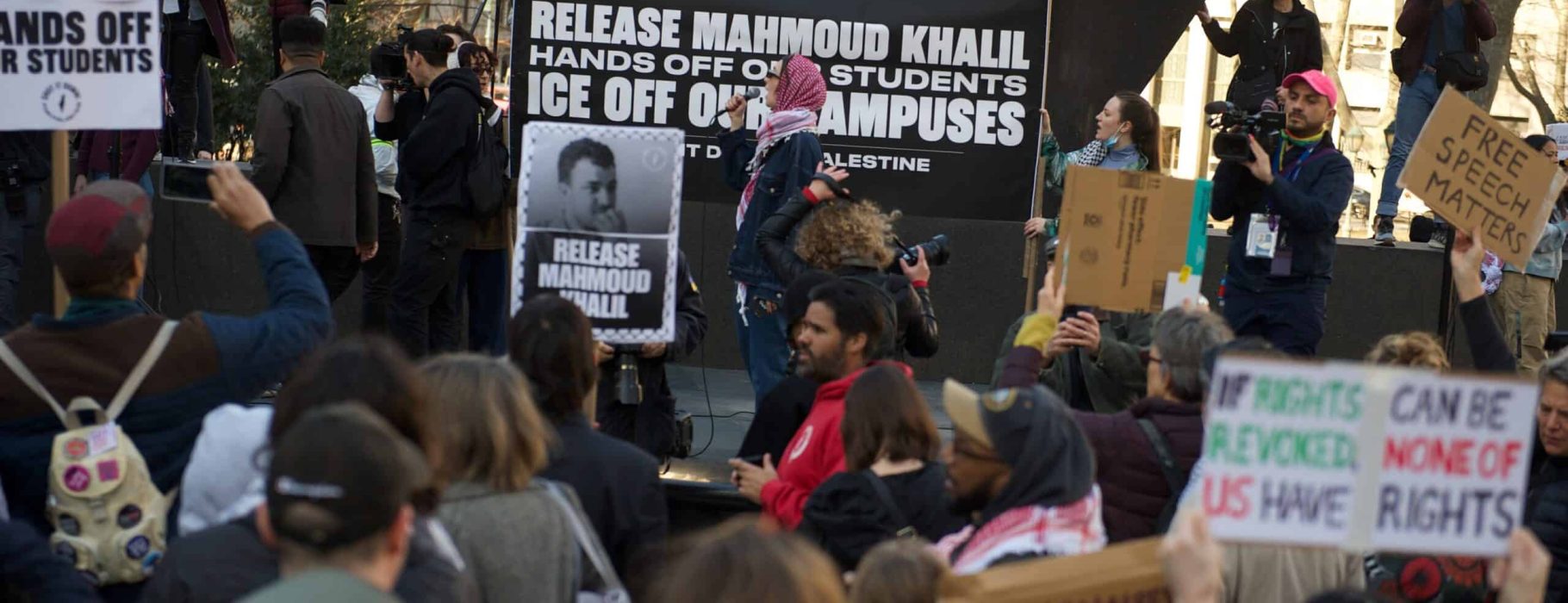
When Mahmoud Khalil was arrested by immigration agents on March 8, 2025, the circumstances seemed at once extraordinary and eerily familiar. Khalil, a recent Columbia University graduate and prominent participant in the campus movement for Palestinian liberation, was taken into federal custody despite being a lawful permanent resident. A month later, immigration agents arrested Mohsen Mahdawi, another Palestinian student involved in protests at Columbia, as he arrived for what he believed would be a citizenship interview. Their arrests were part of a broader campaign against noncitizen students—one that intensified under Donald Trump but drew on longstanding nationalist anxieties about the US university as a globalizing and diversifying institution. Across the country, students discovered that their visas had been revoked or their records terminated in the Student and Exchange Visitor Information System (SEVIS), sometimes with little explanation and frequently for encounters with law enforcement that had never resulted in convictions.
The Trump administration presented these actions as an effort to restore order to universities, punish antisemitism, and remove supposedly dangerous foreign students. Yet the speed with which the federal government identified, surveilled, and threatened students depended on an infrastructure that universities and the federal government had spent decades building together.
International students occupy a peculiar position within the contemporary university. Historically, colleges and universities have aggressively recruited students from abroad. They’ve relied on their tuition and labor, built laboratories around their research, and advertised their presence as evidence of institutional prestige and global reach. But the legal architecture that has permitted these students to enter and remain in the United States has also rendered them unusually governable by both the state and their educational institutions. Their ability to study, work, travel, and remain in the country depends on continuing compliance with rules administered jointly by universities and the immigration state. This contradiction is usually described as a problem of immigration status, but it is also a labor relation that conditions the campus for everyone who works there.
International students are workers. Graduate students teach, grade, conduct research, write code, staff clinics, and perform much of the intellectual labor on which research universities depend. More broadly, students pay tuition, perform unpaid and underpaid academic work, generate research that universities patent and commercialize, and move into labor markets through programs such as Optional Practical Training. Their circulation is embedded in how contemporary higher education accumulates money, prestige, knowledge, and human capital.
International students are workers.… Their circulation is embedded in how contemporary higher education accumulates money, prestige, knowledge, and human capital.
They enter these labor relations on differentiated terms. Students who are not citizens are subject to vulnerabilities that citizen workers do not share, vulnerabilities further structured by race, gender, class, sexuality, disability, nationality, and political identification. Employment is constrained by immigration law, while legal presence may depend on enrollment, institutional sponsorship, satisfactory academic progress, or particular forms of work. Leaving a program, losing an appointment, or falling out of institutional standing can threaten not only a paycheck, but also housing, professional continuity, and the legal basis for remaining in the country.
Nicholas De Genova’s work on migrant “illegality” provides a crucial framework for understanding these conditions.1Nicholas P. De Genova, “Migrant ‘Illegality’ and Deportability in Everyday Life,” Annual Review of Anthropology 31 (2002): 419–47, doi.org/10.1146/annurev.anthro.31.040402.085432; Nicholas De Genova, “The Deportation Regime: Sovereignty, Space, and the Freedom of Movement,” in The Deportation Regime: Sovereignty, Space, and the Freedom of Movement, ed. Nicholas De Genova and Nathalie Peutz (Durham: Duke University Press, 2010), 33–66, https://doi.org/10.1215/9780822391340-002. Deportability, he argues, means that disciplinary power operates not only through actual deportation but through the way the constant possibilities of deportation shape their lives.2De Genova, “Migrant ‘Illegality’ and Deportability in Everyday Life,” 438–39. The state does not have to deport every deportable worker for deportability to organize wages, mobility, workplace conflict, political participation, and the capacity to refuse exploitation. Immigration law produces migrant vulnerability by making the right to remain contingent and revocable, and labor markets exploit the precarity that follows.
De Genova develops this analysis primarily by focusing on undocumented migrant labor, but we can extend this analysis to our understanding of international students. International students occupy formally authorized and often highly prized statuses, but authorization itself is conditional. F-1 status organizes students’ presence through continuing enrollment and a tightly regulated relationship to employment, while universities maintain the records through which that status is governed. This conditionality is set to become more explicit under the Department of Homeland Security’s July 2026 rule eliminating “duration of status”: beginning September 15, F-1 students will generally be admitted for a fixed period tied to their program length and capped at four years, after which continued presence may require a formal extension of stay.3U.S. Department of Homeland Security, U.S. Immigration and Customs Enforcement, “Establishing a Fixed Time Period of Admission and an Extension of Stay Procedure for Nonimmigrant Academic Students, Exchange Visitors, and Representatives of Foreign Information Media,” final rule, Federal Register 91, no. 135 (July 17, 2026): 44976–5089, https://www.federalregister.gov/documents/2026/07/17/2026-14439/establishing-a-fixed-time-period-of-admission-and-an-extension-of-stay-procedure-for-nonimmigrant.
Deportability is therefore a stratified condition. A worker can be lawfully present in the United States, institutionally welcomed, and economically indispensable while disruptions of study or work jeopardize the immigration status that allows them to remain in the country at all. Familiar forms of managerial authority—the ability to hire, evaluate, discipline, fund, or terminate—intersect with state power when it comes to movement and students’ abilities to remain in the country. For many noncitizen students, employment, residence, study, and immigration status form a single field of governance. The discipline of the workplace is backed by the border.
Some workers can leave a job, change institutions, interrupt their education, or enter political conflict without placing their life in the United States at stake. Others cannot. Universities participate directly in producing this differentiated mobility: the institution that recruits, employs, and depends upon noncitizen students also documents the conditions of their presence.
This arrangement has a history. Since the earliest inception of colleges in what became the United States, institutions repeatedly sought out students whose political exclusion from the governing polity was precisely what made their education useful: universities could educate them as missionaries, intermediaries, diplomats, and workers who would extend institutional and state power beyond the boundaries of political membership.4In my forthcoming book, Degrees of Empire, I trace the relationship between noncitizen students and US higher education from the colonial period through the Cold War. Indigenous students educated at colonial colleges; Native Hawaiian and Cherokee students sent to missionary schools in the early decades of the Republic; Chinese students exempted from the first federal immigration law in 1882; and students from Africa, Asia, Latin America, and the Middle East recruited during the Cold War all occupied very different positions. What connects them is a recurring institutional logic: educational institutions incorporated populations whose political belonging remained temporary, partial, or conditional. A significant benefit of educating these students was precisely that they would return to their homes equipped with the logics and knowledge of whiteness, property, and Christianity.
Since the earliest inception of colleges in what became the United States, institutions repeatedly sought out students whose political exclusion from the governing polity was precisely what made their education useful: universities could educate them as missionaries, intermediaries, diplomats, and workers who would extend institutional and state power beyond the boundaries of political membership.
Before 1965, universities could admit populations imagined as racially, politically, or nationally outside the US polity because education carried no guarantee of political membership. Students might acquire knowledge, skills, credentials, and attachments to the United States and then be expected to carry them elsewhere (what I call educate and expel). Their anticipated departure gave their education much of its geopolitical utility. Internationalization, in other words, has never been an alternative to the border; it has repeatedly depended on it. The distinction between a student permitted to enter temporarily and an immigrant permitted to remain was essential to the growth of US international education.
By the Cold War, international students had become valuable to both the university and US foreign policy. Educational exchange promised to cultivate foreign elites, extend US scientific and technical influence, and orient decolonizing states toward a US-led international order. Expanding research universities simultaneously relied on students from abroad as scientists, engineers, researchers, instructors, and workers.
Adom Getachew’s account of anticolonial worldmaking situates this educational project within a broader struggle over the political and economic organization of decolonization.5Adom Getachew, Worldmaking after Empire: The Rise and Fall of Self-Determination (Princeton, NJ: Princeton University Press, 2019), https://doi.org/10.1515/9780691184340. Kwame Nkrumah, W. E. B. Du Bois, George Padmore, Eric Williams, Julius Nyerere, and other Black anticolonial thinkers pursued forms of self-determination capable of confronting the international hierarchies that survived formal empire. African students entered US universities amid this struggle. US institutions imagined them as prospective leaders and professionals whose education might bind new states to US priorities. Yet students participated in competing projects of worldmaking. Nkrumah’s political formation in the United States, including his encounters with Black radical and anticolonial traditions, exemplifies the unpredictability built into educational exchange.
At the same time, US Black anticapitalists and internationalists were cast as foreign, alien, undesirable, and disloyal. Charisse Burden-Stelly’s book Black Scare/Red Scare helps explain the domestic architecture corresponding to this geopolitical project.6Charisse Burden-Stelly, Black Scare / Red Scare: Theorizing Capitalist Racism in the United States (Chicago: University of Chicago Press, 2023), https://doi.org/10.7208/chicago/9780226830148.001.0001. As she illustrates, capitalist racism, exploitative labor relations, imperial expansion, and the policing of political belonging employed antiradicalism as a mode of governance. Labor exploitation, racial ordering, imperial governance, and antiradical repression developed together by casting Black anticapitalists and internationalists as foreign, alien, undesirable, and disloyal.7Burden-Stelly, Black Scare / Red Scare.
Getachew’s and Burden-Stelly’s work helps explain why international students could appear simultaneously valuable and dangerous. Their labor and leadership mattered because they might help build a postcolonial world; their political formation mattered because the shape of that world remained contested.
By the 1970s, Iranian, Arab, Muslim, and Palestinian students became increasingly prominent figures of subversion in US political discourse.8Pamela E. Pennock, “From 1967 to Operation Boulder: The Erosion of Arab Americans’ Civil Liberties in the 1970s,” Arab Studies Quarterly 40, no. 1 (winter 2018): 41–52, https://doi.org/10.13169/arabstudquar.40.1.0041; David Cole, “Enemy Aliens,” Stanford Law Review 54, no. 5 (2002): 953–1004, https://doi.org/10.2307/1229690. Distinct racial formations produced different targets, but political suspicion was repeatedly paired with restrictions to citizenship. Antiforeignness, antiradicalism, and anti-Blackness, writes Burden-Stelly, converged as immigration power transformed political dissent into a question of admissibility and continued presence.9Charisse Burden-Stelly, “Constructing Deportable Subjectivity: Antiforeignness, Antiradicalism, and Antiblackness during the McCarthyist Structure of Feeling,” Souls 19, no. 3 (2017): 350, https://doi.org/10.1080/10999949.2017.1389626. Alienage gave the political production of foreignness distinctive material force. Political undesirability could activate the legal capacity to exclude or remove.
After 1965, educate and expel changed form. Graduate education, teaching assistantships, scientific research, and eventually programs such as Optional Practical Training tied higher education to a labor market in which noncitizens could be recruited for their skills, while staying in the United States remained dependent on institutional and governmental authorization. Temporary inclusion acquired a new economic utility: students could be trained, employed, and selectively retained within a structure of conditional presence.
In 2025, the Trump administration demonstrated how quickly that routine administrative infrastructure could become an instrument of mass immigration enforcement. The consequences of this became clear during the mass visa revocations and SEVIS terminations. Students who believed they had lawful status suddenly discovered that government records said otherwise. Universities scrambled to determine what had happened. Courts intervened; some records were restored; policies shifted. An administrative change could rapidly alter a student’s ability to remain enrolled, employed, and in the country because universities were already integrated into the system that tracked them.
In 2025, the Trump administration demonstrated how quickly [the university's] routine administrative infrastructure could become an instrument of mass immigration enforcement.… An administrative change could rapidly alter a student’s ability to remain enrolled, employed, and in the country because universities were already integrated into the system that tracked them.
The Trump administration’s targeting of pro-Palestinian students and scholars made the political stakes of federal interventions into student visa status especially explicit. In American Association of University Professors v. Rubio, a federal district court found after trial that administration officials had pursued a policy of arresting, detaining, and seeking to deport noncitizen students and faculty engaged in pro-Palestinian advocacy in order to chill their speech. Judge William Young entered judgment in January 2026 and appellate proceedings remain ongoing.
The trial documented noncitizen academics withdrawing from protests, conferences, writing projects, and organizational roles as immigration consequences changed the material stakes of political activity. The legal architecture mobilized against Khalil, Mahdawi, and other activists has deep roots in the Immigration and Nationality Act of 1952, or the McCarran-Walter Act, enacted at the height of the Black Scare/Red Scare. McCarran-Walter expanded the state’s capacity to exclude and deport people on ideological grounds while preserving a national origins system so racially discriminatory that president Harry Truman vetoed the legislation. Congress overrode him. Although the particular foreign policy removal authority used against Khalil and others was subsequently revised and codified, its deployment draws on this longer history in which alienage made political undesirability materially actionable.
Repression disciplines the targeted person while reorganizing the political field around them. Threatening selected people communicates the costs of collective action to everyone watching. For researchers, instructors, graduate workers, and students, political participation can affect institutional standing, employment, professional life, and continued presence in the United States. These consequences reach directly into labor organizing. Immigration vulnerability can shape decisions about joining a campaign, challenging a supervisor, filing a grievance, signing a collective letter, or taking part in a strike. Political discipline and workplace discipline converge through conditional continued life in the country.
Khalil’s July 2026 lawsuit against administration officials, the Heritage Foundation, Betar, Canary Mission, and associated individuals reminds us of the role of private actors. Brought under the Ku Klux Klan Act, the complaint alleges that private organizations identified and surveilled advocates for Palestinian rights and that federal officials converted that targeting into detention and attempted deportation. The allegations remain to be adjudicated.
Khalil has not sued Columbia as a participant in the alleged conspiracy, yet universities occupy a consequential position in this ecology. The same institution that assigns teaching and research work, evaluates academic standing, grants credentials, pays wages, and sponsors noncitizens also generates records, disciplines conduct, polices campuses, and administers immigration compliance. Though he did not sue the university, Khalil has stated that his arrest was made possible by Columbia’s “repression playbook.”10Mahmoud Khalil, “A Letter to Columbia,” Columbia Daily Spectator, April 4, 2025, https://www.columbiaspectator.com/opinion/2025/04/04/a-letter-to-columbia/.
The border is already inside the workplace. Its effects are not confined to those most directly vulnerable to removal. A workplace organized by radically different capacities to refuse, leave, speak, strike, or remain makes every worker more vulnerable. When one category of worker can be disciplined through the threat of deportation, this vulnerability changes the terrain on which all workers negotiate with the institution. The border does not need to threaten everyone equally in order to redistribute power across the workplace.
Academic freedom is therefore a labor condition. The freedom to teach, research, speak, organize, and move requires material security sufficient to exercise those capacities. Immigration status distributes that security unevenly across the university workforce.
In my work with Nick Mitchell, Eli Meyerhoff, and Zach Schwartz-Weinstein, I have argued for an abolitionist approach to the study of the university.11Abigail Boggs et al., “Abolitionist University Studies: An Invitation,” Abolition University, 2019, https://abolition.university/invitation/. Abolition begins from the university’s contradictions. Universities accumulate property, reproduce hierarchy, and organize unequal workplaces while also concentrating resources, classrooms, laboratories, archives, wages, time, and forms of collective life that workers and students can mobilize toward emancipatory ends.
The right seeks to capture and reorganize universities because they produce knowledge, train workers, conduct research, concentrate capital, and legitimate political authority. A left defense of higher education cannot therefore consist simply in defending institutions as they exist. Universities administer immigration surveillance while relying on noncitizen labor. They celebrate international students while benefiting from a structure that keeps their presence conditional. They invoke academic freedom across a workforce whose members possess radically unequal capacities to exercise it.
An abolitionist labor politics asks how university work might be organized so that immigration precarity cannot function as a source of discipline. This means contesting surveillance, disciplinary records, policing, employment practices, and other infrastructures that bind institutional evaluation to immigration status. It also means organizing around the uneven distribution of risk itself.
International student workers have already practiced this kind of politics. During the 2019 and 2020 wildcat strike at the University of California, Santa Cruz, graduate workers demanding a cost-of-living adjustment confronted a housing crisis that bore especially heavily on international students, whose visas sharply restricted their ability to supplement university wages through other employment. International students were nonetheless at the forefront of the strike. As the action escalated, the university’s international student office warned that discipline or arrest could carry immigration consequences, and University of California president and former Secretary of Homeland Security Janet Napolitano threatened strikers with termination. Fifty-four graduate workers ultimately received termination letters; as many as fifteen were international students whose employment carried tuition waivers and implications for their immigration status.12Jack Wareham and Dylan Burgoon, “‘Whose University? Our University!’ The Struggle for a COLA at UC Berkeley,” CounterPunch, April 1, 2020, https://www.counterpunch.org/2020/04/01/whose-university-our-university-the-struggle-for-a-cola-at-uc-berkeley/. The employer could use the border to differentiate the risks of collective action, and to threaten the strike as a whole.
International graduate workers publicly named the threat as one of de facto deportation and continued participating in the strike. Faculty worked to secure research and other appointments for threatened students, while supporters raised funds for striking workers’ material needs. Yulia Gilchinskaya, then a PhD candidate, framed the struggle around the conditions facing future international students and around who could afford access to academic life at all.13Charlotte West, “Breaking: UC Santa Cruz Terminates Contracts for 54 Graduate Students,” Voices of Monterey Bay, February 29, 2020, voicesofmontereybay.org/2020/02/27/international-students-take-charge-at-ucsanta-cruz. Workers organized around the uneven risks produced by immigration status and built forms of solidarity aimed at absorbing some of those risks collectively.
That distinction matters. Solidarity under conditions of unequal security cannot mean asking everyone to assume identical risks. It requires people with greater protection to take on more of them.
Tenure is particularly important here. It is often defended as an individual protection for academic inquiry and speech, but its political value cannot be exhausted by the freedom it grants the person who possesses it. A tenured citizen professor can criticize an administrator, join a protest, sign a letter, defend an organizer, or survive forms of institutional retaliation that a contingent or noncitizen worker may not, even as Steven Salaita’s case demonstrates how institutions can circumvent tenure’s protections by acting before they formally attach. Tenure should therefore function as a collective resource: a form of relative security placed behind those for whom the costs of political participation are higher. Speaking when others face immigration consequences for doing so, refusing collaboration with enforcement, contesting disciplinary measures, and making retaliation against vulnerable workers costly are not acts of faculty benevolence. They are uses of the freedom tenure is supposed to secure.
The organizing unfolding at Yale in the summer of 2026 offers another version of this politics. As Yale entered negotiations with the Trump administration over a federal civil rights investigation, students, faculty, unions, alumni, and public officials organized to demand that the university resist a settlement that could expand federal leverage over admissions, hiring, curriculum, research, student discipline, and faculty governance. Yale’s American Association of University Professors, American Federation of Teachers Connecticut, and the national American Federation of Teachers urged trustees to resist such an agreement. At a July rally outside Yale Law School, an incoming international student from Mexico spoke alongside faculty, students, and elected officials about his own stake in what Yale decided to do.
A tenured citizen professor, an international graduate worker, a dining-hall worker, an undocumented student, and a researcher dependent on federal funding confront this crisis from very different positions. A collective defense of higher education has to begin from these differences rather than invoke an imagined institutional whole whose members possess equal freedom to resist.
Nor can that coalition stop at the campus boundary. Universities are employers, landlords, landholders, healthcare providers, contractors, police forces, and political actors. They shape housing markets, wages, transportation, policing, development, and public resources in the places around them. The conditions under which a university employs workers whose capacity to leave, refuse, or organize is constrained by immigration status belong to the same regional political economy in which other workers negotiate rents, wages, surveillance, and control over their time.
Solidarity with noncitizen students is therefore not charity offered by people whose own interests lie elsewhere. Deportability may be concentrated among noncitizens, but the labor regime it helps sustain does not stop at the edge of campus. The relevant political community includes student organizers, faculty, staff, unions, local workers, tenants, and surrounding communities whose conditions are already shaped by university power.
Burden-Stelly’s recovery of Black anticapitalist organizing is instructive here. The Black radicals targeted by anticommunist repression joined antiracist, pro-labor, anticapitalist, and internationalist organizing efforts because the forms of power they confronted were already intertwined in the structures that governed their lives. Getachew’s anticolonial thinkers similarly sought forms of freedom capable of transforming structures of dependence that persisted through formal political equality. Formal equality in the workplace leaves immigration law available to distribute mobility, security, and political belonging unequally among workers.
For university workers, freedom from deportability entails the capacity to move across jobs, institutions, borders, political commitments, and forms of collective life without that movement—or the threat of its forced reversal—becoming an instrument of workplace discipline. Because this capacity is distributed unevenly, solidarity requires actively redistributing the risks of refusal.
University of California, Santa Cruz’s international graduate workers organized under conditions designed to make organizing especially dangerous. Faculty and supporters used appointments, money, institutional standing, and public advocacy to take on some of the risk the university attempted to use as leverage against those workers. The coalition at Yale likewise suggests that defense against federal capture can be organized across positions within and beyond the university rather than entrusted to administrators negotiating on behalf of everyone else.
The noncitizen student makes the central contradiction difficult to ignore. Universities depend upon their teaching, research, tuition, and intellectual life while participating in an apparatus that keeps their presence conditional. Their labor is indispensable; their security and mobility are distributed by the border.
But these conditions do not belong to noncitizen students alone. When immigration status can discipline one group of workers, it changes the terrain on which everyone organizes. When universities normalize surveillance, policing, political discipline, and collaboration with the immigration state, those capacities become part of the institutional environment in which faculty, staff, students, and surrounding communities live and work.
Faculty, particularly those protected by tenure or citizenship, therefore have an obligation to use the security unevenly granted to them in defense of people whose participation in collective struggle carries greater material risk. Both tenure and citizenship have little political meaning if they function only as individual exemptions from precarity, rather than as political tools of collective struggle. Their meaning lies in what those protections enable faculty to do alongside others.
For universities to become sites of sanctuary, as Naomi Paik argues, would require more than restricting cooperation with immigration enforcement.14A. Naomi Paik, Bans, Walls, Raids, Sanctuary: Understanding U.S. Immigration for the Twenty-First Century (Oakland: University of California Press, 2020), 138–39. It would mean putting institutional resources and the relative security possessed by some members of the university behind broader struggles over who can work, study, organize, move, and remain—and building those struggles with communities beyond the campus rather than acting as if the university can shelter itself from the political world around it. Sanctuary, in this sense, is not a protected space that a benevolent institution grants to vulnerable people while leaving the relations that produce their vulnerability intact. It is a collective practice of refusing the exclusions through which some people are rendered deportable, disposable, or undeserving of protection.
For universities to become sites of sanctuary, as Naomi Paik argues, would require more than restricting cooperation with immigration enforcement.… It is a collective practice of refusing the exclusions through which some people are rendered deportable, disposable, or undeserving of protection.
The infrastructures that produced today’s vulnerability predate the current administration. Universities helped build them and continue to benefit from them. Resisting the right’s capture of higher education cannot mean defending the university as it exists or leaving its most precarious members to defend themselves. It requires converting protections, resources, organizations, and collective capacities already present within and around universities into mobilized power that makes retaliation harder, refusal safer, and freedom less dependent on citizenship or immigration status.
A different university begins when those who possess greater security refuse to treat it as theirs alone. Transforming the university into a site of abolitionist sanctuary is not a refuge from these struggles but one way of organizing through them: using the capacities we already possess to widen the conditions of freedom for others. The people who make knowledge require the material freedom to work, study, speak, organize, move, remain, and belong—and those who already possess some measure of that freedom have a responsibility to struggle for the conditions under which everyone else can exercise it too.