
The immigrants who gained legal status did experience a rise in their real wages, both because they gained leverage with employers who could no longer exploit their legal vulnerability and because they were able to move up the occupational ladder. However, this did not translate to the kind of benefits for US-born workers that Sanders and Osborn anticipate. The industries structured around low-wage immigrant labor did not fundamentally change; instead, they sought out new sources of cheap labor. A retrospective report on the IRCA concludes that, “given the diminishing number of U.S. workers available or interested in meeting jobs in the fast-growing service, construction and other lower-skill sectors, foreign workers filled the gap; and in the absence of legal avenues to enter the labor market, workers and employers took the easier path available to them. The unauthorized population began to swell.”9Muzzafar Chishti and Charles Kamasaki, IRCA in Retrospect: Guideposts for Today’s Immigration Reform, Issue Brief 9 (Washington DC: Migration Policy Institute, 2014), www.migrationpolicy.org/sites/default/files/publications/Lessons-of-IRCA-FINALWEB.pdf.
What this report does not explain is why a diminishing number of US-born workers were interested in those jobs. According to the restrictionist logic, a decline in the low-wage immigrant labor supply should draw US-born workers back at higher wages and increase their leverage with employers. The reality is that US-born workers had already left these jobs in large numbers before immigrants entered them and the working conditions in these jobs declined even when immigrants weren’t present. As the sociologist Ruth Milkman illustrates, in the late 1970s and early ’80s, employers across the country engaged in aggressive campaigns to cut labor costs by subcontracting, particularly to nonunion firms.10Ruth Milkman, “Putting Wages Back into Competition: Deunionization and Degradation in Place-Bound Industries,” in The Gloves-off Economy: Workplace Standards at the Bottom of America’s Labor Market, ed. Annette Bernhardt et al. (Champaign: Labor and Employment Research Association, 2008), www.ruthmilkman.info/_files/ugd/90d188_369821189cc5f854274197089e834071.pdf.
As union density declined, so did wages, working conditions, and benefits. This was the case in places like Los Angeles, where immigrants came to fill jobs in trucking, residential construction, janitorial services, and other traditionally unionized occupations as US-born workers fled them in droves. This confluence gave many the impression that the entry of immigrants had itself caused the degradation of those jobs. But the truth is that such employer offensives were taking place across the whole country. As Milkman puts it, “by the time immigrants became a significant presence in the nation as a whole, union decline was already ancient history.”11Milkman, “Putting Wages Back into Competition,” 84. Even in places like Los Angeles, the turn to subcontracting and deunionization largely preceded the large-scale entry of immigrant workers into those industries.
In the industries that came to depend on undocumented immigrant labor in the 1980s, capital had already defeated the power of organized workers. Then, if one cheap labor source began to dry up due to legalization, employers were neither compelled nor inclined to hire Americans for good pay and benefits. They turned instead to new undocumented immigrants. This happened not in spite of the IRCA’s provisions for employer sanctions and increased criminalization, but because of how the law actually functioned. In practice, the militarization of the border over the following decades did not stop migration and the criminalization of immigrants’ ability to live and work in the country only made them more vulnerable. Far from penalizing employers, sanctions handed them a new weapon for class discipline: workers who tried to organize could now be fired, extorted, and threatened with deportation on the basis of their immigration status. This makes clear that immigration law does not merely control entry; it regulates the capitalist workplace itself.
“Build the Wall”
Restrictionists may argue that today is different—that Trump really is closing the border to illegal immigration from Latin America, not just talking about it. According to them, a reduction in the immigrant labor supply should drive wages up, but over the past year, the opposite has happened. As net migration became negative in 2025 for the “first time in at least half a century,” real wage growth has slowed significantly—particularly for low-wage workers.12Wendy Edelberg, Stan Veuger, and Tara Watson, “Macroeconomic Implications of Immigration Flows in 2025 and 2026: January 2026 Update,” Brookings, January 13, 2026, www.brookings.edu/articles/macroeconomic-implications-of-immigration-flows-in-2025-and-2026-january-2026-update; Simon Mongey, “Immigration Can’t Explain Declining Employment Growth,” Federal Reserve Bank of Minneapolis, October 31, 2025, www.minneapolisfed.org/article/2025/immigration-cant-explain-declining-employment-growth. The missing link in the restrictionist story is that when immigrant workers disappear, so do jobs for US-born workers. If fewer workers were now competing for the same number of jobs, the remaining workers might have more bargaining power. But in reality, when, for example, the immigrant roofers, framers, and drywallers are deported or “self-deport” under extreme duress, projects get delayed and priced out of existence, affecting a whole host of other workers. As a recent study by the Federal Reserve Bank of San Francisco concluded, “U.S. employment growth is likely to face continued downward pressure as long as the ongoing declines in unauthorized immigrant worker flows continue.”13Daniel Wilson and Xiaoqing Zhou, “Unauthorized Immigration Effects on Local Markets,” Federal Reserve Bank of San Francisco, February 17, 2026, /www.frbsf.org/research-and-insights/publications/economic-letter/2026/02/unauthorized-immigration-effects-on-local-labor-markets.
Even if reduced migration did tighten labor markets, this alone would not lead to large gains for US-born workers. Wages do not rise mechanically when the labor supply shrinks. So long as the workforce is divided and politically weak, capital faces little need to improve wages or conditions. Restrictionism only deepens this division and encourages workers to act on their individual interests. But individual workers stand at a “vast disadvantage in information and resources vis-a-vis the capitalist firm” and without collective organization, labor shortages do little on their own to improve wages.14Suzy Lee, “Defend Immigrants from Scapegoat Politics,” Jacobin, January 16, 2025, jacobin.com/2025/01/immigration-guest-workers-trump-labor.
In fact, there is ample evidence that, when faced with shortages of “illegal” immigrant labor, capital will push to expand other legal forms of obtaining cheap and disciplined labor. While the right is aiming to push US-born workers into these jobs via Medicaid work requirements and training programs, these efforts are bound to fall dramatically short. As former head of the New England Carpenter’s Union Mark Erlich puts it, “When conditions have become so degraded — both compensation and safety — [it’s] no surprise people don’t join.”15Scott Neuman, “ICE Is Sending a Chill Through the Construction Industry,” NPR, November 26, 2025, www.npr.org/2025/11/06/nx-s1-5575539/ice-immigration-construction-latino-workers; Scott Morgenstern, “Trump’s Push for More Deportations Could Boost Demand for Foreign Farmworkers with ‘Guest Worker,’ Visas,” Conversation, July 25, 2025, https://doi.org/10.64628/AAI.mqqg6jyvd.
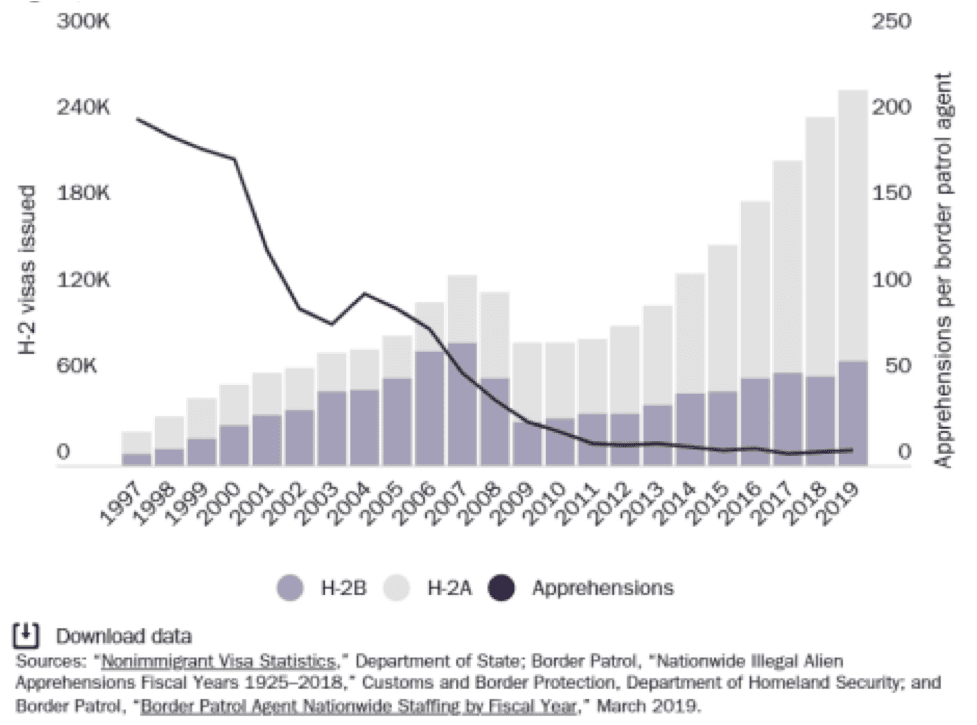
The answer is already being found in the expansion of guestworker programs. These were built into the IRCA and have since steadily expanded, furnishing hundreds of thousands of temporary foreign workers every year for industries like agriculture, construction, landscaping, and hospitality. Over the first two decades of the twenty-first century, as unauthorized border crossings decreased (as reflected in lower apprehensions in the chart below), the use of guestworkers increased in response to the demand for labor.
H-2B and H-2A Visas Issued to Mexicans and Mexicans Apprehended per Border Patrol Agent, FY 1997–2019
The very right of workers in the H-2A and H-2B programs to be in the country is tied to their employment, and employers recognize the leverage this gives them.16Ripe for Reform: Abuses of Agricultural Workers in the H-2A Visa Program (Baltimore: Centro de los Derechos del Migrante, 2020), cdmigrante.org/wp-content/uploads/2020/04/Ripe-for-Reform.pdf; Adriel Orozco, “Biden’s New H-2A Rule Expands Protections and Increases Oversight for Migrant Workers,” American Immigration Council, May 9, 2024, www.americanimmigrationcouncil.org/blog/biden-h2a-rule-expands-protections-oversight-migrant-workers. The programs are “rife with systemic violations,” including the common practice of employers withholding workers’ passports and documents so they are unable to leave. According to the Centro de los Derechos del Migrante (Center for Migrants’ Rights), who interviewed one hundred farmworkers who had participated in the H-2A program, every single interviewed farmworker “suffered at least one serious legal violation of their rights. And 94% of those surveyed experienced three or more serious legal violations.”17Ripe for Reform, 4. Health and safety violations, wage theft, discrimination, and debt bondage are the norm, not the exception. For all the indignities “illegal” immigrants suffer, their employers cannot hold them hostage over their nonexistent documents.
In response to Trump’s aggressive deportation policy, industry groups have been “lobbying furiously” to expand both types of existing guestworker programs and even introduce new ones.18Daniel Costa and Josh Bivens, “The H-2B Visa Program Has Ballooned Without Being Fixed. Expanding it to Year-round Jobs Like Meatpacking Would Lower Wages and Revenue,” Economic Policy Institute, September 18, 2025, www.epi.org/publication/the-h-2b-visa-program-has-ballooned-without-being-fixed-expanding-it-to-year-round-jobs-like-meatpacking-would-lower-wages-and-revenue/#full-report; Gustavo Arrelano, “Former Bracero Doesn’t Want Program to Return. ‘People Will Be Treated Like Slaves,’” Los Angeles Times, October 10, 2025, www.latimes.com/california/story/2025-10-10/bracero-program-donald-trump. The administration is listening, and they are intent on driving conditions in these programs down to the most naked form of exploitation. Trump has rolled back a 2024 set of rules put forth by the Department of Labor that tried to curb the rampant abuses in guestworker programs.19Kanishka Singh, “Trump Administration Suspends Enforcement of Biden-Era Farmworker Rule,” Reuters, June 20, 2025, www.reuters.com/legal/litigation/trump-administration-says-it-is-suspending-enforcement-biden-era-farmworker-rule-2025-06-20. At the same time, his Department of Labor has changed the wage calculation for H-2A agricultural workers, not only lowering their wages but also allowing employers to charge them for housing, giving them an effective pay cut from $17 an hour to as low as $11 an hour.20Daniel Costa and Ben Zipperrer, “Trump’s New H-2A Wage Rule Will Radically Cut the Wages of All Farmworkers,” Economic Policy Institute, November 26, 2026, www.epi.org/blog/trumps-new-h-2a-wage-rule-will-radically-cut-the-wages-of-all-farmworkers-new-estimates-show-farmworkers-stand-to-lose-4-4-to-5-4-billion-annually-under-dols-updated-adverse-effec.
The administration plainly acknowledges that they are doing this in response to their campaign to close the border and carry out mass deportations. A Department of Labor document states:
In short, the agricultural sector is experiencing acute labor shortages and instability because it has long depended on a workforce with a high proportion of illegal aliens who previously cycled in and out of the U.S. through a porous border; now, however, those who might have cycled in cannot do so because of the now secure U.S. Southern Border.… Without swift action, agricultural employers will be unable to maintain operations, and the nation’s food supply will be at risk.21Department of Labor, “Adverse Effect Wage Rate Methodology for the Temporary Employment of H-2A Non-Immigrants in Non-Range Occupations in the United States,” Fed. Reg. 47914 (October 10, 2025), 90, available at www.federalregister.gov/documents/2025/10/02/2025-19365/adverse-effect-wage-rate-methodology-for-the-temporary-employment-of-h-2a-nonimmigrants-in-non-range.
The “swift action” they speak of is cutting H-2A wages. They go on to say that the negative effects of these lower wages will be offset by “additional employment for new H-2A workers who may otherwise lack access to lawful agricultural employment in the United States.” In other words, we need cheap workers, and we can rely on their poverty and lack of other legal immigration pathways to force them to accept these low wages. The same administration that is supposedly carrying out deportations in the name of workers is openly admitting that they must bring in guestworkers to keep wages down.
While restrictionists like Sanders have criticized guestworker programs, they fail to see that the crackdown on illegal immigration is perfectly compatible with—and is in fact driving—their expansion. The oscillation between criminalized undocumented labor and legal guestworker labor demonstrates that both are mechanisms for producing a politically fragmented and materially cheapened segment of the working class, and that “illegal” immigration is not itself the problem.
Ratcheting up Restriction
The decades following the IRCA did not bring about the gains for US-born workers that had been promised. Although it is commonly assumed—and Sanders and Osborn have claimed—that capital wants “open borders,” that is only half the story.22Ezra Klein, “Bernie Sanders: The Vox Conversation,” Vox, July 28, 2015, www.vox.com/2015/7/28/9014491/bernie-sanders-vox-conversation. It is true that employers want a supply of exploitable immigrants, but over the past decades they have learned that criminalization gives them the best of both worlds: a steady supply of workers that is deeply vulnerable. As Lee argues, this explains why capital generally moved to the right on immigration, supporting—tacitly or openly—Trump’s extreme restrictionism. The sweeping expansion of border surveillance and domestic enforcement has created a behemoth structure of repression whose consequences we are now witnessing.
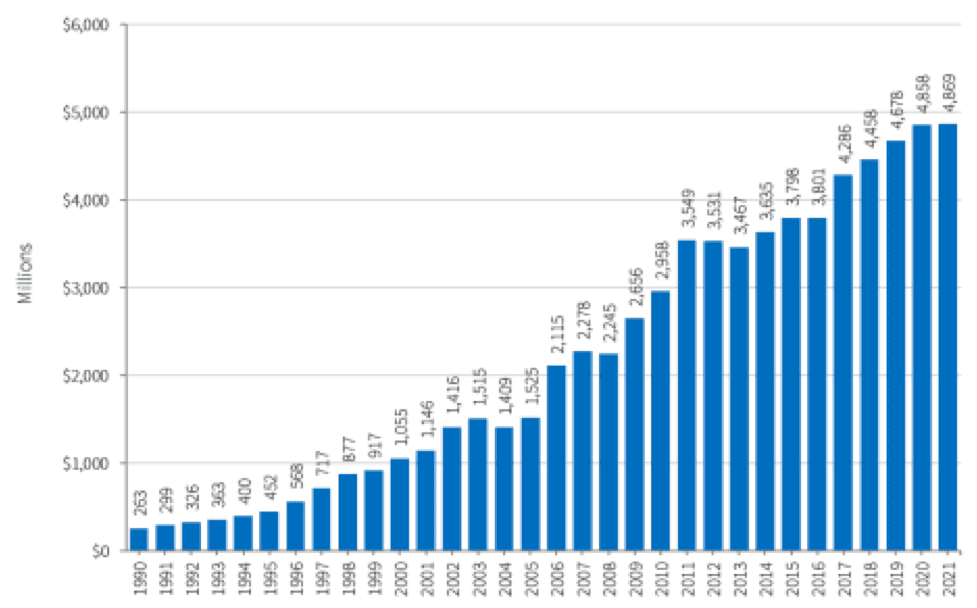
After 9/11, immigration enforcement came under the purview of the newly created Department of Homeland Security and was split between two new agencies: ICE for domestic operations, and Customs and Border Protection (CBP) for border policing. Since then, CBP has grown with bipartisan support to become the largest federal law enforcement agency at over sixty thousand employees. Yet its powers are not limited to the border alone. It has jurisdiction in all territory within one hundred miles of the border, where approximately two-thirds of all Americans live.23Todd Miller, “66 Percent of Americans Now Live in a Constitution-Free Zone,” Nation, July 15, 2014, www.thenation.com/article/archive/66-percent-americans-now-live-constitution-free-zone. As the ACLU explains, constitutional rights are severely curtailed within this zone, and Border Patrol routinely violates even the rights that do exist with impunity.24The Constitution in the 100-Mile Border Zone,” ACLU, August 21, 2014, www.aclu.org/documents/constitution-100-mile-border-zone; Greg Grandin, “The Border Patrol Has Been a Cult of Brutality Since 1924,” Intercept, January 12, 2019, theintercept.com/2019/01/12/border-patrol-history. As the chart below shows, the creation of this immigration policing apparatus has been a thoroughly bipartisan project.
US Border Patrol Budget, FY 1990–2021
These agencies have become, as Justin Akers Chacón puts it, “an instrument of capital accumulation through the function of labor repression.… It is the police, FBI, and the Pinkertons all in one—specifically targeting the more politicized migrant section of the workforce.25Justin Akers Chacón, The Border Crossed Us: The Case for Opening the US-Mexico Border (Chicago: Haymarket Books, 2021). Immigration enforcement is therefore not merely “border policy,” but a political means of segmenting the labor market and keeping its most vulnerable segments both available for capital and afraid.
ICE has been repeatedly unleashed on workplaces where immigrant workers have organized, including a massive 2019 raid on Mississippi poultry-processing plants where workers had successfully sued Koch Foods for harassment and retaliation. In the recent deportation campaign, Border Patrol has acted in concert with ICE as a roving federal paramilitary group, racially profiling and disappearing people deep within the country, beyond the one-hundred-mile zone.26Melissa Cruz, “Why You’re Seeing Border Patrol in Places Like Charlotte and Atlanta, So Far from the Border,” American Immigration Council, November 25, 2025, www.americanimmigrationcouncil.org/blog/border-patrol-charlotte-atlanta-100-mile-zone.
This is not limited to “illegal” immigrants. ICE is sweeping up citizens, green card holders, and immigrants with protected status in its indiscriminate race to meet deportation quotas.27Heidi Altman, “ICE is Detaining Indiscriminately. And Releasing Almost No One,” National Immigration Law Center, October 21, 2025, www.nilc.org/articles/ice-is-detaining-indiscriminately-and-releasing-almost-no-one. Trump’s cancellation of Temporary Protected Status for over 1.5 million immigrants in 2025 also shows the ease with which previously “legal” immigrants can be made “illegal.”28Ariana Figueroa, “Trump Canceled Temporary Legal Status for More than 1.5 Million Immigrants in 2025,” Santa Barbara News Press,” January 14, 2026, https://www.newspress.com/2026/01/14/trump-temporary-legal-status-immigrants-cancellations/. The militarization of the border and the framing of immigration as a national security threat has not deterred immigration, but has led directly to the assault on immigrant rights within the country.29Justin Akers Chacón, “The U.S.-Mexico Border,” International Socialist Review 73 (2010): isreview.org/issue/index3.html?page=3. These are not just attacks on basic democratic rights, but also on working-class organizing: If workers are too afraid to step out the door, how likely are they to fight the boss?
United by Capital, Divided by Capital
If attacking immigration itself is a dead-end road, what kind of politics could build working-class power? Framing immigration through the language and politics of humanitarianism and “social justice” has largely failed.30Isaac Chotiner, “How Democrats Lost Their Way On Immigration,” New Yorker, March 3, 2025, www.newyorker.com/news/q-and-a/how-democrats-lost-their-way-on-immigration. That is not because workers are inherently conservative on the issue—in fact, they have moved to the left over time—but because the Democratic Party, which has touted the benefits of immigration, has also accommodated itself to the decades-long decline of living standards for the majority of the population.31Jared Abbott et al., Working Class Social and Economic Attitudes: An Analysis (Los Angeles and New York: Center for Working Class Politics, Jacobin, Rosa Luxemburg Stiftung-New York Office, 2025), images.jacobinmag.com/wp-content/uploads/2025/07/20091032/CWCP-Jacobin-report-20250721.pdf.
When the immigration question is raised, the left should reframe it in class terms—that the threat to US workers comes not from immigration itself, but from the economic desperation and political terrorization of migrant workers. Whether they enter “illegally” as immigrants or are brought over “legally” as guestworkers, they can be brutally exploited, thereby threatening the standards of all workers. When it comes to US states with fewer labor protections and lower wages, the solution is clearly to fight to equalize conditions between states. The same principle should be applied to immigrants and workers in other countries—not just out of an ethic of international solidarity, but because it is the only adequate response to the globalization of capitalist production.
Capital has enmeshed the working classes of the United States, Mexico, Central America, and the Caribbean together into a vast apparatus of production and circulation, while simultaneously constraining the movement and legal status of labor. This integration has taken two forms: the migration of millions of workers to the United States, and the creation of complex supply chains that crisscross borders. In both cases, this deepening integration has not homogenized conditions, but stratified them. Capital has fragmented the production process between countries, taking advantage of large, structurally unemployed “surplus populations” south of the United States to drive down labor costs and impose harsh discipline on both immigrants and workers in those countries.32Guido Starosta, “Revisiting the New International Division of Labour Thesis,” in The New International Division of Labour: Global Transformation and Uneven Development, ed. Greig Charnock and Guido Starosta (London: Palgrave Macmillan, 2016), 79–103, doi.org/10.1057/978-1-137-53872-7_4, available at https://cicpint.org/wp-content/uploads/2017/04/Starosta_Revisiting-NIDL-thesis.pdf.
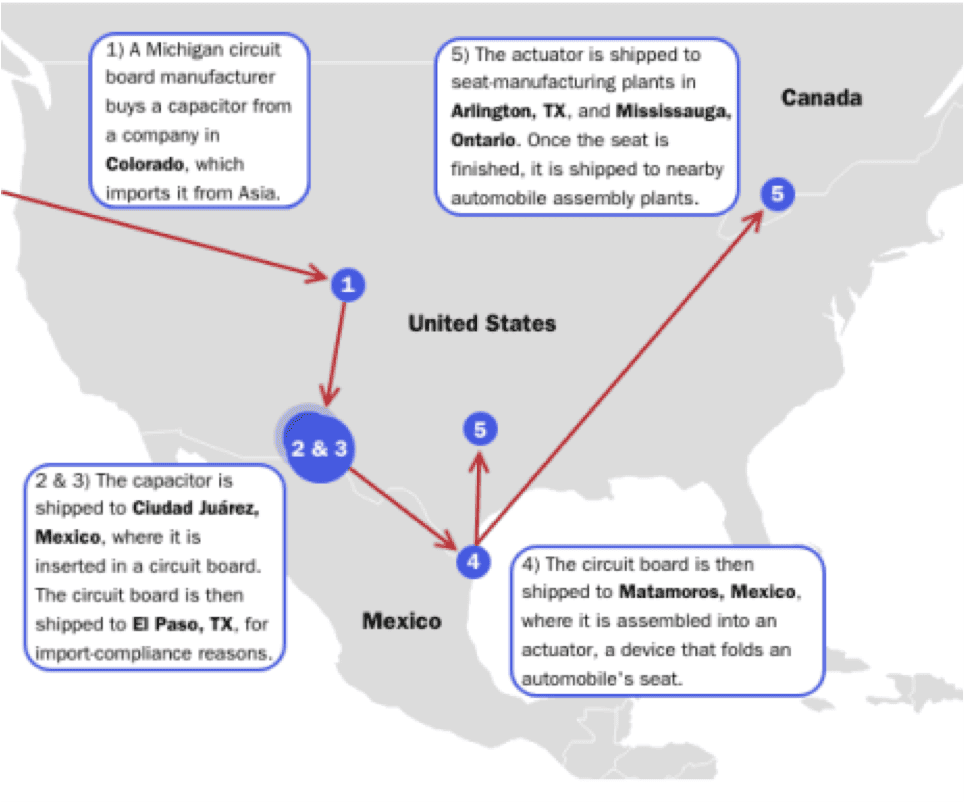
But this hasn’t just created a “race to the bottom” where workers are left powerless. The investment in increasingly high-tech Mexican factories has concentrated large numbers of workers and created new sources of workplace power. And complex supply chains transport semifinished goods back and forth across the border, often multiple times, before their final export to the United States and other global markets. The auto industry is a case in point. The graphic below shows how an automobile part crosses the US-Mexico border four times before reaching a final assembly plant in the United States or Canada. Each node in this international production system is a potential point of leverage and the more workers are organized, the broader disruptions can become.
A Simple Capacitator’s Journey through North America Illustrates the Complexity of the Regional Automotive Supply Chain
Driven by global automakers, the industry has ballooned in Mexico, now employing around nine hundred thousand manufacturing workers, just shy of the approximately one million in the United States. Despite a repressive environment, Mexican autoworkers have organized and fought for independent unions. They have also offered their solidarity to US autoworkers, such as in the 2019 United Auto Workers (UAW) strike at General Motors, when they called on the UAW to help them extend its strike across borders. Until recently, such calls for international organizing have largely not been taken up, but in 2024, the UAW established a Mexico Solidarity Project to support Mexican workers in their organizing efforts, share resources, and coordinate action.33Brandon Mancilla, “The UAW Is Standing Up with Mexican Autoworkers,” In These Times, April 4, 2024, inthesetimes.com/article/uaw-mexico-solidarity-project-autoworkers-union-borders. Such international efforts—not tariffs or “buy American” campaigns—are what have the potential to stop capital from undercutting one set of workers with another and to build class power. By raising the floor on both sides of the border, such solidarity can prevent unequal standards from surviving as a permanent business model.